



After a warm and dry winter, concern about water and the Great Salt Lake has reached new heights.
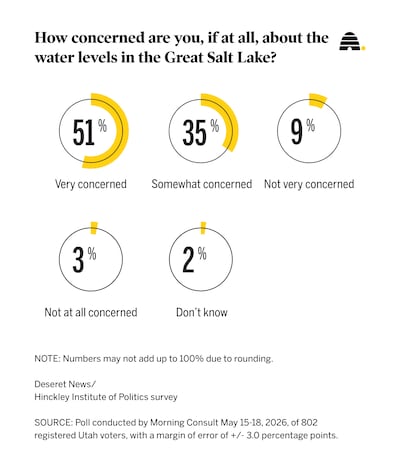
In March, a Deseret News-Hinckley Institute of Politics poll conducted by Morning Consult showed that 81% of Utahns were concerned about the lake. In May, that number rose to 86%, with 51% saying they were “very concerned” and 35% saying they were “somewhat concerned” about its water levels.
More than half of the Great Salt Lake’s lake bed is currently exposed, and state leaders say it needs an additional 261 billion gallons of water (800,000 acre-feet) to come out of its currently-labeled “serious adverse effects” status.
In response, the federal Interior Department has asked Congress for $1 billion in fiscal year 2027 to help the lake. If approved, this allotment would boost agricultural water leasing, help remove invasive plants, provide money for major engineering solutions and more.

Meanwhile, Utah Gov. Spencer Cox declared a statewide drought emergency after a historically warm and dry winter and asked state residents to be conservative with their water use this summer.
The latest Deseret News-Hinckley Institute poll, conducted among 802 voters by Morning Consult, shows who is most concerned about the lake and what they are willing to do to conserve water.
Tim Hawkes, the chair of the Great Salt Lake Advisory Council, told the Deseret News that if the same poll were conducted 10 years ago, the numbers would be the “exact reverse” — meaning many more Utahns are now concerned about their water usage and the need to conserve.
Ben Abbott, the executive director of Grow the Flow, similarly added that the new polling “brings me a lot of hope.”
“There’s not that level of consensus on almost any other issue in the state right now. So I’m really hopeful that we can solve this problem,” he said.
Abbott referenced the uptick in Utah legislation about water conservation and the lake. “Our elected officials ultimately are not leaders. They are followers. That’s how the system is designed. They’re supposed to follow public priority. So the fact that so many Utahns care about Great Salt Lake really gives me hope that we’re going to have the political power we need to solve this problem.”
But even with increased messaging about the state’s water crisis, Hawkes said, “We’ll only get there if everybody sits down and sort of asks themselves, honestly, ‘What can I do to conserve water? How can I get by with less?’”
Who is most concerned about the Great Salt Lake?

Only 3% of the Utah registered voters surveyed said they were “not concerned at all” about the lake.
Millennials were the most concerned, followed by baby boomers, then Gen X, then Gen Z.
Democrats (78%) were significantly more likely to be very concerned about the lake’s water levels than Republicans (36%). About half of Republicans (45%) are somewhat concerned.
As a whole, men and women were equally likely to express worries about the Great Salt Lake’s water levels, with 86% of both sexes being either somewhat or very concerned.
Rural (88%) and suburban residents (89%) were more likely to be somewhat or very concerned about the issue than urban residents (81%).
Hawkes referenced this phenomenon. “I think what explains that is if you live in an agricultural community in the state of Utah, you interact with water all the time. You see it. You see how it’s distributed,” he said. “You’re keenly aware of water scarcity and what it means in a drought.”
On the other hand, water can be “an abstract thing” for urban users. “‘Where does water come from? It comes from the tap,’” he said.
Abbott said he believes this same phenomenon is what makes Gen Z the least concerned about water usage. “Water issues are quite abstract and can be difficult to grasp if you’re young. Your interaction with water is that you turn on the tap and it comes out. Then, as you get older, you start to learn that it’s very complicated and that our water supply is very threatened,” he said.
How do Utahns think the state should enforce water reductions?

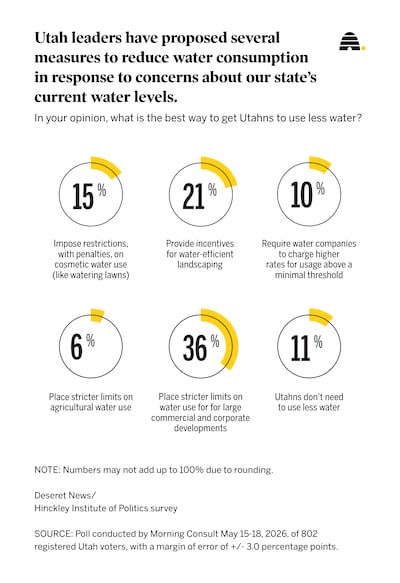
Utah lawmakers have proposed various ways to reduce water consumption, ranging from penalties to incentives. May’s poll asked Utahns to rate five proposals.
Baby boomers were the most likely (29%) to favor the state penalizing cosmetic water use; Gen X was the most likely (27%) to favor incentives for water-efficient landscaping; millennials were most likely (39%) to favor placing stricter limits on water use for large commercial and corporate developments; and Gen Z was most likely (34%) to say Utahns don’t need to use less water.
Democratic men (50%) and Democratic women (56%) were most likely to support restricting water use for large commercial and corporate developments.
Meanwhile, Republican women (18%) and independent men (21%) were most likely to support restrictions with penalties on cosmetic water use.
About a quarter (22%) of Republican men said Utahns don’t need to use less water.

The poll also found that a majority of voters (53%) opposed a proposed data center in Box Elder County backed by “Shark Tank” investor Kevin O’Leary. Many concerns about the data center stem from apprehension that it will use too much water.
Last Thursday, Cox said the project will use less water than is currently used in the area. The data center “will actually return water to the lake,” he said.
What are Utahns willing to do to conserve water?
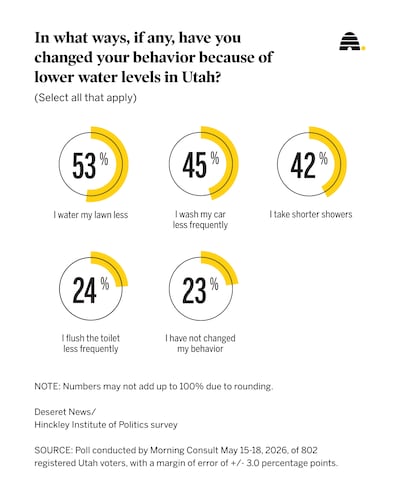
About half of respondents (53%) say they changed their behavior to help conserve water.
Respondents living in rural (65%) and suburban (60%) areas were much more likely to say they changed their behavior than those living in urban areas (37%).
Latter-day Saints were also more likely than average (62%) to report changing their water consumption.
About a quarter of respondents (24%) said they flushed the toilet less frequently to conserve water, while a little less than half of respondents (45%) said they washed their car less frequently.

While cutting indoor water use helps from a water supply standpoint, “from a Great Salt Lake perspective, it doesn’t make any difference at all,” Hawkes said.
“The water that’s used in the home — not a lot of it is depleted,” he explained. “It goes down the drain. It goes to a sewage treatment plant. In many cases, it runs from there to the Great Salt Lake.”
In many cases, flushing less, taking shorter showers or turning off the water when you’re brushing your teeth doesn’t hurt the Great Salt Lake, Hawkes said.
On the contrary, the most reliable source of water for the Great Salt Lake is wastewater effluent that has been treated and cleaned, Abbott said. He then quoted a contributor to Grow the Flow. She “wrote a blog post actually saying, ‘Flush once for yourself and once for Great Salt Lake,’ because it is such a backwards system,” Abbott explained.
The single biggest way Utahns can save water is by using less water outside. Water used on lawns does not go back into the city’s water system.
“If we want to protect the Great Salt Lake, if we want to protect agriculture, we just all have to learn to get by with less, and the easiest place to do that is outside, because our outside water use dwarfs anything we do inside,” Hawkes said.