

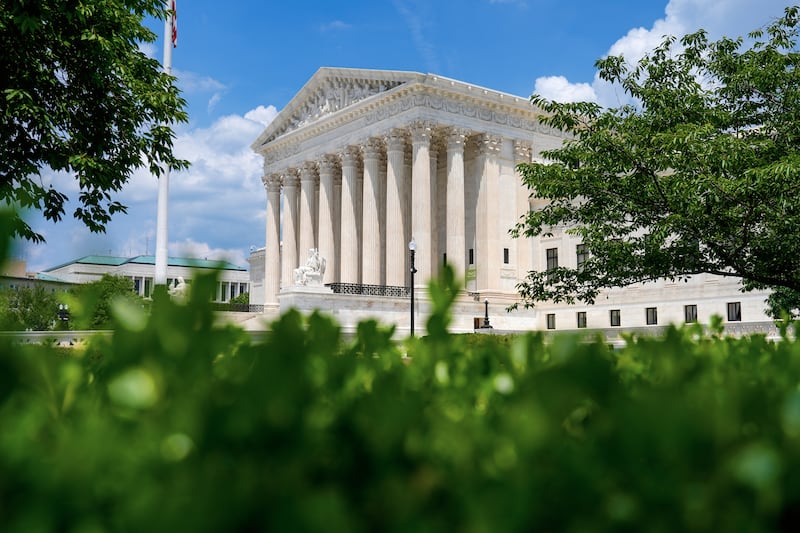

The Supreme Court issued a 6-3 decision Tuesday saying a devout Rastafarian whose dreadlocks were cut off in prison couldn’t sue the prison officials involved.
Justice Neil Gorsuch authored the opinion for the majority, upholding the ruling by the 5th Circuit that while Damon Landor could sue the prison system directly, he couldn’t sue the individual prison officials for damages even though they violated his religious beliefs.
Gorsuch wrote, “Under the Spending Clause, Congress lacks regulatory authority to impose liability on them directly and must depend instead on consent. And because they never agreed to answer suits like this one, Mr. Landor’s case cannot proceed against them any more than a breach of contract action might proceed against a defendant who never formed a contract.”
Case background
Landor was serving a five-month prison sentence and with just weeks left to go in his term, his dreadlocks were forcibly cut by prison officials.
As a devout Rastafarian, Landor had grown out his dreadlocks for nearly 20 years in accordance with his faith. At first, officers respected his religious practice of having long dreadlocks, but he was transferred to a new correctional facility just weeks before finishing his five-month sentence. Guards at the Raymond Laborde Correctional Center cut his hair.
Landor argued that his First Amendment rights were violated, but his attorney, arguing before the Supreme Court last fall, faced some skepticism from the justices.
The case follows two federal laws, both designed to protect religious liberties: the Religious Freedom Restoration Act and the Religious Land Use and Institutionalized Persons Act.
Landor’s attorney, Zachary Tripp, argued that lower courts were wrong in dismissing the case and saying Landor had no grounds to sue prison officials. He noted that nearly everyone in the case, including the state of Louisiana, acknowledged that Landor was treated unfairly.
Tripp faced questions surrounding RLUIPA’s spending clause, which allows Congress to put conditions on federal funds going to states. Congress mandates that states must follow the law and not violate an inmate’s religious rights as a condition for accepting federal funding.
Lower courts said the state officials, including the individual prison guards, aren’t the direct recipients of the federal money and so can’t be sued for monetary damages.
Chief Justice John Roberts focused on this point during oral arguments, saying it’s a contract between the federal and state governments, not the federal government and state employees.
Tripp argued that the prison guards are not members of the general public but rather are state officials who “voluntarily accepted this job,” with contracts that state RLUIPA’s condition.
Justice Brett Kavanaugh pushed back on Tripp’s argument about whether prison guards had clear notice they could be held liable for monetary damages, to which Tripp argued when individuals accept their positions, they are consenting to agree with the contract between the state and federal governments.
Without damages, an inmates’ rights being violated are “meaningless,” Tripp said.
Landor’s case was supported by the Trump administration and Libby Baird, the assistant to the U.S. solicitor general, noted how many religious and nonreligious organizations filed friend-of-the-court briefs on behalf of Landor.
Conversely, Benjamin Aguiñaga, the solicitor general of Louisiana, argued that RLUIPA does not “clearly and unambiguously” create an option for someone to be sued for damages in their individual capacity. He argued that Congress would need to pass new legislation to amend RLUIPA in order to make that clear.
“The answer is across the street, not here,” he said, pointing to Capitol Hill nearby.
Aguiñaga faced some tougher questions from the more liberal justices, particularly over the court’s previous cases like the 2020 ruling in Tanzin v. Tanvir. Tanzin was brought to the high court by Muslim men placed on the FBI’s No Fly List. Under the other federal law in Landor’s case, RFRA, the men were able to receive monetary damages.
Landor argues RFRA and the Tanzin decision should pave the way for him to receive individual capacity damages but Aguiñaga said there were many cases from 2000 to 2020 where no state officials were on notice about being held liable as individuals.
The 6-3 ruling
Gorsuch’s opinion was read from the bench on Tuesday, and was joined by five other justices. Justice Ketanji Brown Jackson was joined in her dissenting opinion by Justices Elena Kagan and Sonia Sotomayor.
Gorsuch argued in his ruling that Congress can’t impose liability directly on prison officials because they did not give their consent to be sued in cases like Landor’s through their contract signed at the time of hiring. He argued that Landor’s point that prison officials can be sued as indirect recipients of federal funds fails because they never explicitly agreed to the possibility of being sued for monetary damages some point down the line in their career.
Gorsuch likened the argument to college coaches and transgender sport issues, or doctors administering vaccines.
“None of that fits with our system of limited and enumerated federal powers where all others are reserved to the States and the people,” he said.
Jackson, in her dissent, argued that under RLUIPA, Congress ordered state and local prisons that accept federal funding to accommodate prisoners’ religious exercise. She sharply disagreed with Gorsuch and the majority, saying they are severing the rights of religious inmates and is a “sleight of hand.”
“It comes by the way of the majority’s full-throated endorsement of a contract analogy even though what secures the rights at issue is not a contract but a law,” she wrote. “Today’s decision magically transforms a federal statute into an invitation to be accepted or declined, deemed binding only if each particular defendant has explicitly agreed to be penalized.”