

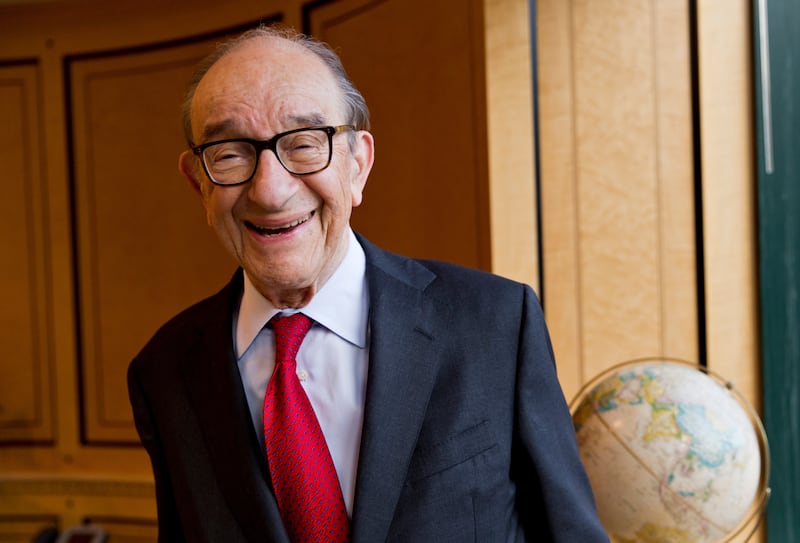

In the summer of 1944, a young clarinet player from New York City was performing with a jazz band at a resort hotel in the mountains of New Hampshire. Frustrated by a nearby commotion drowning out the music, he complained to management — only to learn he had been providing background music for one of the most consequential negotiations in modern history: the Bretton Woods Conference, where the Allied powers were busy designing the global financial system that would govern the postwar world.
That clarinet player was Alan Greenspan, who passed away on June 22, 2026, at the age of 100. His life was one of the most improbable journeys in American public life; an economic Forrest Gump.
Greenspan began at Juilliard, aspiring to a career in jazz. He eventually left music behind, switched to economics and made his way to Wall Street — returning years later to finish a dissertation drawing on research from his time in the private sector.
His topic, fittingly: real estate bubbles. From his earliest days, Greenspan had a knack for being in the right place at the right time and for understanding the systems that most people never thought to question.
That talent kept putting him at the center of history. In the early 1970s, as a White House staffer under President Nixon, Greenspan served on a commission tasked with one of the most consequential military policy questions of the era: whether to end the military draft.
Vietnam had made conscription deeply unpopular, and Greenspan, serving alongside renowned economist Milton Friedman, framed the draft as an invisible tax on young Americans. They argued that if the Defense Department had to compete for talent in the open labor market, it would attract better soldiers and treat them more equitably.
The debate got heated. In one memorable hearing, General William Westmoreland — the commanding general in Vietnam — declared he would not lead an army of paid mercenaries. Friedman shot back that he would prefer volunteers to conscripts any day.
It was Greenspan’s ability to smooth bruised egos and translate sharp economic ideas into language Washington politicians could accept that helped carry the day. The all-volunteer military force we have today is, in part, a product of that commission’s work.
After subsequently serving in the Ford administration on the Council of Economic Advisers, Greenspan was appointed Fed chair by President Ronald Reagan in 1987. Given how polarized our politics have since become, it is remarkable that four presidents from both parties renewed his term.
Greenspan served until 2006 — the second-longest tenure in Federal Reserve history.
At the Fed, the same qualities that made him effective in a hotel ballroom and a congressional hearing room served him again. Greenspan demonstrated a disciplined talent for answering questions without revealing too much, believing his credibility depended on sharing only what was necessary.
Since this leader’s carefully rationed words were rarely enough to fill the growing 24-hour news cycle, reporters took to photographing his briefcase, hoping its thickness might divine where markets would move next. In his book, “The Age of Turbulence,” Greenspan famously claimed that his briefcase was only thick when he packed a lunch to work.
Over nearly two decades at the helm, he guided the country through two recessions, the rise and fall of the dot-com bubble, the roaring 1990s, multiple international currency crises, and the Sept. 11 attacks.
When he warned in 1996 that markets were gripped by “irrational exuberance” — that investors were pouring money into internet companies far beyond what their actual value could justify — few listened. It’s a phrase worth remembering today, as billions pour into artificial intelligence with similar fervor.
Greenspan is not without his critics. Some argue persuasively that he kept interest rates too low for too long after the dot-com bust, helping inflate the housing bubble that triggered the 2008 financial crisis. It is a fair charge, and one he himself grappled with publicly in the years that followed.
But even that criticism speaks to something important: Greenspan operated in a role where decisions of enormous consequence had to be made under genuine uncertainty, and he was willing to be held accountable for them.
That combination — technical mastery, public accountability and the ability to translate complexity into plain language — is rarer than it sounds and harder to cultivate than it looks. At a moment when that kind of public service is increasingly disparaged, Greenspan’s death is a good occasion to ask where the next generation of people like him will come from.
The orchestra still needs a conductor. The question is whether we are still producing people willing to pick up the baton.