

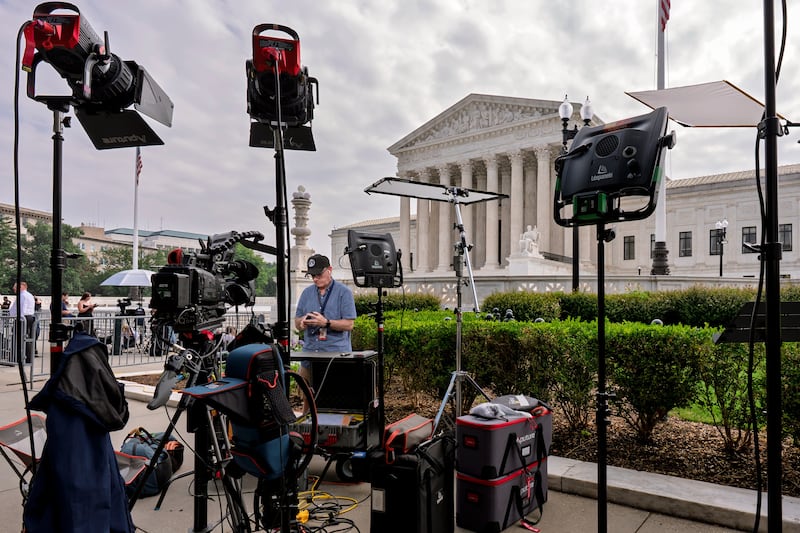

The Supreme Court on Tuesday overturned campaign finance limits for political parties working in coordination with candidates over free speech concerns in a 6-3 decision.
The case stemmed from a challenge that was filed by Vice President JD Vance when he was an Ohio senator and focuses on whether party committees can coordinate spending more openly with political campaigns.
The Federal Election Campaign Act’s “political-party coordinated-expenditure limits violate the First Amendment,” the decision, written by Justice Brett Kavanaugh, says.
Kavanaugh was joined by Chief Justice John Roberts and Justices Clarence Thomas, Samuel Alito, Neil Gorsuch and Amy Coney Barrett. Justice Elena Kagan wrote the dissenting opinion, joined by Justices Sonia Sotomayor and Ketanji Brown Jackson.
Kavanaugh wrote that the ruling evens the playing field between candidates and parties and they now can “compete equally” going forward.
Kagan argued that the court in its ruling is rewriting the rules and will allow for “circumvention of the contribution limits.”
President Donald Trump reacted to the news in a post online, saying it was a big win for Republicans, despite Kavanaugh saying it was a win for all parties.
“The Supreme Court just took restriction off political spending! A BIG WIN FOR REPUBLICANS and, more importantly, The First Amendment!” Trump said.
The ruling overturns a 2001 precedent, Federal Election Commission v. Colorado Republican Federal Campaign Committee. It was a case decided 25 years ago to put spending limits on political parties. It’s the second time in two days that the court overturned precedent.
Case background
Vance filed the lawsuit in 2022, along with former Rep. Steve Chabot, R-Ohio. They earned the backing of the National Republican Senatorial Committee and the National Republican Congressional Committee.
Ahead of the decision, donors could give less to individual candidates than they could to party committees like the NRSC and NRCC. Vance challenged the spending limits on First Amendment grounds.
“FECA’s limits impair the party’s traditional forms of communication such as advertisements; preclude parties from amplifying the voice of their adherents; impose additional monetary costs and burdens on political parties; and inflict a ‘stifling effect on the ability of the party to do what it exists to do,’” the majority opinion says.
The U.S. 6th Circuit Court of Appeals ruled against Vance last year, and the Supreme Court overturned that ruling.
The court has long debated what restrictions can be placed on campaign spending while also juggling the Constitution’s free speech protections.
When Trump took office last year, the Federal Election Commission decided to agree with Vance and not defend the lower court’s ruling, unlike the Biden administration.
So, the justices appointed Roman Martinez, a former clerk to Roberts, to argue in favor of the case. Martinez argued that the court should throw the case our since it’s not clear that Vance won’t run for president in the future.
Vance’s only legal standing in the case is if he plans to run for office again and without another run, Vance has no injury in the case, he argued.
Kavanaugh wrote that Vance did have standing in the case since he still has a statement of candidacy file open with the FEC.
The Democratic National Committee filed a motion to intervene in the case, looking to uphold the lower court ruling. DNC lawyer Mark Elias argued before the court, leaning heavily on precedent, saying if the justices overturn the lower court’s decision, it will “fundamentally reshape the campaign finance regime.”
Andrea Levin, general counsel for the DNC, previously told the Deseret News that the case is “very remarkable” because not only are Republicans returning to the Supreme Court with the same issue 25 years later, but the Trump administration has stepped in “to not only defend a duly passed campaign finance law that’s been on the books for years.”
Levin said the administration and FEC is “abdicating its duty to defend the law” by siding with Vance’s case.
Republicans in the case say if the justices were to strike down the precedent, it wouldn’t lead to corruption or more donor influence. Manhattan Institute fellow Ilya Shapiro agreed.
He said there would be “no difference” in corruption or voter confidence in election integrity. Shapiro expressed confidence that the justices would side with Vance’s argument.
Sotomayor seemed skeptical during oral arguments, saying that every time the court interferes in a campaign finance issue, like the 2010 landmark Citizens United ruling, they end up amplifying voices of corporations but diminishing the voice of the party.
“Now you want to now tinker some more and try to raise the voice of one party. Our tinkering does more harm than it does good,” she said.