



A bipartisan group of lawmakers unveiled a new framework on Wednesday aimed toward gerrymandering reform and reducing political manipulation of congressional districts.
The House Problem Solvers Caucus, a bipartisan caucus evenly split between Republicans and Democrats, announced the framework in a press release outlining four main reforms they believe will ensure fair and consistent map-drawing processes. Lawmakers in the caucus say they will work over the coming months to implement those reforms into actual legislation.
“Two hundred and fifty years after our nation’s founding, we are reminded that American self-government rests on one enduring principle: the people are sovereign,” Pennsylvania Rep. Brian Fitzpatrick, Republican co-chair of the caucus, said in a statement. “That principle is diminished when congressional lines are drawn to protect politicians, predetermine outcomes, or reward the extremes at the expense of the broad center of the country. … If we want a Congress that is more accountable, more representative, and more capable of solving problems, we must change the incentives that drive dysfunction.”

The Problem Solvers Caucus announced the creation of its gerrymandering working group in May, with members working on these guidelines over the last month.
Under the framework, legislation would be drafted to ensure redistricting — or the act of redrawing congressional boundaries according to population — only occurs once a decade after the census. That is typical practice, although those guidelines have been stressed over the last year.
The framework would also mandate that districts are drawn using “clear, objective criteria” rather than in ways that would protect a political party or incumbent lawmaker. Partisan influence would be minimized under the guidelines by encouraging the use of independent commissions, algorithmic mapping, or other methods when it comes to drawing boundaries.
Finally, the framework would establish a federal process for resolving redistricting disputes among state officials after maps are drawn.
“Gerrymandering is bad for America,” New York Rep. Tom Suozzi, Democratic co-chair of the Problem Solvers Caucus, said in a statement. “It weakens the will of the voters, erodes public trust, and creates safe seats that reward extremism and disincentivizes thoughtful, bipartisan collaboration. I’m proud our caucus is leading on this framework to take politics out of redistricting and restore confidence in a system where voters choose their representatives, not the other way around.”
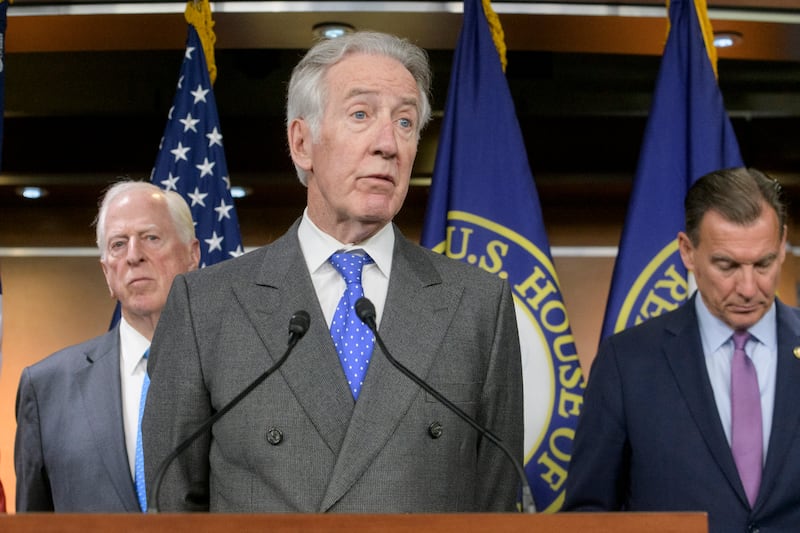
The framework comes after a monthslong gerrymandering battle across the country as both parties sought to leverage themselves heading into the midterm elections.
President Donald Trump pushed state officials in Texas to redraw their map to add five Republican seats in the U.S. House, which prompted California Gov. Gavin Newsom to retaliate by redrawing his state map to counter those new districts.
That set off a firestorm in states such as Florida, North Carolina, Missouri and Tennessee to redraw their maps. Democrats in Virginia also attempted to redraw their map, but that bid was overturned by the courts.
Utah was given its own congressional boundary changes for November, but that map came after a yearslong lawsuit that was unrelated to the most recent gerrymandering fight.
Members of the Problem Solvers Caucus denounced the partisan mid-decade gerrymandering efforts, lamenting it has become more common in recent years. From 1962 to 2020, mid-decade partisan redistricting occurred only twice — but it has now happened in 10 states and counting since the 2020 census, according to the group.
It’s not clear how quickly the caucus can draft legislation in the coming months, or if it will have enough support to pass both chambers of Congress.