

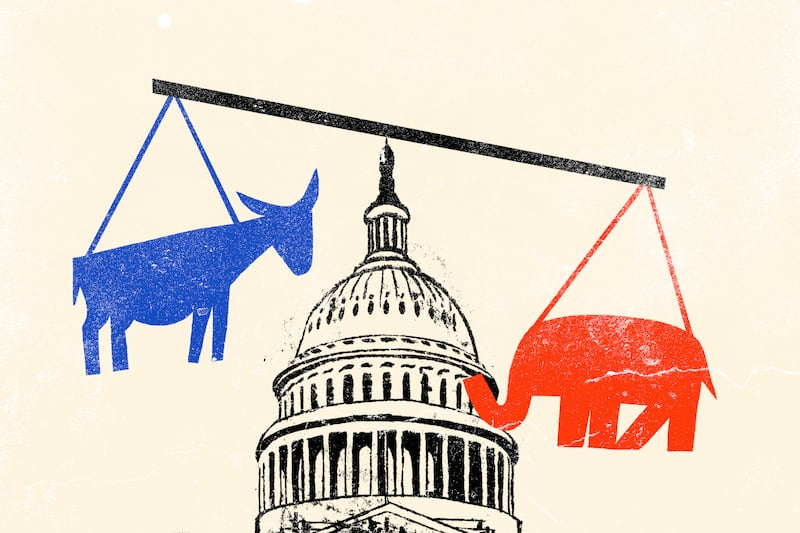

While politicians still act like policy matters in elections, for many voters that is no longer the case. As a recent focus group in Los Angeles showed, for many voters partisanship is more important than policy, and crossing the line to vote for the other side is a bridge too far.
“The traditional ideas in political science were that voters will try to pick candidates who are close to them on the issues that are most important to them,” Scott Huettel, a professor in the Department of Psychology and Neuroscience at Duke University, told the Deseret News. “The challenge is that … voters don’t always work that way."
For many voters, their vote doesn’t just represent what they believe in, but rather who they are, or who they believe themselves to be based upon how they vote.
What does that mean?
“Eighty or ninety percent of elections are determined simply by partisanship at this point,” Jared Abbott, a researcher at the Center for Working-Class Politics, told the Deseret News.
Candidate policy and voter identity are competing influences on voter behavior
“The act of voting to reinforce and support policy and the act of voting to reinforce and support identity can actually compete with each other,” Huettel said, describing the way each influences voter behavior.
Voting decisions, Huettel said, are a combination of policy considerations and an inner appeal to a political or social identity.
When it comes time for voters to fill out a ballot, these two concepts become a trade-off within a voter’s mind.
“If you’re the sort of person who really cares about policy, identity doesn’t matter so much,” Huettel said. “And if you’re the sort of person whose votes reinforce their identity, then policy doesn’t matter so much.”
Associating voting with a political identity can even make policy “irrelevant,” Huettel said.
Los Angeles serves as a case study for this kind of voter behavior
A recent focus group conducted by the Manhattan Institute provided evidence that Los Angeles is an example of a city where voters attach identity to their vote, sometimes with more weight than policy.
The focus group included nineteen voters, including nine Democratic voters and ten voters with no party preference.
Voters complained of a government that was expensive, disorderly and incapable of performing basic functions. When asked to assign a grade to how well city officials were serving residents, their given scores averaged a C.
Yet, even though they were dissatisfied with their government and representatives, voters did not indicate any desire to change the party in power. Instead of moving to the middle, already progressive voters seemed to want greater socialism to bring about change.
Jesse Arm, vice president of external affairs at the Manhattan Institute, identified this as a “disconnect between voters’ diagnosis of the city’s problems and their willingness to reconsider the politics that produced them.”
“These voters were deeply frustrated by affordability, homelessness, crime, waste, and basic government incompetence, but many continued to interpret those failures through a progressive framework,” Arm said in a statement to the Deseret News.
Arm explained that voters were often receptive to ideas associated with the political right, but not if the ideas came from a “Republican messenger.”
“That suggests the challenge for reformers in deeply Democratic places like Los Angeles is not simply persuading voters that the status quo is failing; many already believe that,” Arm said. “It’s convincing them that meaningful change may require looking beyond their existing partisan and ideological assumptions.”
“It is an important phenomenon to watch heading into the midterms,” Arm said.
Political polarization is likely shaping partisan voting
Partisan hostility is on the rise in the U.S., and may be a growing influence on voter choice — especially voters casting a ballot in an “identity-based” fashion.
Abbott conducted a study that examined voters who voted for Trump in 2024. His research found that some of the voters were wavering in their support and even shared an unwillingness to vote for a Republican candidate in 2028. However, instead of turning to a Democratic candidate, many voters said they were unsure if they would vote at all.
“We’ve been kind of, you know, conditioned to think that the other side is bad,” Abbott said, explaining the partisan influence behind this choice. Voters had such a negative view about an opposing candidate they would rather drop out of politics altogether than vote for a candidate from the opposing party.
Steven Webster, an associate professor of political science at Indiana University Bloomington, has done research on what he referred to as “negative partisanship,” meaning loyalty to a party that stems not from positive feelings towards one party, but negative feelings towards another.
“It could be the case that voters are identifying themselves more by what they’re not for, or by what they’re against than what they are or what they’re for,” Webster said in a conversation with the Deseret News.
“A voter might be better served at the local level by somebody who isn’t part of their party,” Webster said. “But because partisanship is so all-encompassing in American politics, I think some voters miss that possibility because of their, in some sense, blind partisan loyalty.”
Webster said there are some benefits to polarization. As parties become more distinct, for example it “clarifies choices at the ballot box,” where “D” or “R” labels might provide a “shortcut” that “simplifies” the voter’s choice.
Polarization becomes problematic, however, when it moves from “ideological polarization” to “affective polarization,” Webster said, meaning members of each party “simply dislike the other side more” because of differing policy positions.
“Arguably, this affective type of polarization is more problematic than ideological polarization, because this affective polarization spills over into everyday life, and it makes partisans unwilling to even associate in apolitical settings with people whose political beliefs are different than their own,” Webster said.
This affects voter behavior in that “there are some people who might just dispositionally be unwilling to engage in a process that is so acrimonious and so bitter like politics often can be,” Webster said.
Identity-based voting decisions may be ‘a feature of human nature’
Huettel said the tendency to seek a sense of identity in voting decisions is “a feature of human nature.”
“People are set up to care quite a lot about things that support their identity,” Huettel said. “We want to feel good about ourselves. We want to reinforce our sense of identity.”
Paying attention to how something affects our identity is “part of what it means to be human,” Huettel said, and “the act of voting itself” is an identity-reinforcing activity.
“The vast majority of Americans have never voted in an election where their vote changed the election,” Huettel said. “In a U.S. presidential election, for example, the chance that your vote sways it is infinitesimal.”
So why do people go to the trouble to cast their vote?
“If it’s not because the vote benefits them, it may be because the act of voting benefits them,” Huettel said. “It’s, again, an expression of something. They feel like they’re participating in democracy.”