

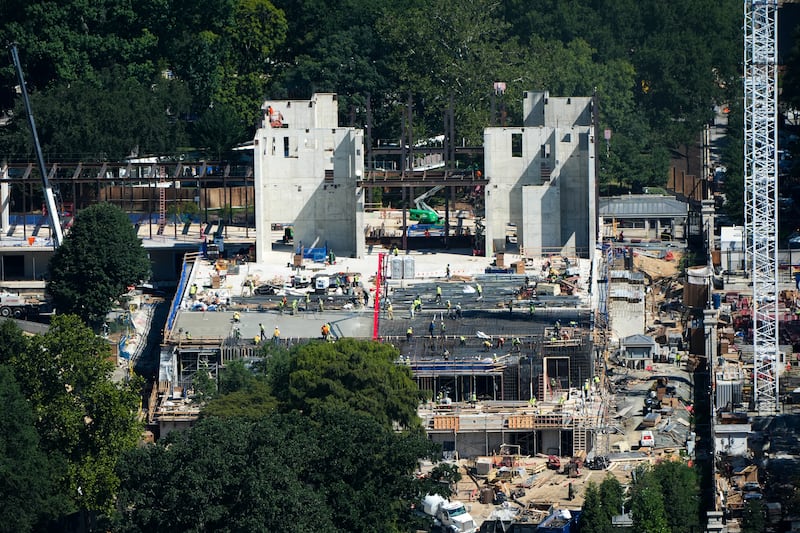

The Supreme Court on Monday allowed construction to continue on President Donald Trump’s White House ballroom in a 5-4 vote Monday, a point of controversy after he tore down the East Wing last fall to make way for the project.
Chief Justice John Roberts sided with the court’s three liberal justices in the dissent, coming just days after the court issued an interim decision, authored by Roberts, saying lower courts couldn’t halt the construction.
A judge in Washington, D.C., initially halted construction in March but allowed work to continue temporarily while the administration appealed his ruling. An appeals court ruled 2 to 1 against Trump. The appeals court said Congress hadn’t given Trump the authority to renovate the exterior of the “People’s House” to fit the desires of one person.
The administration quickly asked the Supreme Court to intervene, saying it was too late to stop the project.
Roberts was assigned the administration’s request since being the chief justice means he handles matters in the District of Columbia, which is why he authored the initial decision.
The 90,000 square-foot ballroom was challenged by preservationists at the National Trust for Historic Preservation, a nonprofit created by Congress to protect public buildings.
They argued that Alison K. Hoagland, a resident in Washington, and architectural historian, was professionally and personally harmed by the destruction of the East Wing, which she walked by routinely.
Hoagland and the nonprofit argued Trump violated the Constitution and Congress’ powers to decide which structures are built on federal property.
It wasn’t enough to sway the justices, however. The court noted that they were not deciding whether Trump’s East Wing project was legal, but just that the “government is likely to prevail” against the preservationists because the plaintiff lacks standing to challenge the project.
“We have repeatedly held that mere offense, disagreement, or distaste does not qualify as a concrete and particularized injury,” the court’s majority wrote.
Roberts similarly noted in his dissent that the construction has gone on for “the better part of a year.”
“That construction is likely unlawful,” he wrote.
The Trump administration said in recent court filings that the construction was already 65% complete, to which the preservationists argue they were fast-tracking the project to side step the court system.
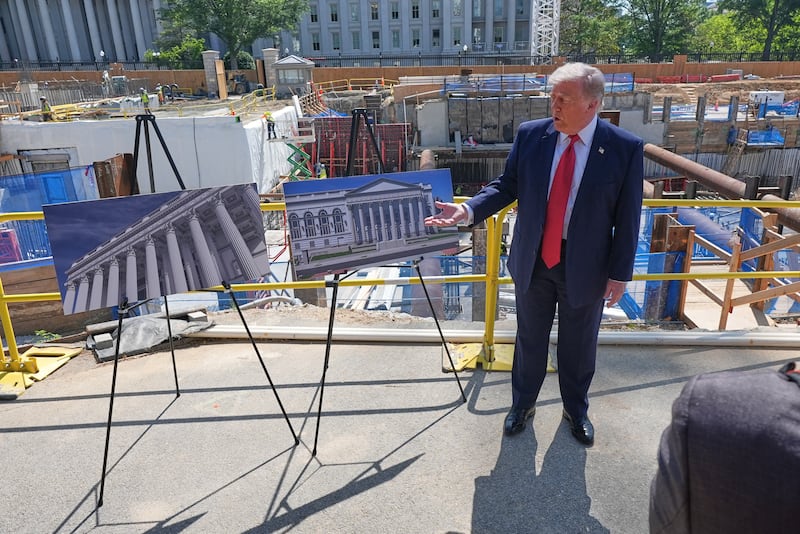
The project has grown since its original projection. Trump and his team are trying to emphasize that while a ballroom is necessary to host gatherings of modern size and scale, it will also serve a national security purpose. The project will include an upgrade to the bunker that sits beneath the East Wing, which was built during World War II.
Trump, who now refers to it as the “Military/Ballroom Complex,” said it is “so vital” for national security and be the “GREATEST OF ITS KIND.”