



Jessica Tarlov is often identified as the token liberal on cable’s top-rated talk show, “The Five” on Fox News. So why is her podcast with Scott Galloway called “Raging Moderates” and why does she identify as a “millennial moderate” in her new book?
After all, Tarlov admits that she checks all the boxes for the stereotype of the “limousine liberal” — she’s from New York City, she has a Ph.D., and she comes from a well-to-do, highly educated family. She’s even got the Rachel Maddow-esque, black-framed glasses.
But Tarlov, a 42-year-old married mother of two, sees herself as a moderate because she wants to promote a “new middle” in America, one that “promotes an understanding of shared struggles and commonalities,” she writes in her new book “I Disagree.”
It’s important, she says, for Americans to get out of their ideological silos and “engage with ideas and people who make us uncomfortable.”
“Going to our corners gets us cornered and little else,” she writes.
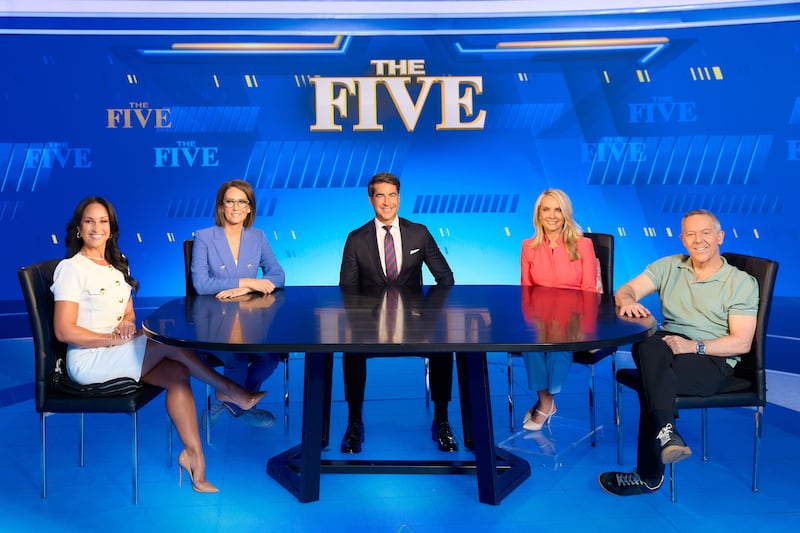
Tarlov is taking her own advice in her role on “The Five,” where she spars with conservative Fox personalities like Dana Perino, Greg Gutfeld and Jesse Watters. It’s not unusual for talk shows to have a personality who fills the “counterpoint” slot — think Scott Jennings on CNN or any of a long line of conservative voices who do battle with liberals on ABC’s “The View.”
But Tarlov stands out because of her reach. “The Five” has been the No. 1 cable talk show for the past four years, and that is currently true not just among Republicans, but Democrats and independents.
“If you want to make a dent in the political space, Fox is where you have to at least start,” Tarlov writes in her book. She says she doesn’t see her job as to change people’s minds, but to open them.
Not that she wouldn’t mind changing them.
Tarlov says that the secret to getting someone who disagrees with you to listen, to pay attention to your arguments, is bringing something to the table with you: data. One good statistics class, she says, “can dramatically improve how you think.” And, she argues, “You don’t have to be cruel to be compelling.”

In an interview with the Deseret News, Tarlov explained why she’s calling her book “a survival guide to having contentious conversations,” how Dana Perino helped her become more effective on “The Five,” why she believes that voters’ anxieties are what should matter most to elected officials, and what it was like to be a “Jeopardy!” clue alongside George Will.
The conversation has been lightly edited for clarity and length.
Deseret News: Most of the publicity for this book, and for your role on “The Five,” describe you as a liberal, but you describe yourself as a moderate. Why?
Jessica Tarlov: Because I know where elections are won. And I want to win elections, and they are won in the middle. That’s just reality.
There’s a reason that Scott and I called our show “Raging Moderates.” It’s because there is a populist rage going on with everybody on the left, no matter which denomination of liberal you are. And I say “millennial moderate” because the mushy moderate of olden times has no place in the party right now. A millennial moderate to me is not someone that is championing bipartisan legislation all the time, or laying down and getting steamrolled ... it’s someone laser focused on understanding who the electorate is, who is persuadable, which is everyone from 1 degree over from AOC to a Romney Republican, a Spencer Cox Republican. And I think my brand of politics speaks to that.
DN: You describe your book as a “survival guide for contentious discussions,” but it also reminded me of Dana Perino’s books written as guides for young women because you offer a lot of advice for young people, early-career people.
JT: Dana is a close friend and she’s been a wonderful mentor. And I wanted to make sure that that side of her was also represented in the book. Before the 2024 election, she was like “come to the principal’s office … I need to talk to you about how you’re going to be able to survive this.” I was heavily pregnant, and she said, “You’ve got to work smarter, not harder, and this is how we’re going to do it.”
It’s very rare to be able to work with people who will do that for you, especially in a business so competitive and cut-throat. ... Folks that vote like me, I imagine, will largely be the audience for this book, and I want them to know about the softer side of some of these characters, and what it’s like to actually work in this environment. If you’ve only consumed clips of me flying around the internet, you might not know that there is actual connective tissue there, that there are friendships that have been built over the better part of a decade.
The way media works right now, it doesn’t pay to have stories of cross-party affection. It sells more when we’re seen at each other’s throats constantly. “The Five” offers both, which is why I think it’s so resonant with people, with 3 1/2 to 4 million viewers who say, “This looks like my family. I either have a crazy Aunt Jessica or annoying Uncle Jesse.”
DN: Our readers in Utah will appreciate your reference to Gov. Spencer Cox in the book. (Tarlov writes: “When people like social psychologist Jonathan Haidt and Utah Governor Spencer Cox tell you to get off your phones and ‘touch grass,’ it’s advice worth heeding.”)
JT: I haven’t read his book yet, but I’ve been enjoying his (media) tour, and the way that he handled Charlie Kirk’s murder was pitch-perfect and desperately needed. Unfortunately, he’s one of those people where you listen to him and watch what he does and you say “This guy should be president.” But you know in this environment, someone like Spencer Cox can’t get off a debate stage because of how angry and vengeful politics is right now.
I remember early on, I had Larry Hogan on “Raging Moderates” while he was running to be senator for Maryland after being one of the most popular elected officials in Maryland history; he had something like an 85% approval rating with Democrats. And there’s just no place for Larry Hogan in what the modern-day GOP looks like.
Utah is very lucky to have leadership like that.
DN: A theme of your book is bringing data to every discussion. Can you talk a little bit about why you think it’s more important to have data rather than anecdotes?
JT: It comes to me by trade, from doing a quantitative Ph.D. (her thesis was entitled “Through the Looking Glass: Controversy, Scandal and Political Careers”) to doing polling and research. I was working with statistics all the time. And it really rewired my brain, and I started to notice that you would be taken seriously in certain environments if you were comfortable with data.
When you’re in this cut-throat business of political communication, and especially on “The Five” where I might have 30 seconds or a minute until someone is going to cut me off, I find it a lot easier to rely on the data. I sum it up like this: Think in averages, not anecdotes.
For the first Trump administration, Ben Shapiro’s mantra “Facts don’t care about your feelings” kind of became the way people understood why the “Access Hollywood” tape didn’t sink him. Even someone like Mike Pence, Mr. Family Values, could find his way back to “Yes, this is the ticket that I should stay on. This is what’s going to put the country in the right direction even if he’s somebody I don’t necessarily want as a babysitter for my kids.
I found I could be much more effective if I was framing (arguments) in averages rather than anecdotes. The same rules apply in relationships — when you have an understanding of the trend lines, you can make sharper arguments.
DN: A lot of your skill in oration, you have said, came from the time you spent around the dinner table with your family. In the book, you say that “dinner is destiny” and that “your first table shapes the way you argue, show up, lead and laugh.”
JT: There is symmetry from the evolution of my dinner table at home to the table of “The Five.” And my dinner table growing up was the place where I was first taught that I was an equal part of the conversation and the fray. My sister and I were obviously a lot younger than my parents, but our opinions mattered. The conversations my parents were having were about adult things; they were talking about work in front of us, they were getting our opinions on things. Our spot at the table was important and solidified that we were part of the fabric of the family. We weren’t talked down to.
DN: Your father was very important to you, so much so that you wear his glasses on the show.
JT: He literally died in them. It’s a wonderful reminder that so much of how he saw the world has shaped how I see the world. He was the person I talked about politics with the most. He was very involved in helping me, especially in the early days of doing TV. He always told me the No. 1 job of our elected (officials) is to alleviate as much anxiety as possible, and I carry that with me as my frame for looking at politics, 100%.
Everything a voter tells you is about how they’re feeling, and how comfortable they are in their existence, whether it has to do with their health care, with the economy, their schools, is a data center coming? Everything is a story of anxiety, frankly. And so my dad really made that my prism. And I love being able to wear a proverbial piece of him while I am talking about these really heady issues.
DN: Is there any exchange on the show that really stands out in your mind, in which you thought you really made a great point, or were able to change someone’s mind?
JT: I do say in the book that I don’t think my job is to change minds, but to open them. And that is happening all the time, from viewers who when I meet them out in the wild, or they send me emails or LinkedIn messages and say “you made me think differently about that.” And that feels like such a win to me, especially in pursuit of eventually changing electoral outcomes.
Because you don’t get swing elections, if there aren’t little instances of people’s sensors being piqued by something, like (saying), “That girl ... I don’t like her politics, but she seems really nice, and the other co-hosts like her, and they mess around with her and she can take it and she can dish it out, and she’s been talking about this thing ... maybe immigration and how 70% of ICE arrests are people without criminal convictions, and maybe I should look at that?”
And that is a spectacular outcome for me, in the pursuit of pushing that boulder up the hill.
DN: Are there any issues on which you have inched your way closer to the right because of your exposure to the other voices on Fox?
JT: Not a wholesale, I totally agree with your position on immigration now. But I’ve talked a lot about seeing just how wide open the border was in the Biden administration, and how that colors the way that you perceive everything, such as the change being inflicted upon Americans who live along the border. That’s just not fair, and it’s not sustainable. And for me to be sitting in midtown Manhattan and saying, suck it up — you just can’t be that kind of person.
Also, I don’t want the audience to think that I’ve forgotten about Sheridan Gorman or Laken Riley. Even though those are outlier events, they still are important, and they very much shape how people see the immigration issue and, frankly, whether they trust Democrats to be able to handle it well.
DN: On a lighter note, last year, you were a clue on “Jeopardy!” alongside George Will. (“From Sanskrit, this synonym for ‘expert’ is used of political commentators like George Will and Jessica Tarlov.”) Did you talk about it with him?
JT: (Laughing) How insane must George Will think this is, that he has to be lumped in with me. I thought, wouldn’t it be amazing if George Will contacted me, if just to say, who are you, and why are you invading my “Jeopardy!” clue? (He didn’t.)
My initial thought was that they must have gotten this wrong. It feels like such a holy grail of pop culture, in a dorky sense. My mom, ever my cheerleader, said, “You and George Will are generational bookends, George Will for boomers, you for Gen Zs and millennials.”
DN: It must be nice having these little affirmations that people are paying attention to you, from that to Donald Trump posting about you on social media.
JT: I prefer the “Jeopardy!” clue.