



The University of Utah athletic department’s deal with private equity firm Otro Capital was officially finalized Friday morning, about six months after the groundbreaking partnership was originally proposed to the university’s board of trustees.
The partnership is the first of its kind in collegiate athletics, but it could be a model that other schools follow as financial pressure continues to mount in athletic departments across the country.
“This new company puts the University of Utah at the forefront of developing creative and strategic solutions to the financial challenges facing college athletics programs across the country,” said University of Utah president Taylor Randall in a statement. “Utah will continue to lead out with unique and entrepreneurial ideas for keeping our Utes sports programs financially sustainable and foundational to the student experience.”
In June 2025, the House v. NCAA settlement cleared the way for universities to share up to $20.5 million with student-athletes, putting a huge new line item on already razor-thin athletics budgets nationwide.
For the University of Utah, the numbers in the new age of college sports weren’t adding up.
By keeping on the current course, Utah would have drained its athletics financial reserves, so the university turned to private equity to help.
“I mean, look, we understand there’s risks with anything of this nature. … We really wanted to take a look at all those risks. We wanted to make sure that the university was properly covered and we wanted to make sure that the deal worked for both sides.”
— Utah athletic director Mark Harlan
“The challenge was that as we kept modeling with my team and certainly with (Utah CFO Tony Wagner’s) team and everybody on the president’s team, it just wasn’t penciling out on our ability to keep up with cost because we’re going to be a powerful program,” said Utah athletic director Mark Harlan at December’s board of trustees meeting.
Utah’s deal with private equity firm Otro Capital, first proposed in December, was expected to infuse a total of at least $500 million, per Ross Dellenger of Yahoo Sports, with the money being injected at various times over the course of the agreement.
The University of Utah did not release any financial information in regards to the deal on Friday, and declined to comment on financial details in a Friday morning press conference.
Why private equity?
Hearing of private equity partnering with their favorite sports team may have rung alarm bells in some Utah fans’ minds, and Harlan acknowledges that there is risk involved in the deal.
“I mean, look, we understand there’s risks with anything of this nature. … We really wanted to take a look at all those risks. We wanted to make sure that the university was properly covered and we wanted to make sure that the deal worked for both sides,” Harlan said.
The other option, though, was continuing to post deficits as an athletic department.
“I would argue that there’s more risk of not doing anything based on the climate that we’re in and the rising costs for player compensation and operation,” Harlan said.
“So when you look at risks, you have to look at both sides of that equation. But I’m very comfortable after a lot of smarter people than I have looked at this deal 15 different ways, sideways, that we’re comfortable that our risks are covered, but most importantly, our opportunities are right there in front of us.”
Ultimately, Utah believes this is the best path forward in order to stabilize athletics funding and “reduce the prospect of long-term debt, remove pressure to cut less-profitable programs and help secure the future of women’s and Olympic sports at Utah.”
How the deal is structured
There are guardrails in place for the university as it embarks on its deal with Otro Capital.
As part of the agreement, Utah Athletics’ revenue side is being spun off into a new, for-profit company called Crimson Brand Partners.
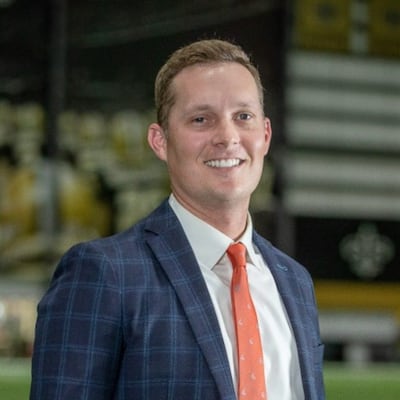
Matt Webb, who was previously the vice president of corporate sponsorships for the New Orleans Saints and New Orleans Pelicans and has two decades of experience in professional sports, will be the chief executive officer of Crimson Brand Partners.
The new company will manage the revenue side of Utah Athletics, including events at stadiums and arenas, branding, licensing and sponsorships, ticketing and digital media.
Otro will receive a percentage of the revenue generated by Crimson Brand Partners, but the exact number has not been disclosed publicly.
The university will continue to manage all aspects of coaching, recruiting, scheduling, student-athlete support and private fundraising. All athletics facilities, like the Huntsman Center and Rice-Eccles Stadium, continue to be owned by the university, and the school controls all power in hiring and firing decisions for coaching staffs.
“The governance is very clear on this. Matt and I will work closely together on this as we build and prosper together. All the management of the coaches, student-athletes, all the work within the Big 12, the NCAA, all of those things continue to report through the athletic director, me and the president (Taylor Randall) and the (University of Utah) board (of trustees),” Harlan said.
Crimson Brand Partners will be governed by a board, which will be chaired by Harlan.
The December proposal outlined a potential board structure that included four seats for Utah, including Harlan, two seats for Otro and one seat for a Utah donor/investor.
The board structure is still being finalized ahead of July 1, when Crimson Brand Partners will officially begin operating, but Utah will retain the majority of seats on the board, which is important. It’s not expected that there will be a board seat for a Utah donor/investor.
There’s also an exit strategy for Utah within five to seven years, per Dellenger, and Utah holds the right to purchase Otro’s stake.
Harlan confirmed there are details about exiting in the agreement, but declined to go into those details Friday.
“There is some details about exit and how that would look. We’re not going to get into all of those details, but the concept here is that we have a nice long runway to work with Crimson Brand Partners to get better in everything that Matt just described,” Harlan said.
“When we get to that point years from now, we’ll obviously be able to explain that one a little bit better, but it’s fair to say that we’re very, very excited about all the details that were worked out in that. And the most important thing is we got plenty and plenty of years down the line to worry about it.”
The impact of private equity
One of the first publicly visible impacts of the private equity partnership was the news of layoffs on the Utah Athletics revenue side.
“In preparation for the growth of Crimson Brand Partners (CBP, formerly Utah Brand Initiatives), the university has begun the process of transitioning select units of some university operations to the new company,” a Utah Athletics spokesperson said on June 1. “The first step of that process requires the discontinuation of the individual positions in those units through a reduction in force (RIF), to be followed by CBP’s hiring process.”
Utah needed to wind down the current departments on the revenue side in preparation for the new company, Crimson Brand Partners, to take over those aspects, and many of those that were laid off could be rehired at the new company.
Utah officials said on Friday that Crimson Brand Partners aims to integrate approximately 15 current Utah Athletics employees and is expected to grow to approximately 70 individuals over time.
“Obviously there was some news lately about some of the positions that were what’s called RIF in the university system codes, but these positions are designed to sit within Crimson Brand Partners, so obviously that’s where they’ll go going forward.” Harlan said.
“Those employees are interviewing, going through that process. I anticipate many of them will be working there and that process obviously is underway.”
When people hear about private equity, often the first thing that comes to mind is increased prices and decreased quality.
In a December press conference, Harlan didn’t shy away from potential increases in ticket prices, but shared that he wanted to use “common sense.”
“I think we have to be very cognizant of the different fan base that we have and the different sections and be very, very smart about it. But I don’t want to act like season tickets aren’t going to get raised. That happens in the industry, but how we do it is going to still continue to be monitored.”
Fan experience
Will other aspects of the fan experience be altered by the private equity deal?
“I think the popular idea is cut and burn with private equity, and I think that’s the exact opposite of what we’re going to do here. The thesis for us is we have this incredibly powerful brand and we’re just going to pour more into it,” Webb said.
“We’re going to pour more capital, pour more resources, pour more people into it. And what you’re going to see is basically content and experiences that the fans want and delivering it to them in a way that they’re going to be able to enjoy. Again, our thesis is if we can build this incredibly powerful brand through in-game experience, activation, concessions, content, you’re going to have this umbrella effect that you’ve got this powerful brand and you’re going to drive revenue underneath it.”
New York-based Otro Capital has experience in sports. Its co-founder, Alec Scheiner, was president of the Cleveland Browns from 2012-16 and was also senior vice prescient of the Dallas Cowboys.
Otro’s portfolio includes F1 team Alpine Racing, one of 11 team in F1 racing, sports event and marketing company FlexWork Sports, and fan and data analytics platform Two Circles.
With Otro’s experience in professional sports, it can help Crimson Brand Partners modernize and streamline revenue generation under one roof.
“Up until maybe a year ago, generally speaking, you would have a separate (multimedia rights) partner, you would have oftentimes a separate ticketing partner. Concessions would be run outside of your purview, under your control, but generally a different partner. Then you’d have somebody else that’s doing campus-wide partnerships,” Webb said.
“... So for us, being able to look at this and say, ‘OK, instead of having four groups with four different agendas, because none of those have the agenda at the athletic department or the university really at the forefront, let’s centralize it under the purview and in the joint venture, under the purview of the foundation and let’s lead with the university.’”
The leadership team
Aside from Webb, Crimson Brand Partners announced three other members of the leadership team, including two with professional sports experience.
Alex Schulte, who held leadership roles for the Kansas City Royals, New Orleans Saints and Pelicans, and International Speedway Corporation (now NASCAR) for over 15 years, will be the chief commercial officer.
Joel Adams, who has two decades of ticketing experience, including senior roles with the Arizona Cardinals, LA Clippers and Miami Dolphins, will be the chief ticketing officer
Garrett Best, who has nearly 20 years of finance and accounting experience, with leadership roles at Mediconnect, Verisk, Cotiviti and Biomerics, will be the chief financial officer.
Is this a model other schools could follow?
The eyes of the college sports world are on Utah as it begins the first-of-its-kind partnership.
Utah is still the only school to complete a private equity partnership. Boise State created Bronco Athletics Growth Solutions and were considering a private equity partnership, but never went through with a deal or found a partner.
The Big 12 Conference partnered with investment management firm RedBird Capital to offer up to $30 million in a line of credit that would have to be paid back with a double-digit interest rate, but no school has taken them up on the offer.
While Utah is the first in this space, it may not be the last, especially if there’s no meaningful reform to college athletics.
With many schools running a deficit in the athletic department, they will need some way to bridge the gap. Some athletic departments cut sports, others put a new surcharge on ticket sales. Each and every way to cut expenses and increase revenue has been explored.
The current model is proving to be unsustainable for most of those not in the upper echelon of college athletics, so private equity could start to look attractive in certain cases.
“I would say on this matter, yes, I’ve received multiple calls from presidents and from ADs — ‘How did you do it? How is this going to work’ — so I know there’s a lot of interest,” Harlan said.
“I will harken back to the University of Utah is unique. It’s special. It has leadership that is leading into the new day. We have a group of trustees that really understand and listen and learn about everything we’re going through.
“So it takes a lot of people to come together to figure out a deal, and you guys saw how long it took us to really get every ‘T’ crossed and ‘I’ dotted,” he continued. “So we’ll see what happens. What I really hope is the industry continues to figure out different creative ways to manage. We all have a responsibility to keep intercollegiate athletics going as strong as we can. So I do hope that folks find solutions as we move ahead.”
