

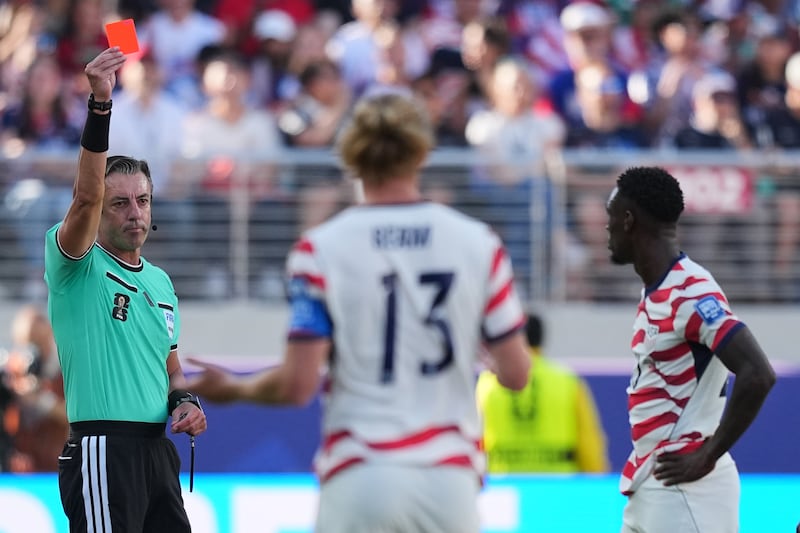

Every U.S. soccer fan’s question right now is “What is going to happen to Folarin Balogun?”
The soccer star received a red card after making contact with Bosnian defender Tarik Muharemovic’s ankle during Wednesday night’s match.
The contact caused brief agony to the Bosnian but he still managed to finish the match.
The U.S. defeated Bosnia 2-0 — even scoring its second goal down a man with only 10 players on the field after Balogun’s ejection. However, the U.S. will still be without Balogun, its leading scorer this World Cup, in the next knock-out match against Belgium, as red cards bring an automatic one-game suspension.
Is a red card the right decision?
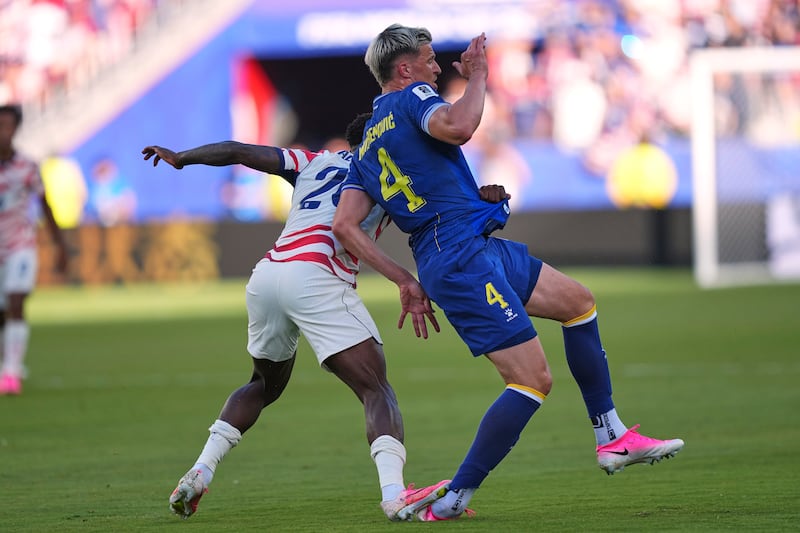
Fox Sports rules analyst Mark Clattenburg stated his opinion on the play.
“To reach a criteria of a red card, there has to be some speed, there has to be some force and there has to be some malice — this lacked that," he said.
“But what it does have, which is what the element of the VAR is hiding behind, is it endangers the safety of the opponent because of that foot-on-foot challenge which could have acted and ended with a broken ankle.”
Clattenburg believes it was an accidental challenge since Balogun did not look for the foul and the play occurred in a split second.
“For me, this did not reach the criteria of a red card and it shouldn’t have been a VAR intervention.”
Can the red card be appealed?
Despite Clattenburg’s opinion on the play, he confirmed it is mandatory the one-game suspension is served regardless of any further review. However, if the disciplinary committee deems the action reckless enough, Balogun could serve even more games, which Clattenburg doubts.
Assuming the U.S. can best Belgium, Balogun will likely be back for the quarterfinals.
Reaction to the red card
It seems very few things are as good as sports at uniting a country, especially when that country feels slighted.
Like this portrait of George Washington crossing the Delaware to describe “me and the boys” appealing Balogun’s red card.
Or the patriotic feel of “ref you suck” chants.
Whataburger felt bad for Balogun and posted “free burgers” for the star.
Others felt there was some favoritism on two similar plays. in one play earlier in the World Cup, soccer legend Lionel Messi stepped on an Algerian player’s calf and only received a foul without a card.
Many wondered where VAR was for Messi’s incident.
One post connected the incident to Brendan Sorsby’s injunction that made him available to play football for Texas Tech momentarily
More red card drama
New this year, the World Cup instituted the “Prestianni Law” which penalizes any player who verbally confronts an opposing player while covering his mouth.
So far the rule has only affected two players this tournament. The players may or may not have said anything offensive, but, with no way to verify, a decision to eradicate the behavior completely was made.
Clearly some players knew the rule while others received a harsh reminder.
It was introduced following Gianluca Prestianni allegedly called Vinicius Junior a slur while on the pitch. Prestianni did not receive any punishment in the match because officials could not visually determine what was said.
To prevent this in the World Cup, the International Football Association Board along with FIFA fast tracked a new rule allowing referees to penalize any time a player confronts an opponent with their mouth covered.
Most recently, it occurred when Mexico defeated Ecuador in the knockout stage.
Ecuador’s Piero Hincapie covered his mouth while he was in a heated exchange with Mexico’s Santiago Gimenez, who knew the rule and let an official know. Later Hincapie was shown a red card and gone from the game.
It did not have much consequence since Ecuador trailed 2-0 and the match was nearing its end.
The other incident occurred in the group stage when Paraguay’s Miguel Almiron covered his mouth and said something to Turkiye’s Mert Muldur with his mouth covered.
This time it occurred with another half left to play putting the Paraguay at a disadvantage for the rest of the game.
Penalty for receiving a red card
Almiron was forced to sit the rest of the game and he served a one-game suspension against Australia the next, which ended in a draw. As an additional penalty for the red card, Paraguay played the remainder of its match against Turkiye with 10 players instead of the usual 11 since teams cannot put in a substitute following a red card.
Given the severe penalty for a red card, the new rule could bring some major ramifications, especially in the knockout stage.
Players with red cards so far
So far, this World Cup has seen 11 red cards, which is more than the last two combined (8). Still, the record is still afar from 2006, when 28 were handed out over the course of the 64 games.
A list of the players who have seen red cards in 2026:
- Sphephelo Sithole (South Africa) — denial of obvious goal
- Themba Zwane (South Africa) — violent conduct
- Cesar Montes (Mexico) — denial of obvious goal
- Homam Ahmed (Qatar) — denial of obvious goal
- Assim Madibo (Qatar) — serious foul play
- Tarik Muharemovic (Bosnia) — denial of obvious goal
- Miguel Almiron (Paraguay) — covered mouth
- Nathan Ngoy (Belgium) — denial of obvious goal
- Rebin Sulaka (Iraq) — denial of obvious goal
- Agustin Canobbio (Uruguay) — violent conduct
- Piero Hincapie (Ecuador) — covered mouth
- Folarin Balogun (United States) — violent conduct
Reaction to the new rule
The new rule received mixed reactions from the internet, but many feel the rule is necessary to curb slurs being hurled on the pitch.
Others pointed out that it could be exploited.
But others responded saying there is no point to cover your mouth if you have nothing to hide.