

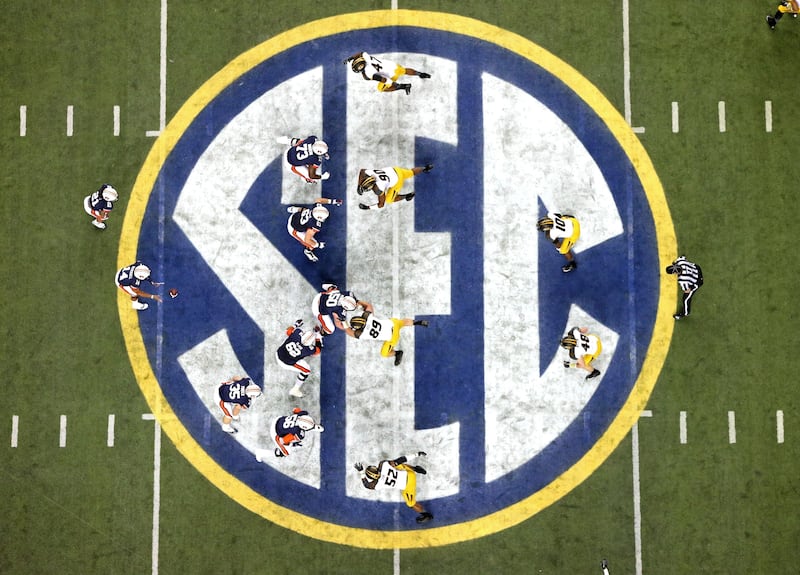

A gray curtain of clouds lingered over downtown Tampa on Tuesday morning, spitting rain at the streetlight banners welcoming the Southeastern Conference to town for its annual “Media Days.”
I live about 30 minutes west, across Tampa Bay in St. Petersburg, so I spent the morning puttering around the constellation of enterprises that had sprouted around the SEC’s presence — food trucks and satellites and TV studio sets, plus the occasional fan braving the brewing storm.
Inside the palatial Marriott near the mouth of the Hillsborough River, the SEC had welcomed reporters from across the South and from as far away as the United Kingdom. They’d come to speak with the SEC’s 16 head football coaches, plus an address-and-Q&A with league commissioner Greg Sankey. For whatever reason, conference leadership decided the Deseret News did not need to be in that room. All the same.
Because as the storm clouds rolled, the most important story swirling around SEC Media Days was not to be found inside the Marriott ballroom.
It was to be found in the gap between Sankey’s words a day earlier, when he confirmed conference leaders had discussed breaking away from the NCAA entirely, and legislation currently under consideration in the U.S. Senate, which seeks to preserve college football as fans have known it.
That gap is still under negotiation, but the SEC’s historic instinct to wall itself off — regionally, financially, lucratively — is the same instinct informing its reflexive opposition. And it could be the lynchpin that finally breaks college football for good.
The Protect College Sports Act
Back in early June, Sen. Ted Cruz, a Texas Republican, and Sen. Maria Cantwell, a Washington Democrat, introduced the Protect College Sports Act to the Senate Commerce, Science and Transportation Committee; it quickly became a bipartisan cause célèbre.
By the 18th, the bill had been passed out of committee by a vote of 19-9, with 13 Republicans and six Democrats in support — including Nevada’s Jacky Rosen, New Mexico’s Ben Ray Luján, Colorado’s John Hickenlooper, Wyoming’s Cynthia Lummis and Utah’s John Curtis. As written, the bill would:
- Grant the NCAA a limited antitrust exemption so it can enforce its rules without getting sued.
- Restrict schools’ ability to drop women’s and Olympic sports, including scholarship guarantees for athletes.
- Limit athletes to one penalty-free transfer, with subsequent transfers requiring a year of sitting out.
- Cap NCAA eligibility at five years.
- Ban former pro athletes from reentering NCAA competition.
- Tighten NIL regulations to prevent sham deals above market value while also ensuring athletes have a right to earn NIL.
- Codify the revenue-sharing cap established by the House settlement, with annual inflation adjustments.
- Forbid schools from hiring a head coach from another school during the season (the “Lane Kiffin Rule”).
- Prohibit conferences with annual revenue over $700 million from expanding.
- Allow schools to voluntarily pool and sell their broadcasting rights — though only if 75% of Division I FBS schools choose to opt in.
The same day the bill advanced out of committee, however, the SEC and its fellow superconference, the Big Ten, issued a joint statement making clear that the conferences didn’t support the legislation in its current form.
Their objections were framed in terms of practical considerations: inadequate preemption of existing state laws; the potential for bureaucratic gridlock; expanded possibilities for litigation; and a possible reduction in revenue sharing payments to athletes — all of which are real concerns, but none of which get at the root of their reflexive opposition.
That root is simple arithmetic: In 2025, the Big Ten pulled in $1.47 billion in revenue, while the SEC amassed $1.11 billion. The Atlantic Coast Conference and Big 12 combined didn’t haul in as much revenue as the Big Ten.
The Big Ten and SEC, in other words, have opened up a financial chasm between themselves and everyone else in college sports. And they’re not keen on embracing anything that could threaten their superiority.
Going into SEC Media Days, reporting suggested the conference had even considered breaking away to form its own exclusive, self-governing league if the Protect College Sports Act, or something like it, were to become law. Sankey’s very first question during Monday’s Q&A asked whether those conversations had taken place.
“They’re real,” he answered. “People have talked about that. They’ve opined about the frustrations that bring them to the point of saying we should look at something significantly different.”
That possibility, however, is not imminent, and conversations with lawmakers are ongoing; Sen. Cantwell’s chief of staff was even present at SEC Media Days. To win the SEC’s support, Sankey outlined four key sticking points, three of which were related: the establishment of enforceable national standards; a full federal preemption of current state laws regarding college sports; and name, image and likeness standardization. The fourth point, though, is the key.
The SEC wants any potential legislation to “treat similarly situated organizations equally while preserving institutional choice.” Which sounds pretty dry, but that’s Sankey’s way of addressing what had been the two most controversial aspects of the legislation — and, arguably, its two greatest equalizers.
To conference commissioners, it’s all about money and control. Their greed is bankrupting all but the biggest schools.
— Cody Campbell, Texas Tech booster and Protect College Sports Act supporter
One is a proposal to limit further conference expansion by capping membership for conferences reporting over $700 million in annual revenue. That proposal, per reporting from Yahoo Sports, will be changed to allow smaller teams to move up to bigger conferences if invited, although the process is expected to be much more rigorous than in the past.
The other proposal, perhaps the bill’s most controversial measure, would allow schools to pool and sell their media rights.
As it stands currently, conferences pool and sell their media rights, which is the most significant source of the SEC’s and Big Ten’s good fortunes. The two conferences feature many of college sports’ most valuable brands, and therefore, they command extremely high prices for the rights to broadcast their games. If other schools could pool and sell their media rights across conferences, that could threaten SEC and Big Ten hegemony.
But for that to be allowed, the legislation specifies that 75% of Division I FBS football schools would have to opt in — which is a very interesting threshold.
Currently, there are 138 such schools, meaning 104 of them would be needed to reach the threshold — while 35 schools could block it. The SEC and Big Ten have 34 schools combined. And Notre Dame, which is not a member of any conference, maintains its own exclusive broadcasting contract, making it likely to side with the Big Ten and SEC — and effectively blocking any changes to media rights pooling.
So if that’s the case — if the SEC, Big Ten and Notre Dame effectively have veto power over the Protect College Sports Act’s biggest threat to their dominance — then why have they been so resistant?
Immediate questions
One of the Protect College Sports Act’s biggest boosters is Cody Campbell, the oil magnate who bankrolled the Texas Tech football juggernaut that steamrolled BYU twice last season en route to the school’s first College Football Playoff appearance.
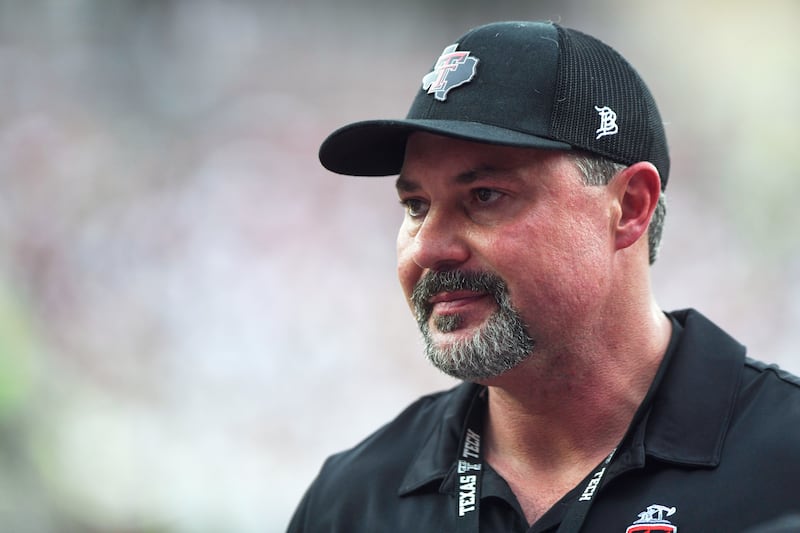
Campbell, whose Red Raiders could benefit from some of the bill’s provisions, has lobbied for the legislation in more sweeping terms — both with political leaders and with the public via a blitz of commercials launched in September. One attacked the SEC and Big Ten in all but name. “To conference commissioners,” Campbell told the camera, “it’s all about money and control. Their greed is bankrupting all but the biggest schools.”
Later, he doubled down — this time directly. “(The legislation) protects the entirety of college athletics. It doesn’t protect just the Big Ten and SEC, which is what the Big Ten and SEC want,” he told a Lubbock TV station on June 16. “They kinda wanna grow their duopoly they have and squeeze everyone out.”
Campbell has become something of a college football lightning rod, given that he followed up his supposedly principled advertising push by fighting at every step to allow Texas Tech transfer quarterback Brendan Sorsby to suit up for the Red Raiders this fall despite revelations that Sorsby placed bets on his own team’s games — one of the most serious sins in any sport. One Alabama columnist described Campbell this week as “the Texas Tech super fan who is funding a fight against the SEC on Capitol Hill,” among other colorful descriptors.
“Campbell says the SEC doesn’t want to fix what’s broken about college football. What a bozo,” he continued. “Go pay another quarterback who bets on his own games, Cody.”
Whatever the personal animosity toward Campbell, his basic selling point is compelling: College football has changed so much in recent years as to become nearly unrecognizable and unsustainable, and it’s threatening to take down the rest of college sports with it. And Washington needs to step in before something truly revolutionary — like a breakaway SEC — undoes the sport for good.
On that point, there actually is broad consensus. “I do believe that the SEC doesn’t want to — or Greg Sankey, at least, doesn’t want to — do any kind of breakaway,” says Ross Dellenger, one of the country’s leading college football insiders who has covered this issue extensively. “He would prefer a congressional bill. So that’s why the bill is so important.”
And real progress, Dellenger says, has been made, even since Sankey’s remarks on Monday.
On media pooling rights, which had once been the biggest hurdle to overcome, compromise could be on the horizon. “The SEC and Big Ten wanted it clarified in the bill that it was optional, that they wouldn’t have to do it and they wouldn’t be sued into doing it,” Dellenger says. “There’s just been some, what they might call, ‘definitional clarity’ to the language in the bill, and they seem to be OK with that.”
Some smaller sticking points remain, especially around a proposed revenue sharing cap for athletes that could potentially add a “retention pool” — basically, schools would be able to spend extra money on players who stay at a school, versus a smaller cap for players who transfer in — as well as conference expansion specifics.
“The whole thing’s kind of a fluid situation,” Dellenger says. Yet, “It feels like they are getting close to agreeing to the bill,” he adds. “I think a lot of the things that they want changed are being changed.”
That’s important on the political end of things because the bill’s bipartisan sponsors are looking for a fairly sweeping passage. Such thorough support would give the legislation momentum in the House — while failure to secure the blessings of the SEC and Big Ten could end up tanking the whole effort. “It could get dicey,” Dellenger says. “They could still hold a vote, but it’s probably going to be very difficult.”
College football’s appeal has always been that it belongs to everyone, from Gainesville to Provo to Lubbock — and the Protect College Sports Act, for all its imperfections, is the first serious attempt to make sure it stays that way.
Sankey has dismissed Campbell and his allies, indirectly though not at all unclearly, as outside “interests” trying to exert control for their own benefit. Speaking about the proposed media rights pooling on Monday, Sankey made his contempt obvious. “Why,” he said of his first reading of the bill, “is that even in there?”
Both sides, then, stand accused of meddling where they don’t belong. But lost in those factional squabbles is the bigger question about this bill and the debate surrounding it: Will it actually make college sports more compelling, familiar and fair?
A question of responsibility
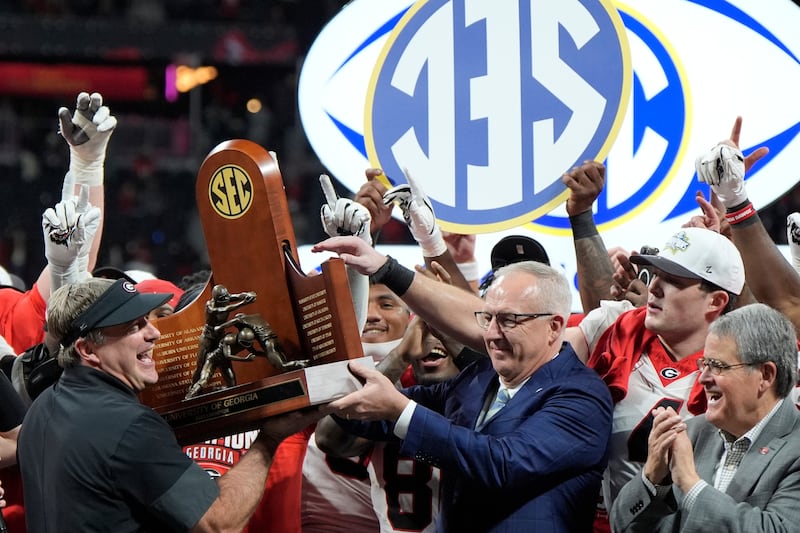
Greg Sankey agrees with the intention. College sports needs federal regulation to remain cohesive, he said Monday, since the current patchwork of state legislation sows confusion and competitive disadvantage. To curb runaway spending and preserve some semblance of competitive balance, congressional action is welcome.
“At its core,” he said during his introductory remarks, “it sounded like a straightforward objective.”
His North Star on the issue, he continued, actually comes directly from SEC athletes, who’ve told him again and again that what they most want from NCAA governance is an assurance of fairness. “Among all the press releases, legislative drafts, committee hearings, and political commentary, that message from our student-athletes to me is the clearest message we have heard,” Sankey said. “Hold everyone to the same standard.”
That sure sounds like fairness, but the “same standard” he has in mind is also the one that has allowed the SEC and the Big Ten to tower over the rest of college sports. The “same standard,” as the SEC understands it, is the one that gives SEC and Big Ten schools annual payouts in the $70 million range, while the Big 12 offers about half that. Is that really fair?
From one vantage point, of course it is. The SEC and Big Ten, this thinking goes, should not be punished for growing and generating revenue. The fact that their schools are more valuable should be celebrated — not punished. Plus, per Dellenger, the bill’s current form might give more to the Big 12 than the SEC.
“The way the legislation is written, it would bring a harder revenue-sharing cap to college athletics. And that would probably be good for leagues like the Big 12 and ACC who can’t spend as much money as the Big Ten and SEC,” he says, “if this brings more of a leveling of the playing field.”
Is that the same as holding everyone to the same standard? That’s what Sankey must decide, and he isn’t blind to the challenge. The last question he took on Monday asked about his role as custodian of the SEC versus his role as custodian of college football. In other words: Does he have an obligation to his conference’s self-interest — or to college sports themselves?
“I hope to be both,” Sankey said. “Yes, unapologetically for the Southeastern Conference, but with the recognition that national competition — the ability to hold a national championship trophy up, compete against colleagues from different states in an equitable fashion, and achieve the mountaintop of a national championship — that has meaning.
“We’re challenged now to keep our focus on that reality. That is a responsibility I recognize.”
Time is the enemy
Back outside the Tampa Marriott, the storm clouds lingered as Tuesday morning turned to afternoon; as negotiations continued beneath the veneer of coaches giving their typical speeches about high expectations. From the outside looking in, I’ll confess divided loyalties.
I grew up a fan of, and later graduated from, the University of Florida. I still follow the Gators closely, and I understand the SEC’s instinct to protect what it has, because what it has is genuinely special.
I also lived for five years in Utah, though, writing mainly for fans of the Big 12 and Mountain West, while my wife earned her Ph.D. at BYU. These days, I’m just as likely to tune in for the Cougars as for the Gators, and I can appreciate why they’d be upset about the sport’s current imbalance and the SEC’s reluctance to accept major changes.
Yet I don’t think those two loyalties are incompatible. In fact, I think they’re the point: College football’s appeal has always been that it belongs to everyone, from Gainesville to Provo to Lubbock — and the Protect College Sports Act, for all its imperfections, is the first serious attempt to make sure it stays that way.
I hope to be both. Yes, unapologetically for the Southeastern Conference, but with the recognition that national competition — the ability to hold a national championship trophy up, compete against colleagues from different states in an equitable fashion, and achieve the mountaintop of a national championship — that has meaning.
— Greg Sankey, SEC commissioner
There are real signs it might work. Dellenger says progress has been meaningful. The pooling fight, once the bill’s most explosive provision, appears to be settling into something both sides can live with. For all the theater of Sankey’s Monday remarks and Campbell’s TV broadsides, the people doing the actual negotiating seem to be converging.
The trouble now could be the clock.
The Senate has two working weeks left before it breaks for a monthlong recess on Aug. 7. After that come the midterms, and after the midterms, a new Congress — and no guarantee that anyone picks this up again.
There’s some optimism that the legislation will come up for a vote in the Senate before then — although multiple senate staffers told me that, frankly, this just isn’t a priority compared to the SAVE America Act, the Iran War and the upcoming midterm elections.
Those elections could also add a more partisan dimension to the legislation, which is supported by President Donald Trump; some Democrats who might support the idea in principle could choose to vote against it to avoid handing Republicans a perceived political victory so close to election season.
And even if the Senate passes the bill, the House still has to act. Cruz has called this college football’s “fourth-down territory.”
As the final play call looms, so too did the storm clouds Tuesday afternoon. The Marriott seemed to be exactly on the edge of a brewing tempest. It was unclear whether the downpour visible on the horizon was coming or going, and it didn’t matter much for the folks inside, who could safely ignore it. But outside, I figured I should probably head home just in case.
On my way, I drove past the streetlight banners promoting SEC Media Days, every one of them slick with rain from earlier in the day. Droplets pooled and slid down their faces, then dropped toward the sidewalk in a frantic trickle.
Correction: A previous version of this story was inaccurate regarding the political party makeup of the committee vote on the Protect College Sports Act; the votes in favor included 13 Republicans and six Democrats, rather than 12 and seven. The text has been updated to reflect the correct breakdown.