

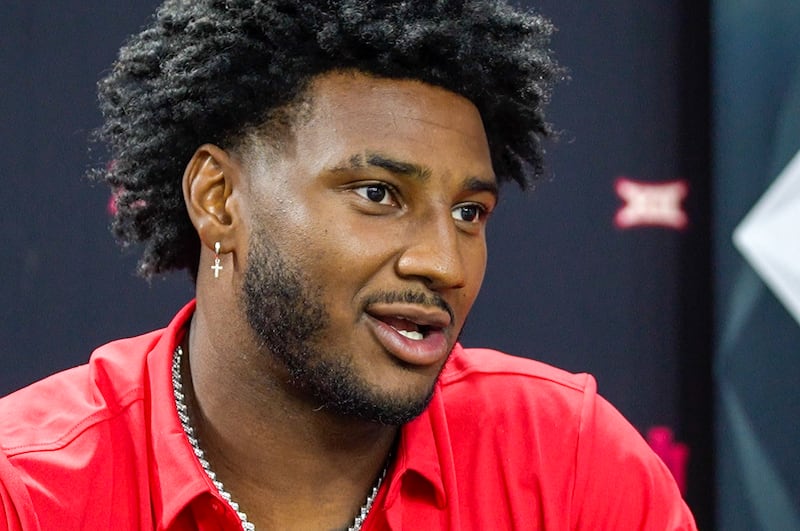
Utah offensive coordinator Kevin McGiven and quarterback Devon Dampier talk about the coaching staff's confidence in giving Dampier control of the offense.
utah football
Utah’s coaches are giving Devon Dampier more control of the offense
OC Kevin McGiven has made it a point of emphasis to give Dampier more ability to change protections, audible plays this season

This article was first published in the Ute Insiders newsletter. Sign up to receive the newsletter in your inbox each Wednesday night.
During a recent practice, Utah quarterback Devon Dampier surveyed the field and gave his receivers a pre-snap audible based on something the defense was showing.
“He gave the receivers a check that we never talked about,” Utah offensive coordinator Kevin McGiven said.
Dampier’s instincts were right, and the play went for a huge gain.
“I just kind of looked over at (quarterbacks coach Ryan Gunderson) and said, ‘I don’t know what you’re teaching these guys, but that was pretty cool,’” McGiven recalled.
In the spring, McGiven and Gunderson worked with Dampier on improving his pre- and post-snap processing — reading the defense, going through his progressions, etc. — and have seen “a ton of progress” in that area.
“We’re giving him the keys to the car in that element.”
— Utah OC Kevin McGiven on quarterback Devon Dampier
One point of emphasis for Dampier as Utah goes through fall camp in preparation for the season is giving him more power to read the defense and call audibles. In recent weeks, McGiven has seen improvements in Dampier’s ability to control the offenses, especially in protection shifts.
“We’re giving him the keys to the car in that element,” McGiven said. “There’s some different things on the perimeter with looks that he sees where he can get himself into the best situation based on what he’s given with route concepts and things like that.”
As Dampier continues to exhibit command of the offense and success in calling audibles, McGiven in turn puts more on his plate. It’s all part of McGiven’s process of developing Dampier into more of a complete quarterback as he enters his second season at Utah, and fourth season overall in college.
Going back to Dampier’s audible during practice, McGiven said that he thinks that specific check was one that Dampier and his receivers worked on during player-led offseason training in the summer. While a good portion of that training happened at Utah’s football facility, Dampier also flew his receivers down to his hometown of Phoenix, Arizona, for a twofold purpose — continuing the on-field work and also continuing to build off-the-field chemistry.
Receivers coach Chad Bumphis, who played in the NFL, said it reminded him of something that would happen in the pros. With players being paid and teams bringing in general managers, college football is becoming more and more professionalized each season, and Dampier has led the charge of Ute players working year-round.
“It’s their vacation month, right? So a lot of guys are hanging out, but they took it upon themselves, they wanted to go out and get some work and get better. So all for it, man, I love it,” Bumphis said.
“And again, it just shows that this is important to us. We want to win. We want to be one of the top offenses in the country. So it takes that, especially with some of the option routes we do, that takes a lot of offseason work. You got to be on the same page with the quarterback. So taking that ownership and doing it on your own is huge for us.”
McGiven, who guided Utah State’s offense to 409.5 yards per game and 30.9 points per game last season with Bryson Barnes at quarterback and a middling offensive line, has always approached each new season by trying to fit his offense to his personnel, rather than the other way around.
“He is going to identify our playmakers and get them the ball. He understands that we have to establish the line of scrimmage,” Utah head coach Morgan Scalley said. “We have to establish a physical brand of football, but he’s also really good at, ‘Here are my playmakers, here’s how we’re going to get them the ball.’ Not, ‘Here’s my scheme, you have to fit inside of it.’
“It’s ‘Who do we have and how can I really accentuate them? How can I highlight them and their skill set?’”
“They are different. They’re playmakers. They’re going to do some stuff that makes me look like a really smart guy. They’re going to do some stuff that is going to frustrate me, and my job is to minimize that.”
— Utah QBs coach Ryan Gunderson of Dampier and Ficklin.
As the Utes ramp up for the 2026 season, McGiven has a clear picture of what he wants this offense to be and what will be best to run, given his personnel. It all starts with the quarterback — Dampier, and to an extent, Byrd Ficklin.
When designing Utah’s offense this season, McGiven looked at the skill sets of the quarterbacks and went from there. Dampier plays at his best when he’s in an RPO offense and is given the freedom to make plays with his legs and on the run, but he’s also shown that he can throw it deep if needed as well.
Dampier’s ability to improvise is a critical part of his game, and while Utah doesn’t want to discourage that, McGiven still needs him to play within the structure of the offense at times.
“They are different. They’re playmakers. They’re going to do some stuff that makes me look like a really smart guy. They’re going to do some stuff that is going to frustrate me, and my job is to minimize that,” Gunderson said of Dampier and Ficklin.
“They’re kind of wild mustangs and I don’t want to make them a horse at a carnival. They need to be mustangs, but I got to just, let’s bring the fences in a little bit. So that’s what my job is. I wouldn’t say that to you if they hadn’t proven that they could play. But in terms of rooms, I don’t think I’ve ever had two guys like them that dynamic.”

McGiven has worked with Dampier in designing the offense to fit his strengths, and that means it could look similar to the offense of Jason Beck, the former Utah and New Mexico OC who worked in concert with Dampier over the past three seasons.
“Probably is very similar. Probably similar. You have formation of the boundary stuff. You have shifts, motions, the quarterback run game. And that’s a big reason why Devon and Byrd wanted to stay, is because it was very similar,” Scalley said. “There’ll be some added wrinkles obviously. But yeah, I would say to the average fan, you’re sitting there going, OK, this is real similar.”
Dampier, who is coming off of the most injured season of his career, is feeling healthy heading into 2026. While the Utes don’t want to neuter his rushing ability, which is part of what makes him so dynamic, they are mindful of keeping him healthy as Utah goes through the season.
“Always sensitive to how many hits the quarterback is going to take, whether it’s how we’re constructing our protection or what we’re doing with him in the run game and then also knowing how much he just creates on his own,” McGiven said. “That’s something we’re going to have to manage.
12
Comments
“We’re going to want to utilize his feet. We’re going to want to create numbers in the run game that the advantage that you can have when you involve some of that quarterback run game. I don’t think we want to take that element of the offense away, but in terms of the hits and the types of hits that he’s taking, definitely want to manage that.”
As Dampier suits up for the season, he’s more empowered than ever in his management of the offense — something Utah’s coaches think will benefit the team.
“McGiven trusts me so much with the offense. He gives me the ability to get into a different play, get into things that we run very well. So just to have that aspect, it makes me very confident going into any game that we have the game plan to do what it takes to win,” Dampier said.

In case you missed it
The Morgan Scalley era has begun. Here’s what stood out on Day 1 of fall camp.
From the archives
Extra points
Join the Conversation
Looking for comments?