

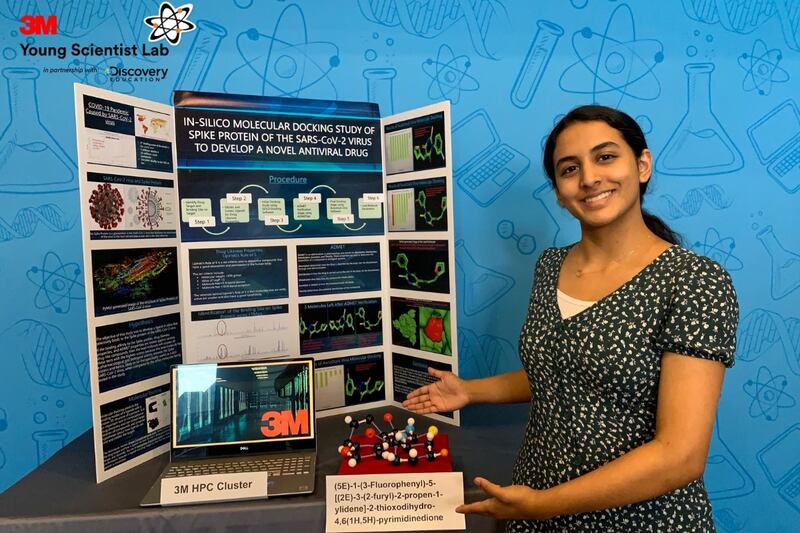

Anika Chebrolu recently won a $25,000 award for her research on a possible cure for the novel coronavirus.
- Chebrolu, of Frisco, Texas, won the 3M Young Scientist Challenge award for her research.
- “I’m excited, still trying to process everything,” Chebrolu told the New York Stock Exchange:
Her discovery included finding a molecule that could bind with the spike protein of the coronavirus.
- “Anika used in-silico methodology for drug discovery to find a molecule that can selectively bind to the Spike protein of the SARS-CoV-2 virus in an attempt to find a cure for the COVID-19 pandemic,” 3M Young Scientist Lab said on its website.
She used software to review millions of small molecules to see how they could work as therapeutic drugs to end the coronavirus. She specifically looked at how well they bind to the spike protein of the virus, according to the Dallas Morning News.
Chebrolu started her research into influenza after she had a case of it earlier in 2020. Once the pandemic hit, she shifted her focus to SARS-Cov-2, the virus that causes COVID-19.
She worked her mentor, Dr. Mahfuza Ali, to conduct the research.
- “Being a scientist, I know what it takes to work on a scientific project, and beyond her age, that work Anika did is amazing,” Dr. Ali told The Houston Chronicle “Her enthusiasm, her tenacity, it was amazing.”
Chebrolu also received the “Improving Lives Award,” according to a release from Frisco ISD.
- “I am extremely humbled at being selected America’s Top Young Scientist as all of the finalists had amazing projects and were extremely well-rounded individuals,” Anika said in the Frisco release. “Science is the basis of life and the entire universe and we have a long way to go to understand it fully.”