

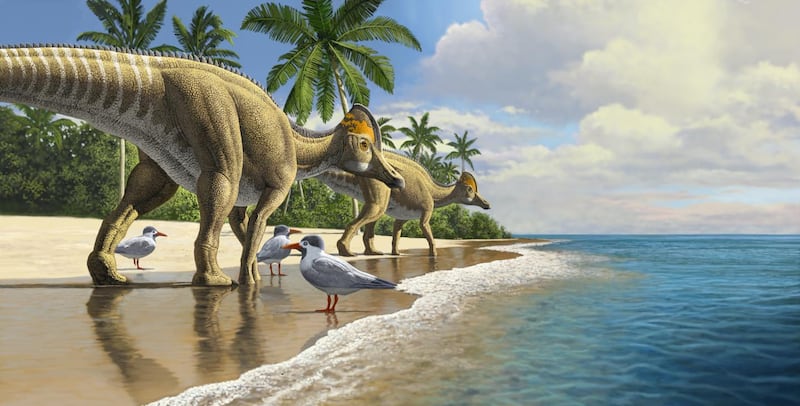

Experts recently discovered fossils of a duckbill dinosaur in Africa — a sign that dinosaurs could swim across oceans to reach different continents.
What’s going on?
Scientists recently discovered fossils of a new dinosaur named Ajnabia odysseus, a duckbilled dinosaur and herbivore.
- The fossils were found in Morocco. They date back about 66 million years.
- The dinosaur, in some cases, could be 49 feet long. But most consider the dinosaur to be about the size of a pony.
- And yet, somehow it ended up in Africa.
Nicholas Longrich, a senior lecturer at the Milner Centre for Evolution at the University of Bath, who led the study, told CNN that the finding was “about the last thing in the world you would expect.”
- “It was completely out of place, like finding a kangaroo in Scotland. Africa was completely isolated by water — so how did they get there?” Longrich said in a statement.
The theory:
The scientists said duckbills must have crossed open water to arrive in Africa since it was isolated by oceans at the time. The duckbills would have had to be “rafting on debris, floating, or swimming” to get there, according to a release.
- There’s also chance they swam the whole way since “they had large tails and powerful legs, and are often found in river deposits and marine rocks, so they may have simply swum the distance,” according to a release.
“Sherlock Holmes said, once you eliminate the impossible, whatever remains, no matter how improbable, must be the truth,” said Longrich. “It was impossible to walk to Africa. These dinosaurs evolved long after continental drift split the continents, and we have no evidence of land bridges. The geology tells us Africa was isolated by oceans. If so, the only way to get there is by water.”