

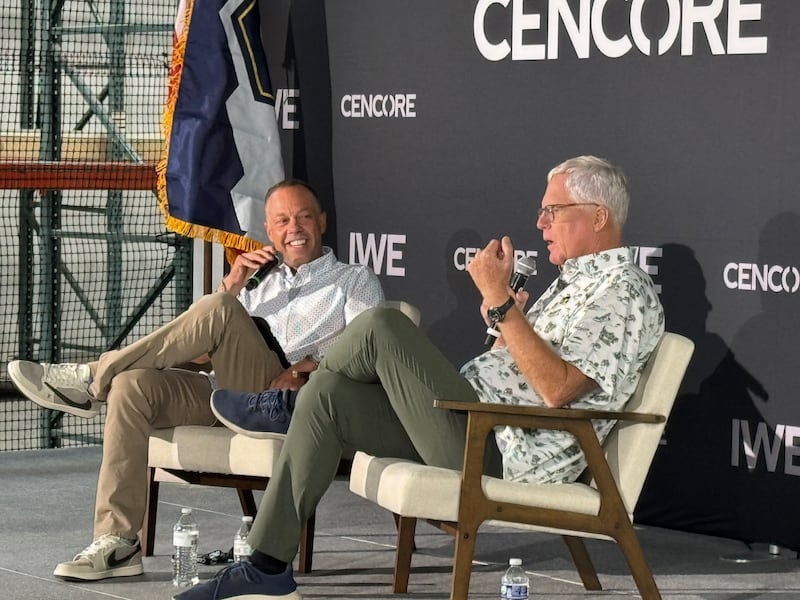

- Defense-industry companies participate in the public launch of the Integrated Warfighter Ecosystem.
- Utah Gov. Spencer Cox calls for cross-sector collaboration to best serve the needs of American troops.
- Former Acting Defense Sec. Chris Miller joins in "innovator" discussion with CenCore's Adam Fife.
The United States doesn’t suffer shortages of bright people, great ideas or “patriotic Americans who want to contribute and give back,” said Utah Gov. Spencer Cox on Friday to an audience of defense industry innovators and entrepreneurs.
But too often, he added, the country is slow to connect strengths.
Perhaps a startup develops a product but can’t “navigate the system.” Maybe a soldier spots a battlefield need but waits years for solutions. Or maybe an entrepreneur has a breakthrough, but can’t “cross the valley” between prototype and development.
“Every person in this room has some ability to shorten those distances and close those gaps,” said Cox. “Industry can collaborate more. Government can move faster. Universities can connect research to real-world missions. And states can make it easier to build and invest.”
Most importantly, all of those shared abilities optimally serve those who wear America’s uniform.
The men and women serving in today’s U.S. Armed Forces don’t get to choose the missions they are ordered to serve, said Cox. And they don’t decide whether the tech arrives on time.
“They simply trust that this country is behind them and has done everything possible to give them the advantage,” said Cox.
“That creates a very heavy obligation on all of us people in this room. Their courage deserves our urgency. Their willingness to serve deserves our best technology, our best manufacturing, our best ideas and our best people.
“And their mission should matter more than our bureaucracy, our institutional silos or our individual interests.”
Cox was in Payson Friday to join in the public launch of the Integrated Warfighter Ecosystem (IWE)— a coalition of more than 150 American companies committed to supporting American military personnel on the ever-evolving global battlefield.
The IWE was founded and orchestrated by CenCore, a defense and security company headquartered in Payson and operating across 27 sites nationwide, employing approximately 1,700 people.
But most of IWE’s coalition consists of small businesses, including many startups owned by veterans. The coalition aims to help close operational gaps between private industry and the Defense Department to ensure the best equipment and resources are placed timely in the hands of those entrusted to protect the nation.
Cox: Mustering Utah’s ‘culture of service’
In his opening remarks, Cox said Utah is committed to doing its part to supporting “our shareholders” — the American warfighter.
“We are building. We are welcoming the companies and people who share this mission and this vision, and we are going to do more.
“We’re going to help make sure that the United States of America remains the strongest, most innovative, and most capable nation in the world.”
Technology, companies and contracts all matter — “but ultimately, this work is about people,” the governor added.
The world is dangerous and rapidly evolving. So it’s essential that American troops have the full technological capacity to do their essential job. The nation’s enemies are watching. They are moving quickly. It’s an urgent moment.
“But it’s also a moment for enormous confidence,” said Cox. “Because when America actually gets our crap together and decides to build, there is still no country on Earth that can match the combination of ingenuity, entrepreneurship, manufacturing capacity, and free people that exists right here.”
A great military depends on a great industrial base — factories, machine shops, semi-conductors, critical minerals and energy. It also needs startups willing to take risks. And a government that understands that speed is critical, said Cox.
The Beehive State plays “an outsized role” in the next chapter of supporting America’s warfighters, he added. “Utah sits at an unusual intersection of technology and manufacturing, entrepreneurship, and, maybe most importantly, patriotism.”
Beyond the state’s growing aerospace and defense ecosystem, Utah is building leadership in critical minerals, advanced energy, AI, aerospace and frontier technologies.
“And we have something else that’s a little harder to quantify: Utah has a culture of service,” said the governor.
“We believe this country is worth defending. We believe that this country is worth preserving. We believe that this is still the greatest country in the history of the world.”
Cox extended an invitation to the companies taking part in Friday’s IWE event who are based outside of Utah:
“Come and join us. Come and join what is already happening here. Come and build here. Come hire here. Come manufacture here. Come and test here. Come work here with our universities and our technical colleges. Come meet the Utahns who will become your engineers, your technicians, your operators, and your employees.”
An entrepreneur talks shop with a veteran military leader
Meanwhile, the IWE’s founder — CenCore CEO Adam Fife — sat down Friday with Former Acting Secretary of Defense Chris Miller during the “nexus” summit to discuss mission, innovation and ways civilian companies can best serve the nation’s warfighters through industry.
The two had an unscripted, wide-ranging conversation about the challenges facing the nation’s defense community — and the essential role of innovators on today’s battlegrounds.
Miller noted the difficulties that investors often face working with the Pentagon, and the value of solid investor pitches.
“I have such profound respect for those that are willing to take that risk,” said Miller, “It’s just not financial — it’s reputational, it’s professional, it’s psychological. That risk to start something that they believe in.”
Humility, he added, is essential for founders.
And regardless of their product, observed Fife, innovators must never forget that the most common user is likely to be a 20-year-old. That’s the stakeholder and the priority. They are the ones being asked to utilize the tech.
“I think we get lost in the sexiness of the technology and lose our way forgetting who we’re actually building it for,” said Fife.
Miller agreed that having employees who understand the nature of combat can offer key insights. And innovators should not fear failure.
“If they’re not failing,” added Fife, “it means they’re not trying anything.
“If they’re not trying anything, it means they’re not actually advancing through the process that allows them to get that contract that allows them to be successful.”
When asked how those who serve should be viewed, Miller replied that “service is inherently honorable” — whether it’s a firefighter, the mayor or a dog-catcher.
“It’s not good for America when we have a separation between those that serve and those they serve,” he said. “That’s why I always come back to the National Guard. It’s the fundamental thing. You come from a local community. You go overseas, you serve and you come back home.”
Miller concluded with a “thumbs-up” for those in uniform: “I’ve got so much confidence that the kids we send out there are so smart and so committed. We just need to let them know we support them and that there’s nothing they can’t do.”
Saluting defense-industry innovators
Brig. Gen. Michael Kjar, the Adjutant General of the Utah National Guard, also spoke at Friday’s IWE gathering.
Kjar thanked innovators of all sizes who “make sure that our warfighters are getting what they need in order to do what we need to do and protect what we have.”
Readiness and innovation are the general’s top priorities. And battlefield innovation is critical at a moment when drones and other technologies are reshaping combat.
“Know that what you’re doing is supporting young men and young women who are eager to defend the flag that stands behind you, and I’m thankful for that,” Kjar told his audience.