

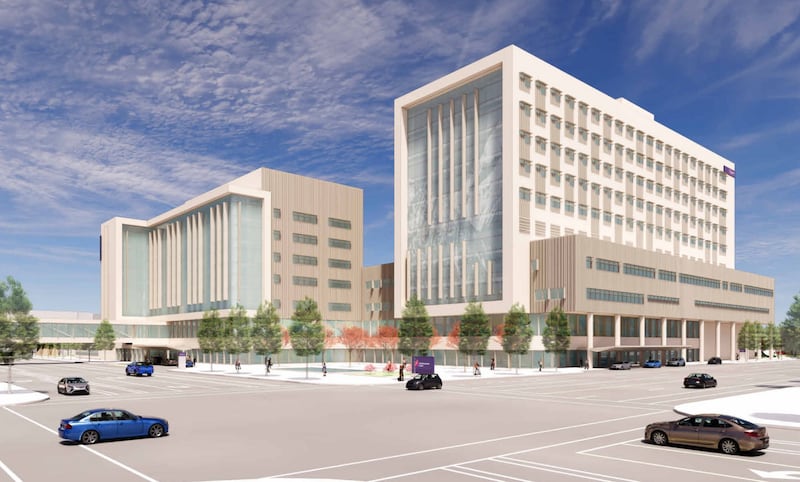
LDS Hospital will be relocated to downtown Salt Lake City following years of speculation.
However, it’s unclear what’s next for the old hospital site, which has been a fixture of the city’s Avenues neighborhood for over a century.
Intermountain Health’s board officially approved the new hospital last week, which will be located on land it purchased near 754 S. State almost five years ago. The project still has some remaining planning approvals, but the healthcare provider hopes to break ground before the end of this year, officials said on Wednesday.
Construction is expected to take three to five years to complete once it begins.
“This is a perfect location for a healthcare campus — we are really excited about that,” said Heather Wall, president of LDS Hospital, standing at the center of the open lot, pointing to its proximity to major freeways, large roads and public transit.
LDS Hospital, 325 E. 8th Avenue, first opened in 1905, seeking to provide patients care away from the valley’s coal-burning smog. It’s grown over the past 121 years, but officials have been concerned about its facilities and its location.
The neighborhood’s narrow, hilly streets can be tricky for ambulances and other vehicles to navigate, especially in the winter.
Intermountain Health acquired the approximately 8-acre former Sears block property in 2021, three years after the department store closed. It received rezoning approval for an “urban hospital” in 2024 and reached a development agreement with Salt Lake City to outline certain conditions for the project.
Wednesday’s briefing marked the first time the company has spoken publicly about the project since submitting several new renderings and other details in documents filed with Salt Lake City last month. Those outlined a multibuilding facility with the tallest building topping out at a little over 200 feet.
The new campus, Wall said, will feature a 10-story hospital with more than 521,000 square feet of space, along with a seven-story medical office building. Many existing inpatient and outpatient services at LDS Hospital will also be moved to the new site, including specialized care, intensive medicine and care for women, newborns and families, such as a Level 2 neonatal intensive care unit.
These services will be mostly split between the two primary buildings, said Trevor Cottam, vice president of Intermountain’s Salt Lake Valley medical operations.
Planning for how to transfer existing services to a new hospital i s starting to begin now that planning for the new facility is all but over.
The campus will also include behavioral health options, addressing a concern brought up by the county. KSL obtained a letter that Salt Lake County leaders sent the Salt Lake City Council last week, asking it to include more behavioral health resources than LDS Hospital currently provides.
It was the only hospital in Intermountain Health’s network that offers inpatient behavioral health beds before new beds were added at Alta View Hospital, Wall said. She said those and other behavioral health resources will remain in the new hospital, although inpatient beds are currently slated to remain the same.
It’s something that could change depending on needs over time.
“We will assess that as we see how the beds at Alta View are used for our patients (and) how that balances with the rest of the valley, and it will evolve,” she told KSL. “We know it’s going to have to.”
Residents previously asked for amenities like green space and an outpatient pharmacy, as well as space to allow the block’s revered taco carts to remain in the area. Those are all included in the project, as many of those were included in the development agreement.
In all, the project is expected to support approximately 2,000 jobs, which Intermountain Health estimates will generate more than $1.1 billion in annual economic impact.
The new site should also help a growing Salt Lake City, said Mayor Erin Mendenhall. She believes options are “extremely limited” to expand the growing needs of the city within the current hospital site, but that can be fixed with the new site.
“This site creates an opportunity for them to carry forward the history of their service and their medical professions in a modern hospital that’s built for their growing needs and our growing needs,” she said.
What’s next for the old hospital?
Planning for how to transfer existing services to a new hospital is starting to begin now that planning for the new facility is all but over.
Intermountain Health wants to open both its new hospital and medical facility at about the same time, though some services might be available before others. The company has yet to determine what it will do with its outgoing hospital in the Avenues.
City leaders are curious about what’s next for the Avenues. Mendenhall lauded Intermountain Health for considering neighborhood feedback on the new hospital site. She believes the healthcare provider will do the same for the outgoing site.
Some services, such as internal medicine, may remain in the neighborhood, while parts of it could be redeveloped over the next few decades, Wall said.
“The part that we just don’t know yet is what we’re going to be doing with the current main hospital,” Wall said.