


HOUSTON — CEO Peter Huntsman has all the trappings of a conservative businessman: the crisp black suit, the corner office suite looking upon downtown Houston from the 22nd floor, the Financial Times neatly folded on the corner of his disturbingly tidy desk.
Business journals and chemistry tomes line the bookshelves, along with some of the small plastic tombstones emblazoned with the names of companies gobbled up by Huntsman LLC.
BORDER="0">
BORDER="1"> FACE="Verdana,Helvetica,Arial"
SIZE="2">Huntsman series:
FACE="Verdana,Helvetica,Arial" SIZE="2">
Sunday: The mixed environmental record of the Huntsman petrochemical conglomerate.
Monday:Philanthropy and political, religious and civic connections.
Today: The past, present and future of the Huntsman business empire.
But one photograph seems out of place. Huntsman is cradling a Kalashnikov assault rifle, surrounded by heavily armed Christian Armenian militiamen with ominous glares. A decrepit Soviet transport helicopter is in the background.
"I was in the second of three helicopters. The first one got shot down," he said with a boyish grin, his blue eyes sparkling at the memory of his 1994 tour of the front lines in a remote section of Armenia where Christians and Muslims are still locked in a bloody dispute.
"I went on a three-hour tour and ended up staying three days," he added.
The glee with which he tells the harrowing story reveals there is much more to Peter Huntsman, the second-oldest son of billionaire Jon Huntsman Sr.'s nine children, than meets the eye.
Peter is a man who loves risks that others might consider reckless. And the volatile chemical industry is a notoriously risky business that suits the 40-year-old college dropout just fine.
"He is one of the finest CEOs in this country," said his father, the former CEO of the only family controlled chemical dynasty in the world.
"I'm sure nepotism has a value," Peter responded. "There are not many college dropouts running $9 billion companies."
Brink of bankruptcy
Anointed CEO of Huntsman LLC in July 2000, it is now Peter's job to bring the company back from the brink of bankruptcy. And if he can pull it off — and the financial outlook is still cloudy but improving — Peter could establish himself as a business genius on par with his now-legendary father, Jon Huntsman Sr.
The future of the worldwide family-owned petrochemical empire is now in Peter's hands, says Jon Huntsman Sr., the chairman of the board who watches the company's activities from his Salt Lake offices. But he wonders if handing over the reins of the company he built with credit and chutzpah was Peter's blessing or his curse.
"We hit a perfect storm: over supply and high energy prices," he said. And the company almost capsized.
The Huntsmans bankrupt? Sounds impossible, but Jon Huntsman Sr. said it was a close shave, adding that commitments the family had made to charitable contributions convinced him that the company had to be saved.
And saved it was. And now its vast wealth is — to some yet-undetermined degree — available to Jon Huntsman Jr. and his run for the Utah governorship this year.
In May 2000, before the perfect storm, Huntsman LLC was riding the crest of unprecedented profitability with projected earnings of $250 million and ambitious expansion plans. And when Peter became CEO in July 2000, there was no reason to believe things would change.
Things did change. Within months of taking over, natural gas prices quadrupled, adding $50 million a month to the cost of generating electricity used to fire Huntsman's massive chemical manufacturing plants — 17 in the United States, 33 more around the world. And demand for Huntsman's products, which are sold primarily to American manufacturers who use them to make some 20,000 different products — from bowling balls to TV set cases — withered in the wake of the economic recession.
The impact was swift and devastating. Within nine months, the $250 million projected profit had vanished, and the cash reserves, once healthy with $250 million to $300 million, dwindled to less than $75 million.
The company was within 60 to 90 days of being unable to pay its bills or meet payroll.
In desperation, the company cut 835 jobs and eliminated 300 more contract employees. The family also gave up 49.9 percent of the company's equity to CSFB Global Opportunities Partners LP, a Boston-based investment fund that purchased 82 percent of Huntsman's outstanding bonds and took $1.1 billion in debt off the books.
But the move also left the Huntsman family with 50.1 percent ownership and still in charge of day-to-day operations and the board of directors.
Without the move, "we would be bankrupt, no doubt about it," Peter Huntsman said.
He adds there is a five- or six-year window for him to turn the company around and buy back the 49.9 percent from CSFB.
"We are seeing a lot of indications the industry is turning around," Peter Huntsman said. "We hit rock bottom this past summer, but we have seen a doubling of profits since then, and demand has been picking up. And Europe has improved over the past six months, and Asia in the past three or four months."
Those comments came just before natural gas prices spiked again in December, sending the company reeling — and had Peter Huntsman calling for congressional investigations into price manipulation by speculators.
By the end of December, prices had again stabilized. "I see it as more of a bump in the road rather than a setback," Peter Huntsman told the Deseret Morning News in early January. "No doubt we will have a hit in December due to these higher prices, but the longer term outlook continues to be positive."
Gary Adams, president of Chemical Market Associates Inc., a Houston-based global petrochemical consulting firm, shares the Huntsmans' optimism for the future, saying the industry recovery projected for 2004 is on target.
And Huntsman LLC, because of its cost-cutting and reorganization over the past several years, is perfectly positioned to take advantage of an accelerated recovery through 2006, Adams said.
When combined with a weak dollar internationally, something that spurs exports, "The future is bright, much brighter than the last three to five years," Adams said. "Timing is everything, and they seem to be positioned at the right time in the right market."
The woes that befell Huntsman LLC were not unique to the company. Petrochemical companies that were divisions of larger conglomerates with oil refining survived despite the losses. Those petrochemical companies without the cushion of profitable oil divisions were forced into drastic restructuring, and some did not survive. For example, Union Carbide was acquired by Dow Chemical.
"It was the whole industry, not just Huntsman," Adams said. "It was a classic down cycle in a cyclical industry. Those companies that acted quickly to downsize survived, and now they are in the best position to thrive."
And if that recovery happens, as industry experts predict, it will be Peter at the helm of a company still controlled by the Huntsman family, albeit with a smaller share.
Rags to riches
Nepotism undoubtedly played a role in Peter Huntsman's rise to the top of the petrochemical world. But he has also paid his dues, working a plethora of industry jobs in New Jersey, Houston, Europe and back to Houston, along the way learning the chemical industry from the bottom up.
His first job in the industry was driving a gasoline delivery truck for Olympus Oil, a small distributorship he and his father started in the early 1980s in Salt Lake City that involved the struggling Top Stop gas stations. Peter, at the time 22, juggled the job with classes at the University of Utah, but he gave up college after two quarters.
"My siblings were all smart enough to finish college at prestigious institutions," he quipped. "Maybe someday I will go back."
 | Deseret News graphic Huntsman holdingsRequires Adobe Acrobat. Huntsman holdingsRequires Adobe Acrobat. |
At age 24, Peter was named president of Olympus Oil. The following year, in 1987, he and his family were packing their bags for New Jersey to work in a chemical plant just acquired by his father — the first of a series of acquisitions that would make Huntsman Chemical the largest privately held company of its kind in the world.
Peter's siblings also worked for the company off and on through the years. (The siblings collectively own one third of the Huntsman family's share of the company; Jon Sr. and wife Karen own two-thirds of the family's 50.1 percent share.) But Peter is the only one to have remained actively employed by the company since day one.
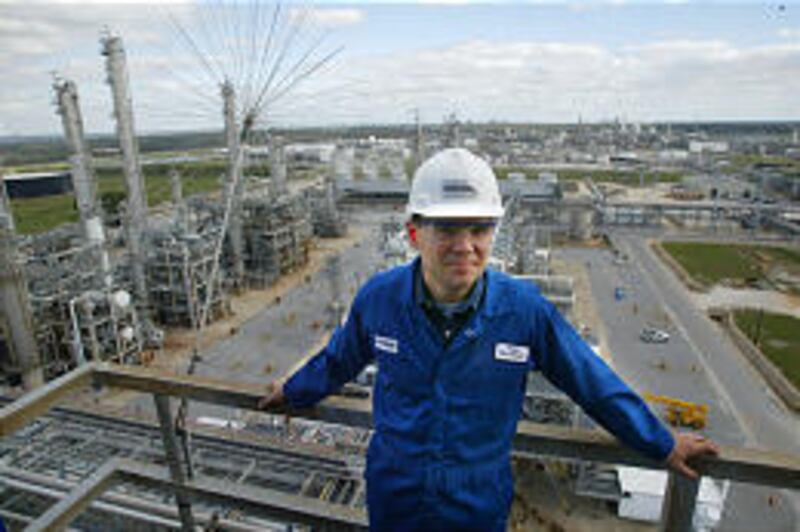
Today, Peter lives in North Houston where he moved in 2002 with his wife and eight children. He doesn't see them as much as he would like.
On most days, he rises at 4 a.m. to run four or five miles, then calls Europe to check on business operations. At night, it is time to call Asia. His watch is set to four time zones, his cell phone seemingly attached permanently to his ear.
"The business is very time consuming," he admitted.
Peter says he has been so busy globe-trotting to Huntsman plants around the world that it took him a year and a half to get around to turning in the rental car he picked up when he moved to Houston.
It's all part of the job, he says. But it's also part of Peter Huntsman's management style — a style inherited from his father where the boss's place is on the factory floor rubbing shoulders with the rank and file.
Whenever he visits a plant, Peter meets with employees, giving them an inside look at the financial health of the company, the effect of national energy policy on corporate profits and pitching energy conservation. The pitch is followed by question and answer sessions where employees have personal and uncensored access to the CEO.
"The biggest change we've seen (since Huntsman acquired Texaco Chemical in southeast Texas) is they are willing to listen," said Buddy Elmore, the International Brotherhood of Electrical Workers union representative for the Huntsman plants in southeast Texas. "There is an attitude this is an employee-employer partnership."
The IBEW, one of three major unions that represent roughly 99 percent of workers at the plants, has not filed any grievances since Huntsman acquired the Texaco facilities in 1994.
Elmore said union officials are involved in Huntsman plant management meetings where they have direct involvement on plant safety and improved efficiencies.
"At least we are getting the opportunity to give our input on what will keep people safe," he said. "I was here during the days I would come to work nervous about how I was going to leave. I have no fear of coming to work for Huntsman."
A rare breed
The Huntsman ownership style has set the company apart from other petrochemical giants.
As Jon Huntsman Sr. points out, the great industries throughout American history, from railroads to petrochemicals, have all evolved into publicly traded companies where the risks and rewards are spread among millions of investors.
In many cases, giant conglomerates own petrochemical divisions that are but a small part of the overall company portfolio. And when there are losses, they can be swallowed by profits in other businesses.
But none of those companies have a human face. "There are no individuals left in the great industries," said Jon Huntsman Sr. "None but the Huntsmans."
| Deseret News graphic Huntsman timelineRequires Adobe Acrobat. Huntsman timelineRequires Adobe Acrobat. |
Regardless of wealth, individual industrialists in today's world can no longer withstand the economic ups and downs where profits and losses can swing by hundreds of millions of dollars every year. A family with billions in assets one year can be flat broke the next.
"We are riding one of the last horses of (the industrial) era," said Jon Huntsman Sr. "And it has been an incredible ride. I am looking forward to turning it over to the next generation."
The mantle has been passed to Peter, who is in charge of the petrochemical operations around the world. But Jon Huntsman Sr. isn't getting out of the business game entirely, despite hints in recent years the elder Huntsman might convert his holdings to cash to further his charitable causes.
He told the Deseret Morning News he still loves the fights with Wall Street lawyers, and there is still a passion for the free market that produces fighters and toughens survivors.
"I'll be out cutting deals . . . and looking for opportunities to diversify," he said.
"The company will continue to buy and sell assets," Peter agreed, adding the corporate wheeling and dealing are the means toward the family's philanthropy. "Dad will die with one hand cutting a (business) deal and the other one giving it away."
A family company
It is more than the family's unique status among modern industrialists that distinguishes the company from all others. Those who live in the communities where Huntsman has a presence insist the company has set an entirely new ethical standard.
It has paid for cancer screenings for local residents, it has negotiated unprecedented contracts with the unions and it has raised the safety ethic in an industry noted for nasty and often-fatal accidents. (Jon Huntsman Sr. is particularly proud that no Huntsman employee has ever died on the job.)
"I don't agree on everything they do, but I don't disagree on everything, either. And I couldn't say that before," Elmore said.
"The Huntsman way is different," he added. "If we have a problem, we sit down with them and discuss it. There is a better commitment to working out problems."
That approach is unique in an industry where job actions are standard and union contracts are typically negotiated for only one or two years. Huntsman's first contract with the union was for six years, an unheard of length of time that immediately earned the trust of union activists and turned potential foes into friends.
A big part of Huntsman's appeal in southeast Texas is what Beaumont attorney Wayne Reaud calls a family attitude that embraces the community. When a worker dies, someone from the Huntsman family attends the funeral.
"People notice . . . when the owner cares about the people on the factory floor," Reaud said. "They notice when the owner shows up at the plant wearing khakis instead of a suit followed by a whole bunch of other suits. Most (plant workers) had never seen the owner before Jon."
Part of the appeal, local residents say, is that Huntsman LLC has become a part of the local community, contributing to schools and reaching out to residents. They hold town meetings and open houses.
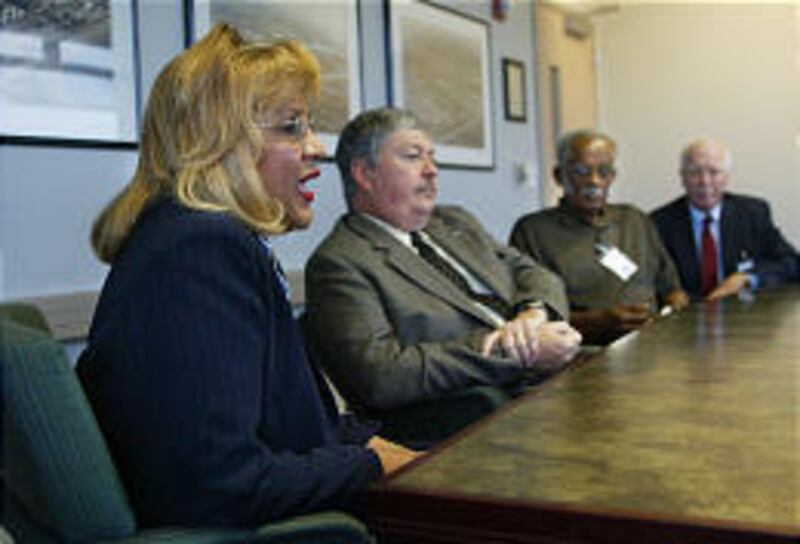
As do all petrochemical companies in the region, Huntsman also created a citizens advisory panel consisting of a diverse group of local leaders who offer suggestions. But the company actually acts on the recommendations, said Joe Hill, a retired Gulf Oil worker who lives near one Huntsman facility in Port Arthur, Texas.
"We make requests and they come back with results based on those requests," he said.
To appreciate how far it has come, they say, you have to understand the long and stormy relationship the region has had with big oil, which fostered an "us against them" mentality. The Huntsmans have turned that around.
"Trust is one of the most important things the family has done for us," said Jefferson County Commissioner Waymon Hallmark.
And in a region where the industry owners are seen as Yankee outsiders, the Huntsmans are seen as part of the community. "People see a family, not a board of directors," Hallmark said.
"This is truly a family-run company," said Peter Huntsman. "Our name is on the door."
E-MAIL: spang@desnews.com; bbjr@desnews.com