

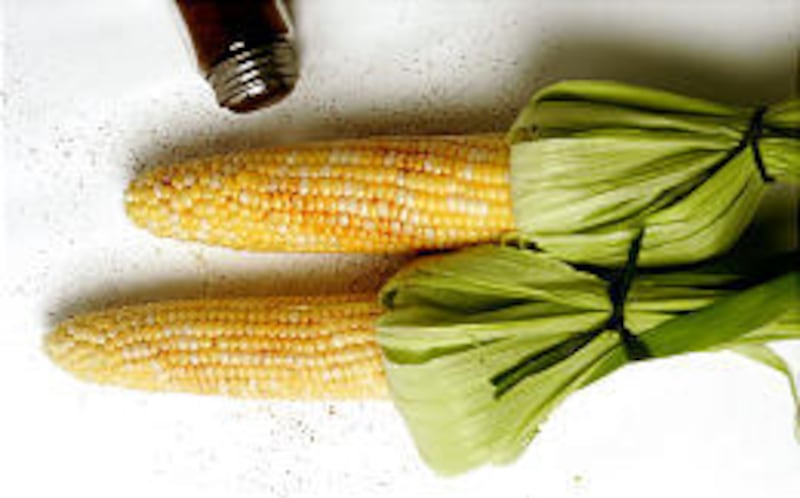

Corn on the cob for dinner . . . again??
Around this time of year, there's no need to feel sheepish about serving fresh corn so often. With only a few short months to enjoy it, you may as well take advantage while the season lasts. Why settle for carrot sticks or frozen peas that you can get year-round?
When it comes to corn, "maize" remains the chosen term of historians and botanists. According to "The Gourmet Atlas," the term "corn" refers to the grain most common in a given region, such as wheat in England, oats in Ireland or maize in America. That answers the question of how the Pharaoh of Egypt dreamed about seven fat ears of corn in the Bible, if corn as we know it is native to America and thus wouldn't have been around in ancient Egypt. The "corn" in the biblical story is actually wheat, according to "A Biblical Feast: Foods From the Holy Land," by Kitty Morse.
Corn — maize — whatever, is the only grain native to North America, and it's really a giant grass. Columbus found the native Americans using this new grain much the way Europeans used wheat.
Today, it's second only to rice in tons of grain harvested worldwide. In the United States, the corn crop is equal to the combined harvest of wheat, barley, oats, rice and millet, according to "The Gourmet Atlas." Of course, a large proportion is grown for animal feed.
Corn is high in fiber and carbohydrates, and a fair source of vitamin A, according to "The Nutrition Bible," by Jean Deskins. It also contains traces of iron, vitamin C and some of the B vitamins. It's low in fat — until slathered with butter, of course.
Much of today's corn has been crossbred to make it sweeter than that of yesteryear. The sugar in most old-fashioned corn converted into starch soon after picking, so you'd end up with tough, starchy kernels if you didn't cook it right away.
A few farmers across the country, like John Borski of Kaysville, still grow "heirloom" corn that hasn't been crossbred. Silver Queen is a variety that's been around for many years and was improved by isolating it while growing and saving the seeds from year to year, Borski said.
"It's one of the few types you can find on the market that hasn't been hybridized," Borski said. It has a creamy color and is naturally sweeter than the old-style yellow starchy corn, which Borski and other farmers now call "Old Yeller."
"They cross-bred corn to improve the sugar content and tenderness, so much that it nearly melts in your mouth," he said. "The modern hybrids have been crossed with sugar cane and all kinds of other hybrids; it's almost mind-boggling when you hear about it."
The sooner corn is cooked after harvesting, the better. When buying, look for bright-green husks and plump, almost translucent kernels. If the kernels have a dented-in look, the corn is older or has lost moisture in storage, and it will taste dry and starchy. But be considerate of other shoppers — don't paw through the pile of corn and pull down the husks of every ear. The husk protects the kernels from losing moisture, and exposed kernels will soon get the dry, dented look. This is why it's best not to buy corn that's already husked, even though it's more convenient.
If you can't eat it the day you buy it, refrigerate it without shucking, or removing the husks. Although it's probably the biggest deterrent to cooking corn, shucking only takes 20 or 30 seconds per ear. Stand over to your kitchen garbage can to catch stray leaves and silk strands. Start at the top and firmly strip the husks downward, grabbing the silk strands as you go. Snap the husk and stem off at the bottom. Pull off any remaining silk strands. Cut away any wormy or blemished kernels and rinse under cold water.
Like watermelon, corn-on-the-cob is a summer tradition that can get messy. Some folks chomp across the cob, typewriter-fashion. Others end up with butter dripping off their nose or chin. In polite company, is there a more elegant way?
"Fresh corn on the cob will most likely be served at informal gatherings and can be broken in half to make it easier to handle," writes Rochelle Udell in her etiquette book, "How to Eat an Artichoke." "The key to eating it is not to butter or season too much at once. Whether to eat across the cob or around it is a matter of personal choice; either method will work. Focus on only a few rows or a section at once —buttering, salting, eating — and then repeat. This keeps the mess on your hands and face to a minimum."
Accessories like cob holders (also known as "corn-stabbers" in some households) and individual platters make corn-eating less messy. And don't butter your corn by rolling it around in the butter dish! As you would with rolls or bread, take a pat with a butter knife to spread on your corn.
Several orthodontist brochures advise cutting the corn off the cob before eating, to avoid damaging braces.
Flavored butter and other toppings can help perk up your corn palate.
"Perfect Vegetables" gives a recipe for soy-honey glazed corn, which is a familiar sight in summer fairs in Japan.
Or mix your favorite herbs or spices (such as basil, thyme, cilantro, parsley or chives) with butter and brush it on the corn. Or mold the butter into little pats and place on a serving dish alongside the corn. As a general guideline, use about 2 tablespoons of chopped fresh herbs to 1/2 cup (1 stick) of butter. A quick way to chop fresh herbs is to place the leaves in a cup and then snip with kitchen shears.
The August 2004 issue of Martha Stewart Living shows ears of corn wrapped in bacon strips, then wrapped back up in the husk before grilling
So, play it by ear — experiment with seasonings.
DILL BUTTER
1/2 cup (1 stick) butter, softened
2 teaspoons dried dill weed
2 teaspoons chives, chopped
1/2 teaspoon salt
1/4 teaspoon pepper
Mix together and brush on cooked corn.
BASIL-CHIVE BUTTER
1/2 cup (1 stick) butter, softened
2 tablespoons chopped basil
1 tablespoon chopped chives
1/2 teaspoon salt
1/4 teaspoon pepper
Mix together and brush on cooked corn.
ROASTED GARLIC AND HERB BUTTER
10 medium cloves garlic, skins left on
6 tablespoons unsalted butter, softened
1 tablespoon minced fresh parsley leaves
1 tablespoon minced fresh basil leaves
1/8 teaspoon ground black pepper
Toast the garlic cloves in a small skillet over medium-high heat, shaking the pan occasionally until the garlic becomes fragrant and the skins are golden brown, about 5 minutes. Transfer the toasted garlic cloves to a cutting board. When the cloves are cool enough to handle, skin and press or mince the cloves. Using a fork, beat the butter in a small bowl until light and fluffy. Beat in the garlic, herbs and pepper until thoroughly combined. Makes enough to butter 8 ears of corn.
—"Perfect Vegetables" by the editors of Cook's Illustrated
LIME-CILANTRO BUTTER
6 tablespoons unsalted butter, softened
1 1/2 teaspoons grated zest from 1 lime
1 tablespoon minced fresh cilantro leaves
Pinch cayenne pepper
Using a fork, beat the butter in a small bowl until light and fluffy. Beat in the lime zest, cilantro and cayenne until well-combined.
—"Perfect Vegetables" by the editors of Cook's Illustrated
ROSEMARY BUTTER
1/2 cup (1 stick) butter, softened
2 tablespoons chopped rosemary
1 tablespoon chopped chives
1/2 teaspoon salt
1/4 teaspoon pepper
Mix together and brush on cooked corn.
CURRY BUTTER
1/2 cup butter, softened
2 teaspoons curry powder
1/2 teaspoon salt
Mix together and brush on cooked corn.
SOY-HONEY GLAZED CORN
1/3 cup honey
1/3 cup soy sauce
8 fresh ears of cooked corn
Mix honey and soy sauce in a 10-inch skillet. Simmer over medium-high heat. Reduce heat to medium and simmer until slightly syrupy and reduce to about 1/2 cup, about 5 minutes. Turn off the heat and set aside.
Using tongs, take each ear of corn and roll it in the soy mixture. Place the glazed corn on a medium-hot grill for 1-2 minutes, turning once. Serve immediately.
— Adapted from "Perfect Vegetables," by the editors of Cook's Illustrated
GRILLED CORN WITH SPICY CHILI BUTTER
6 tablespoons unsalted butter
2 medium cloves garlic, minced or pressed through a garlic press
1 teaspoon chili powder
1/2 teaspoon ground cumin
1/2 teaspoon paprika
1/4 teaspoon cayenne pepper
8 ears fresh corn
1 lime, cut into 8 wedges
Salt to taste
Melt the butter in a 10-inch skillet over medium heat. When the foaming subsides, add the garlic, chili powder, cumin, paprika and cayenne. Cook until fragrant, about 1 minute. Turn off the heat and set aside.
Pull away most of the corn's husks, down to the last layer. Grill the corn over a medium-hot fire (you should be able to hold your hand 5 inches above the cooking grate for 3 to 4 seconds) turning the ears every 1 1/2 to 2 minutes, until the dark outlines of the kernels show through the husk and the husk is charred and beginning to peel away from the tip to expose some kernels, 8 to 10 minutes.
Transfer the corn to a platter. Carefully remove and discard the charred husks and silk. Using tongs, take each ear of corn and roll it in the butter mixture. Serve immediately, with lime wedges and salt to taste.
—"Adapted from "Perfect Vegetables," by the editors of Cook's Illustrated
E-mail: vphillips@desnews.com