


Fewer big deer, more young deer, thicker brush, more water and just about the same number of hunters. That's pretty much what is expected on the opening of the Utah general deer hunt.
The hunt will open at daybreak on Oct. 22. It will run anywhere from five to nine days, depending on the region a hunter chooses.
Overall, Utah's mule deer are in excellent shape. This past winter was kind to them and to the forests, which resulted in plenty of food and water.
As a result, there will be more yearling and two-point bucks roaming the mountains on opening weekend.
There will be fewer larger bucks seen in the central and northeastern regions. The simple explanation is that hunters did too well last year. There were more deer 3 1/2 years or older harvested than is typical.
"Heavy snow fell throughout much of the state right before the rifle hunt last year. The snow drove deer out of the higher elevations and right to the hunters. Those hunting in central and northeastern Utah took a lot of mature bucks," said Craig McLaughlin, big game coordinator for the Utah Division of Wildlife Resources.
Many of those mature bucks will be replaced by younger bucks this year.
"After four years of decline, the number of fawns per 100 does rebounded in 2003 and 2004," McLaughlin said. "During surveys this past March and April, biologists found an average of 70 fawns per 100 does across the state, so I think hunters will see good numbers of young bucks this fall."
There will be about 60,000 hunters afield, about the same number on the general rifle hunt since a cap on the number of deer tags issued was placed back in 1994.
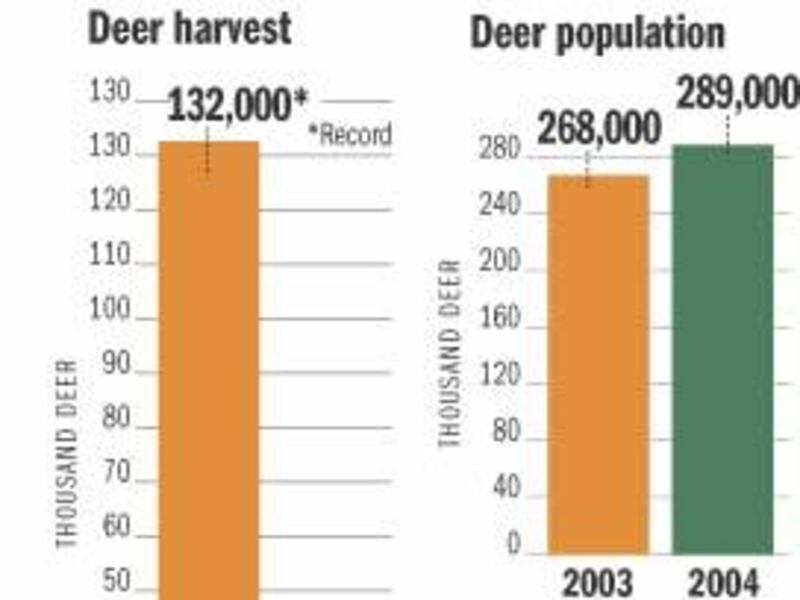
Based on surveys conducted after Utah's 2004 rifle hunt, DWR biologists estimate 289,000 deer were in Utah at the start of last winter. That's 21,000 more animals than the 268,000 deer estimated after the 2003 hunt.
"Unless snow falls between now and the start of the hunt, the deer will be scattered, which will make it more challenging for hunters to find them," he said. "Also, all of the vegetation that's in the backcountry this year will make it more difficult to spot deer."
McLaughlin encourages hunters to scout their hunting areas before the season opens.
"Scouting before the opener will pay off because you'll learn the travel routes deer are taking in the area you'll be hunting," he said. "Also, if there have been any changes in areas that are open to hunting, you'll know about those changes in advance.
"If the weather turns cold, look for deer on sunny, south-facing slopes," McLaughlin said. "Unusually warm weather will keep deer in shaded areas with heavy cover."
As of Oct. 5, more than 2,000 Northern Region permits were still available for the hunt. Permits may be purchased at the DWR's Web site — wildlife.utah.gov — and at DWR offices and from more than 200 hunting-license agents in the state. Permits in the other four regions have been sold out.
"Last year, permits for the Northern Region sold out on the Wednesday before the hunt," said Judi Tutorow, wildlife licensing coordinator for the DWR. "They're selling at a faster pace this year. I would encourage hunters to buy their permit as soon as possible."
Hunters who purchase a permit at the Web site are reminded that it will take about a week for the permit to arrive in the mail. They need to buy permits far enough in advance that they will arrive before hunters leave for their hunt.
Following is a region-by-region look at deer-hunting prospects, prepared by the DWR:
Northern Region
Last year's heavy harvest of mature bucks may have fueled hunter anticipation this year.
"Last season was the best season I've seen in 12 years," said Scott McFarlane, Northern Region wildlife biologist.
Heavy snowfall, especially in Cache and Rich counties last winter, may affect hunter success this year, however.
"Hunters may see fewer young bucks as a result of the heavy winter, but before the snows fell, the three-year buck-to-doe average on the Cache and Box Elder units was 17 bucks per 100 does, which is among the best in the state," said Justin Dolling, Northern Region wildlife manager.
Deer-herd classification surveys conducted this past spring found that 90 percent of the fawns born on five of the seven deer units in spring 2004 made it through last winter. The Cache and Ogden units had just less than than 70 percent fawn survival.
Extensive habitat-restoration projects initiated within the past three years could make a difference in reducing deer loss during tough winters, such as the Cache unit experienced this past winter.
"Above-average moisture is really going to kick-start the habitat projects that are in place and should provide abundant forage for mule-deer populations across the region," Dolling said.
Weather conditions just before and during the rifle hunt will affect deer movement and concentrations. "With good forage and water supplies, deer may not be as concentrated as they have been in past years," said Phil Douglass, Northern Region conservation outreach manager.
To help hunters know where boundaries are with the various units, the DWR has posted maps in the Big Game section of the DWR Web site, wildlife.utah.gov.
For more information about the Northern Region, call 801-476-2740.
Central Region
Archery and muzzleloader hunters reported seeing decent numbers of bucks throughout the region this fall. They also reported a lot of younger bucks.
Some large mature bucks also have been taken thus far.
"Although the region's three-year buck-to-doe ratio is slightly under the 15-bucks-per-100-does objective, favorable habitat conditions should improve the ratio next year," said Scott Root, Central Region conservation outreach manager.
"Last spring, initial postwinter deer counts indicated excellent fawn production on the mountainous eastern half of the region, which has benefited the region's deer herd," he said. "With another favorable winter, this could put the eastern portions of the region right back to the buck-to-doe-ratio objective."
Root said the deer are in excellent health and antler growth has been good because of plentiful food and water sources.
"As predicted, deer are scattered because of the plentiful water and food found throughout most of the region," he said. "Scouting is crucial when deer are not tied to a single water source. Hunters need to look for well-used game trails and invest time on prehunting scouting trips to learn the habits of the deer this year."
Root noted the western portion of the Central Region, west of I-15, is mostly desert terrain.
"Though water is more abundant this year in the desert, this portion of the region has fewer deer, and I'd strongly recommend prehunt scouting trips," he said.
Most hunters concentrate on the Tintic, Deep Creek, Oquirrh and Stansbury mountain ranges, but pockets of deer can be found throughout the western portion of the region.
"Higher mountain elevations in the desert that have components of deer habitat generally attract deer and are a good place to hunt," he said.
The deer herd in the western portion of the region is rebuilding. "The current buck-to-doe ratio is below the management objective, but fawn production is the best it has been in this area for about four years," Roots said.
Hunters are reminded that a good portion of the western part of the region is part of the Vernon limited-entry deer unit, and general-deer-season hunters need to stay out. A boundary description is available in the 2005 Utah Big Game Proclamation.
For more information about the Central Region, call 801-491-5678.
Northeastern Region
The number of bucks in the Northeastern Region will be down slightly from last year, but hunters should find deer fat and healthy.
"I expect buck numbers to be down on the Currant Creek unit this year over previous years," Boyde Blackwell, Northeastern Region wildlife manager, said of one of the region's most popular areas. "We had a very good buck harvest last year compared to previous years. This has reduced the number of bucks available for this year."
Blackwell said hunters will notice a lot more vegetation in the region than during the past several years of drought. The increased vegetation will mean healthier and fatter deer this year. It also will encourage good deer-fawn production in 2006.
Blackwell said the abundant vegetation and watering holes will also scatter the deer, and he encourages hunters to do a lot of preseason scouting.
"Hunters need to get out into the areas they plan to hunt prior to the season," he said. "Water holes will not be scarce this year, so the animals should be spread out.
"Hunters should also look for escape cover near the areas where they find deer during their preseason scouting. Once the first shots are fired, the bucks will head for those secluded places. Sportsmen who do not scout their areas and learn the patterns the deer are following will likely be less successful than those who spend time in the field prior to the hunts."
In addition to preseason scouting, hunters are encouraged to know the hunt boundaries in the region.
"Check the boundaries and mark them on your map prior to hunting, especially if you're hunting an area you're not familiar with," said Ron Stewart, Northeastern Region conservation outreach manager.
For more information on the Northeastern Region, call 435-781-9453.
Southeastern Region
Rifle hunters should find more bucks in the Southeastern Region this year, said Bill Bates, region wildlife manager.
"Good fawn production in 2004 and good survival this past winter have strengthened herds across the region," he said. "Most units show both short- and long-term upward trends as far as the total number of deer in the herds."
While the number of deer is up in the region this year, all of southeastern Utah's deer herds are still under management objective as far as total number of deer. Bates said deer habitat in southeastern Utah faces a long road to recovery after years of drought, but aggressive habitat restoration work by the DWR and other agencies is beginning to pay off, thanks to normal rainfall during the 2005 growing season.
"If the weather returns to a normal pattern, the vegetation in the region will rebound and the deer herds should continue to grow," he said.
To improve their chances of bagging a buck, Bates encourages rifle hunters to scout before the season begins.
"Spend time observing deer in your prospective hunting area," Bates said. "Get to know where the animals feed, bed down and water. Develop a hunting strategy based on your observations. Try to anticipate changes in animal behavior due to hunter pressure and weather conditions."
For more information on the Southeastern Region, call 435-636-0260.
Southern Region
Rifle hunters should see more bucks in the Southern Region this year, thanks to favorable winter conditions and abundant spring moisture across the region.
"The Southern Region has had some very cooperative weather over the past few months, and there's a good crop of yearling mule deer in the region," said Lynn Chamberlain, region conservation outreach manager. "Combine those deer with a good contingent of 2-year-old bucks, and we expect hunters will enjoy a fair hunt in the region this year."
Chamberlain said the buck-to-doe ratio on the region's general-season units has climbed slightly to an average of 15 bucks per 100 does. The total number of deer in the region is still below management objective, but deer numbers have increased slightly over the past two years.
Chamberlain said the weather in southwestern Utah is cooling off, so hunters can expect to find deer scattered but moving from higher to lower elevations.
"Fire danger is extreme in most places, so hunters need to be careful with fire," he said.
For more information on the Southern Region, call 435-865-6100.
E-mail: grass@desnews.com