

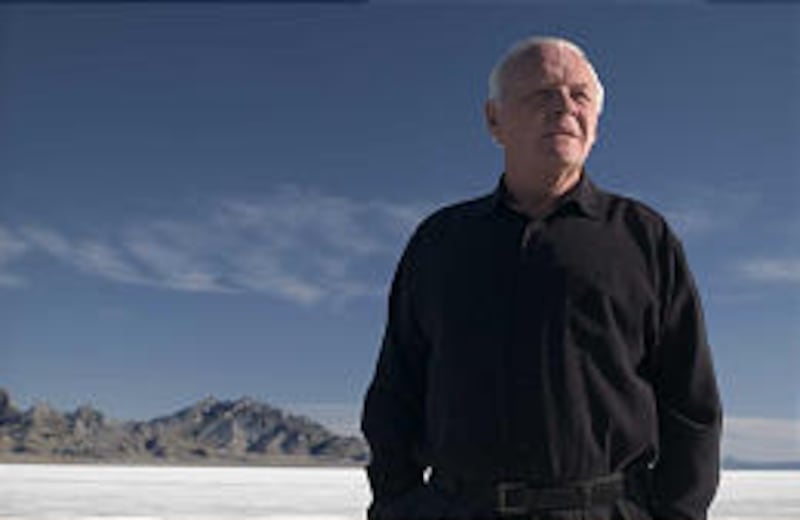
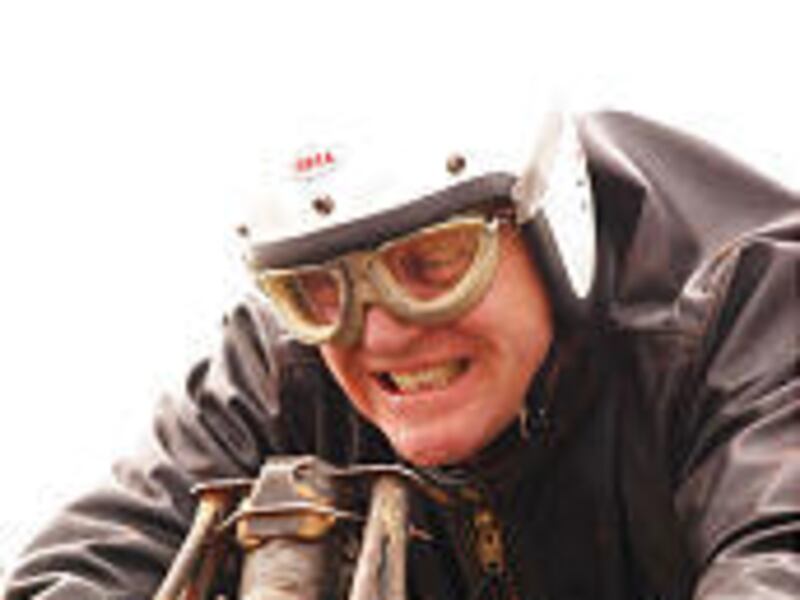
What's a 67-year-old man doing riding a modified 1920 Indian Scout motorcycle at speeds in excess of 200 miles per hour?
If that man is Anthony Hopkins, the answer is playing 72-year-old Bill Munro in "The World's Fastest Indian." In 1967, the plucky New Zealander broke the land-speed record for motorcycles. (The film is already playing in New Zealand and will open in New York and Los Angeles in early December to qualify for Oscar nominations, then go wider in February.)
"What I liked about him is that he seemed quite an open character," said Hopkins. "He had a wonderful philosophy of life. He thought he could live more in one minute on a motorbike than most people live in a lifetime. That was his passion."
The film was directed by Roger Donaldson, who worked with Hopkins on "The Bounty" (1984). Donaldson had been interested in Munro since 1971, when he made "Offerings to the God of Speed," a documentary about Munro. Hopkins saw that film, but says he didn't mimic Munro, although he did pick up on the man's way of searching for words.
Munro may have had to search for words, but not for goals. As portrayed in the film, he was a man who couldn't be deterred, even when others ridiculed him.
"I don't know where that quality comes from," said Hopkins. "It's like people who go sky diving. I can't get my head around the idea of anyone jumping out of a plane. I think it comes from a philosophy of 'nothing to win/nothing to lose.'
"I came to this crazy business of acting and jumped off the deep end. When I lose, it doesn't matter. Burt's was a more spectacular philosophy because he could have gotten killed."
"World's Fastest Indian" is not the 67-year-old Hopkins' first brush with speed. In the 1998 BBC film "Across the Lake," Hopkins played Donald Campbell, an engineer who set world water-speed records during the 1950s and 1960s.
"He was a much different character," said Hopkins. "He was a bitter man. He hated the press. He was angry, but brilliant and courageous. Burt wasn't at all self-destructive."
Still, it wasn't familiarity with a speedster that brought Hopkins to the role; it was Donaldson.
"He's a maverick director with a passion for things," said Hopkins. "He has tenacity. He loves adventure, and he loves cars and bikes.
"Roger and I didn't get on at all on 'The Bounty.' Twenty years later, we met up and we got on, and we've become good friends. We've both mellowed a bit, I suppose.
"But he's still a force to be reckoned with. He shoots lots of film (when he directs), but I went along with it this time. I thought, 'If this crazy Australian director believes in a film that doesn't sound very exciting on the page, I'll go along with it.'
"Twenty years ago, I was feisty, you know, an arrogant young actor, and I was impatient, as well. You get older and you think, 'They're paying me. May as well get on with it.'
"That change of heart came about 10 years ago. The only thing that rattles me now is when directors waste time, when they're walking around in circles and don't know what they're doing."
Shot in New Zealand and Utah's Bonneville Salt Flats, "World's Fastest Indian" calls for Munro to spend a fair amount of time on his bike.
"It's a killer on the back and neck," said Hopkins. "I didn't have to spend that much time on the bike; the stunt men did most of it. And I'd have long breaks in which I'd get a cup of coffee or do some exercise."
Hopkins, of course, has been in his share of major studio productions, and just about everyone knows that he's the man most responsible for putting Hannibal Lecter into the pop-cultural vocabulary. But the actor likes to wander off the beaten track with smaller productions: He has no desire to play things safe.
"This was done on a shoestring. They didn't have a distributor when they started. That's really guerrilla filmmaking. The big-budget movies are OK, but they take more time, and it's more difficult. With something like this, everyone pushes together."
Hopkins currently is working on "Bobby," directed by Emilio Estevez, and which reportedly deals with 22 people who were at the Ambassador Hotel in Los Angeles when Robert F. Kennedy was assassinated. It's another film in which the cast is pulling together; Hopkins describes the on-set atmosphere as "invigorating."
These days, Hopkins sounds like a man on a mission: He wants to work efficiently. "So much time can be wasted on film sets with people talking about things and fretting. . . . I say, 'Let's get on with it.' "
Robert Denerstein writes for the Rocky Mountain News in Denver.