

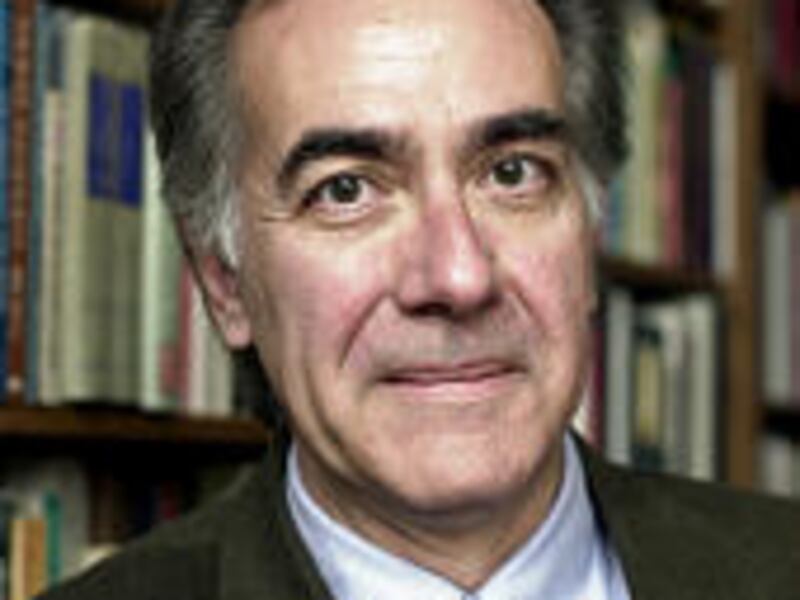
On Wednesday evening at the University of Utah, after he finished giving the keynote address for the "Hell and Its Afterlife" conference, Carlos Eire took questions from the audience. One man asked what viewpoint of God he was advocating.
"I'm not advocating anything," Eire answered. And, he continued, "I'm not claiming I saw God." The audience laughed. Eire added that he wasn't saying the Protestants were correct or that the Catholics were correct in their view of what happens after death.
Eire had just finished describing how the Protestant Reformation changed Western civilization forever, by challenging the Catholic concept of purgatory. He had summed up his talk with this conclusion: Because of Martin Luther and the Reformation, we moderns find ourselves feeling more closely related to monkeys than we do to God.
Eire is a professor of history and religious studies at Yale University. He has published numerous scholarly works and also won the National Book Award in 2003 for his memoir, "Waiting for Snow in Havana." In that book, Eire described growing up in Cuba, as the son of a judge, before the revolution. In 1962, when he was 11 years old, his parents sent him and his older brother to safety through the Pedro Pan refugee program. He spent the next three years in foster care in the United States, before his mother was able to leave Cuba and join her children.
Eire came to Utah this past week to deliver the U.'s annual Sterling M. McMurrin Lecture on Religion, presented through the Obert C. and Grace A. Tanner Humanities Center. Earlier on Wednesday, Eire had spoken with the Deseret Morning News about the way in which he teaches religious history without advocating for his own Catholicism.
"The funny thing is," he told the Deseret Morning News, "people bring their own baggage to class." He has often had students from the same class react in opposite ways. One student will say, "Since I took your class, I have decided I will never set foot in a church again." Another student will say, "Since I took your class, I have decided to become a Christian."
Religion is not logical in the same way that philosophy is logical, Eire believes. Religion has its own logic — and it always requires a leap of faith. He said people come to his class ready to leap or unwilling to leap, and their willingness has nothing to do with who their teacher is.
Eire knows other professors of the history of religion who are atheists and who have had students find God after taking their class. "When people begin to look closely at religion, they look at it through their own lens," Eire noted. Still, that doesn't stop students from being curious about what lens their professor might be using.
He tells his students they may ask him about his own beliefs when the semester is over. Later, when he tells them he is Catholic, they are often surprised, he said.
In his lecture he gave a brief history of Martin Luther's differences with the Catholic Church, including what Luther considered to be the "selling" of indulgences. Eire explained the practises of the 16th century church in fairly unromantic terms. (Give a donation to the church and a Mass will be said for your dead relative, which will hasten the progression of his soul from purgatory into heaven. Leave your property to the church when you die and the priests will say Masses for your soul for many years. And incidentally, you are going to need our help because no human — except for the occasional nun or priest — is sinless enough to go to heaven without first spending some painful time in purgatory getting his or her soul cleansed.)
Before the Reformation, all Christians lived in close contact with their dead relatives, Eire noted. The veil between purgatory and Earth was thin. Also, once the departed loved ones did make it to heaven, they were powerful friends to have, as unwavering allies on behalf of the living.
Protestants refused to believe in saints and purgatory. They described the dead as being far away and beyond the help of the living. They also said that visiting ghosts were actually apparitions from the devil. "The change in attitudes toward the dead is one of the largest paradigm shifts in Western history," Eire said. The topic hasn't been studied and discussed enough, he said.
He said there is another reason why he chose to talk about death when he came to Utah. Eire finds members of The Church of Jesus Christ of Latter-day Saints to be an exception in the modern world, because they do draw close to their departed relatives, through their genealogy work and through the ordinances they perform on behalf of those who have died.
E-mail: susan@desnews.com