

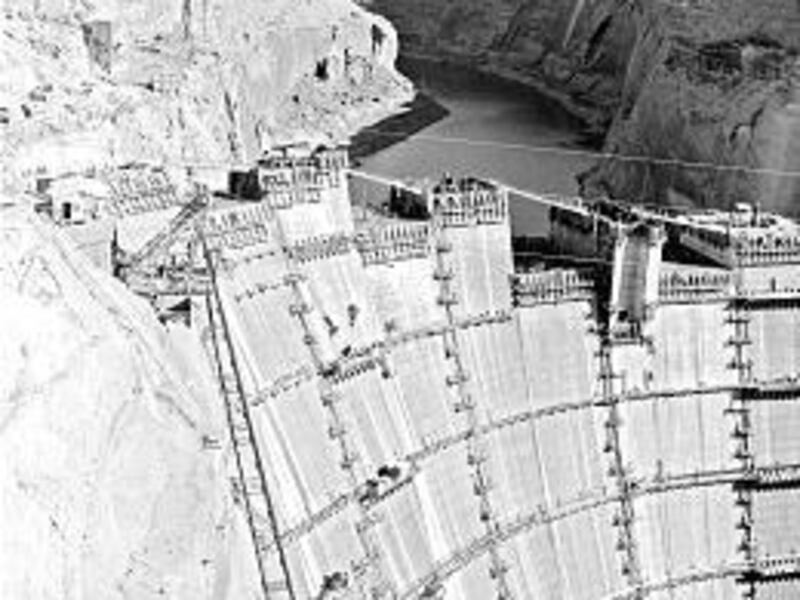

W.L. "Bud" Rusho liked Glen Canyon Dam. But while he worked to document the dam construction in the 1950s and early '60s, in his words, "I fell in love" with the amazing southern Utah canyon that the dam eventually drowned.
Last week Rusho released "Glen Canyon Remembered," a DVD that provides a haunting glimpse of the canyons that have been lost beneath the waters of Lake Powell. Running one hour, 10 minutes, with extras such as a historic film, the DVD is available at Ken Sanders Rare Books, 268 S. 200 East.
Besides the lore of the river and the beauty of the vanished canyons, the DVD provides stories about the massive archaeological salvage project that attempted to save some of the region's prehistoric treasures.
It describes the history of the region, including John Wesley Powell's two explorations; surveys for railroads and dam sites; the "discovery" of Rainbow Bridge, which had been known to Indians in the area; ill-fated gold dredging; river-running; early filmmaking in the canyon; and the mysterious disappearance of the young artist Everett Ruess.
A historian who lives in Holladay, Rusho has authored books about Ruess, who vanished in 1934 after leaving Escalante and heading toward Davis Gulch.
As a public affairs chief, Rusho headed a team of U.S. Bureau of Reclamation photographers recording the construction of Glen Canyon Dam near Page, Ariz. The dam was built between 1956 and 1964, with the first three years dedicated to excavating and shaping the site. This was followed by placing the concrete and building the power plant.
Rusho started his part of the project in 1958, and Lake Powell began filling in 1963.
"I followed the dam all the way through," he said. "It was very exciting. . . . It was a fascinating place to work."
He traveled up Glen Canyon and studied the history, and realized a strange disconnect: He admired both the dam and the natural habitat it was destined to destroy.
When Lake Powell was still quite low, a friend invited Rusho to visit the Crossing of the Fathers, where the Dominguez-Escalante expedition had cut steps in the slickrock in the 1770s. He was horrified by the thought that the lake would inundate the historic site.
"All of a sudden things came together," he recalled. He thought, "What have I done? What have I participated in? . . . It's terrible."
Rusho has preserved some of that history and natural beauty in "Glen Canyon Remembered."
Especially interesting from a scientific standpoint is his section on the Glen Canyon Salvage Project, which carried out archaeological excavations before the reservoir covered an estimated 2,000 ancient sites.
Under federal law, the Bureau of Reclamation paid for the salvage operation. The bureau passed money along to the National Park Service, he said, which contracted with the University of Utah and the Museum of Northern Arizona.
Under the leadership of the famous U. archaeologist Jesse Jennings, teams worked against the relentless rise of the lake water. They only tried to "salvage the principal things," Rusho said.
"There were 2,000 sites that they found under the level that would be covered by the lake. Now, all of those were not excavated." Only the most important could be dug. Of the rest, he said, "all of the archaeology is gone, just gone."
In February 2005, when the now-ended drought had caused a drastic drop in Lake Powell's waterline, Rusho returned to recently exposed sites. One was Hole in the Rock, a trail early pioneers cut in steep cliffs in order to reach the Colorado River.
"The bottom part of Hole in the Rock is eroded so badly that you can't imagine people taking their wagons down," he said.
He also visited Register Rock, where pioneers carved their names. The inscriptions were "quite visible before the lake came up, and now they're covered with scum and eroded away. We could identify a name or two, but that was about all."
Rusho visited the famed "Cathedral of the Desert," a huge lovely alcove with streaked desert varnish on the salmon-colored walls. In 2005, one end of the "cathedral" was exposed by the dropping lake waters.
It hardly looked the same, he said. "The vegetation was gone and the color was gone." The cliffs had been rendered drab by overlying sediments.
"I could recognize the shape," Rusho said, "but it wasn't the same."
His party tried to hike up Davis Gulch to see some petroglyphs, but "we were stopped by about 100 yards of quicksand. . . .
"That lake has really made a mess of Glen Canyon."
E-mail: bau@desnews.com