

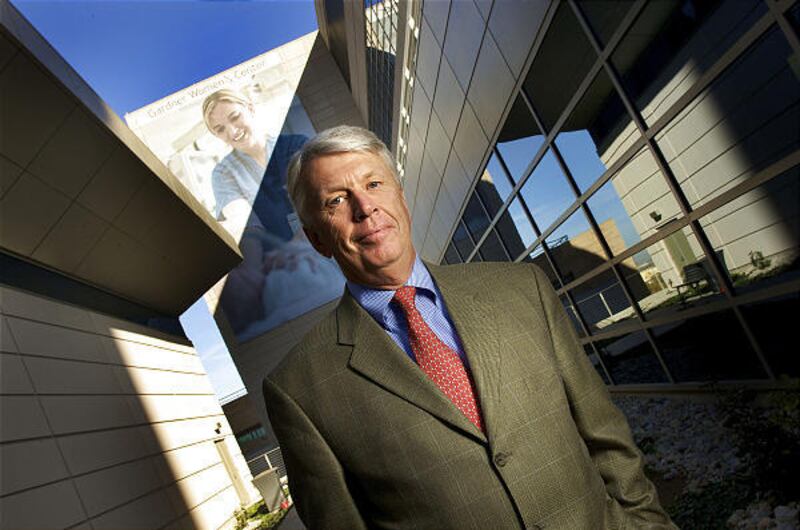

As he prepares to step down from the helm of Utah's largest health-care system, Intermountain Healthcare CEO William H. "Bill" Nelson notes that it's sappy to refer to Intermountain's role in the community as "noble and caring." Still, he calls it that all the time, he adds with a smile, because, well, "that's what we are. I am committed to the noble and caring nature of what we do."
He will retire in December after nine years as president and CEO, turning leadership over to Dr. Charles Sorenson.
Nelson is a somewhat accidental health-system executive. He was born in Cedar City, raised in California where surfing was a daily delight, and attended Brigham Young University, where he met his wife-to-be, Christine Miles. He earned his degree in accounting, then did graduate work at the University of Southern California, before serving an LDS Church mission to Italy. He also earned an MBA.
He became an accountant at Ernst & Ernst in Los Angeles, grabbed from the bullpen to do whatever needed to be done until one of the partners decided it might be a good idea to form a group that would deal exclusively with health care, which is complicated. He joined that team "because I liked the other people" who were part of it.
Four years later, Nelson started working on the accounts of The Church of Jesus Christ of Latter-day Saints, which was getting ready to divest itself of hospitals in Utah and Idaho. Nelson was assigned to the divestiture and moved to the accounting firm's Salt Lake office in 1974, where he worked closely with representatives from the church.
When the newly formed Intermountain Health Care (it has since changed the name to make Healthcare one word) needed a chief financial officer, he applied. And that began a long career with Intermountain that would take the young man, 29 when he came on board, to the pinnacle of the organization.
At the time, it was just a family-friendly decision. "I loved public accounting, but I was working 60-70 hours a week," he said. "The kids (he has eight) were asking where I was. This was an opportunity to get more control in my life, and I liked the people and organization (at Intermountain)."
Were he keeping score, he says, his career has had more high points than lows. He's received prestigious awards and Intermountain has been honored a number of times as an example of a well-run health-care system. Among his favorite honors is a national study that says if the care and cost in three areas — Rochester, N.Y.; Salt Lake City and Portland, Ore. — could be replicated nationwide, Americans would save $35 billion and the outcomes for patients would be significantly better.
Over the years, he's developed some definite ideas about what makes a health-care system work — and what reform ought to look like.
The industry faces huge challenges in terms of reform, he says. "All of us demand health care. We demand the best. And we demand it right away." While reform is needed, he adds, "I think the challenge is how to use the health-care system differently to balance the costs and the services we get."
Polls show that most people want health-care reform, he says. But ask if anyone's willing to pay $100 more a year to get it and the answer is no, someone else should pay that.
He believes the best reform would include a basic benefit plan and both incentives and penalties, depending on how one uses the system. It would break health-care services into several categories, providing coverage of preventive care and "ongoing logical stuff," including for the acute and necessary. Coverage would be different for services that are beneficial but not critical. And the entire cost of "lifestyle and convenience" care would be borne by the individual, he says.
"People are looking for the bad guys" in health-care cost and reform. "In reality, we're the bad guys, every one of us." Still, Utahns are lucky because they live in what he calls the "sweet spot" of health care: the highest quality and lowest cost in the country.
Intermountain has reduced variation, spending considerable time and resources finding the best practices and making them standard across cases. Practicing evidence-based medicine, with proven outcomes, makes both financial and medical sense, he says. So there are protocols and the result is health care he calls safer and more effective.
Nelson's quick to point out that he is not the idea guy. "My role is an enabler." Once the "brilliant thinkers" have come up with something, he makes it happen and "maybe sets priorities, too." He spends most of his time in meetings.
The lowest point in his tenure, he says, came when the Legislature considered removing Intermountain's tax-exempt status and formed a task force to examine health-care delivery in Utah, amid allegations that Intermountain was a monopoly. That also turned out to be one of the high points, he adds, after an independent consultant concluded that Utah was lucky to have Intermountain.
"It turned out wonderfully. The consultants' report said we are clearly a benefit to the community."
E-mail: lois@desnews.com