

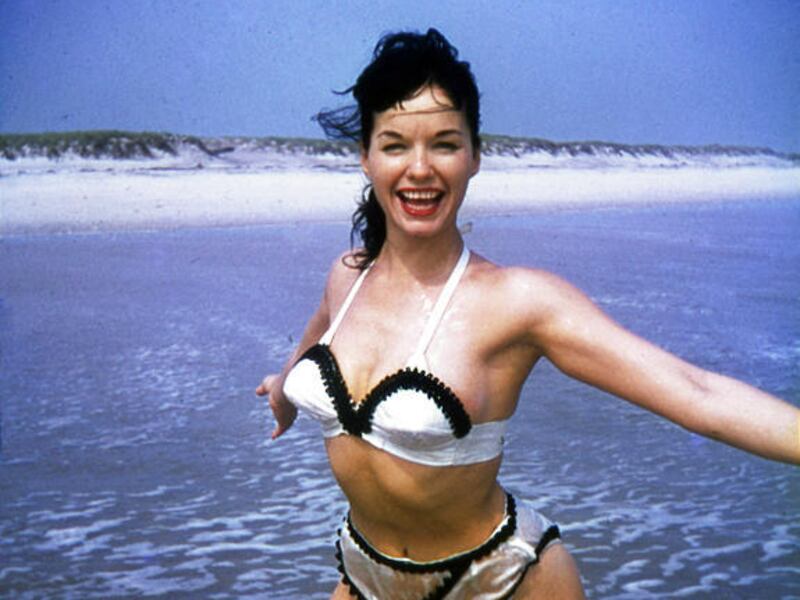
LOS ANGELES — Bettie Page, the brunet pinup queen with a shoulder-length pageboy hairdo and kitschy bangs whose saucy photos helped usher in the sexual revolution of the 1960s, has died. She was 85.
Page, whose later life was marked by depression, violent mood swings and several years in a state mental institution, died Thursday night at Los Angeles' Kindred Hospital, where she had been on life support since suffering a heart attack Dec. 2, according to her agent, Mark Roesler.
A cult figure, Page was most famous for the estimated 20,000 4-by-5-inch black-and-white glossy photographs taken by amateur shutterbugs from 1949 to 1957.
Decades later, those images inspired biographies, comic books, fan clubs, Web sites, commercial products — Bettie Page playing cards, dress-up magnet sets, action figures, Zippo lighters, shot glasses— and, in 2005, a film about her life and times, "The Notorious Bettie Page."
A religious woman in her later life, Page was mystified by her influence on modern popular culture. "I have no idea why I'm the only model who has had so much fame so long after quitting work," she said in an interview with the Los Angeles Times in 2006.
She had one request for that interview: that her face not be photographed.
"I want to be remembered," she said, "as I was when I was young and in my golden times."
Bettie Mae Page was born April 22, 1923, in Nashville, Tenn. She was the oldest girl among Roy and Edna Page's six children. Her parents divorced in 1933.
After high school, Page earned a teaching credential. But her career in the classroom was short-lived. "I couldn't control my students, especially the boys," she said.
She tried secretarial work and marriage. But by 1948, she had divorced a violent husband and fled to New York City, where she enrolled in acting classes.
She was noticed on the beach at Coney Island by New York police officer and amateur photographer Jerry Tibbs, who introduced her to camera clubs.
Page quickly became a sought-after model, attracting the attention of Irving Klaw and his sister, Paula. Her most professional photographs were taken in 1955 by fashion photographer Bunny Yeager.
At 35, Page walked away from it all. She quit modeling and moved to Florida, where she married and divorced.
In 1967, she married for a third time. After that marriage ended in divorce 11 years later, Page plunged into a depression marked by violent mood swings. She got into an argument with her landlady and attacked her with a knife. A judge found her innocent by reason of insanity but sentenced her to 10 years in a California mental institution.
She was released in 1992 from Patton State Hospital in San Bernardino County to find that she had unwittingly become a pop-culture icon. A movie titled "The Rocketeer" and the comic book that inspired it contained a Bettie-esque character, triggering a revival, among women as well as men, that continues unabated.
She spent most of her final years in a one-bedroom apartment, reading the Bible, listening to Christian and country tunes, and watching westerns on television.