


"Draw not nigh hither; put off thy shoes from off thy feet, for the place whereon thou standest is holy ground," said God to Moses in Exodus 3:5 on "the mountain of God, even to Horeb" (Exodus 3:1).
Today Christians primarily tend to associate sacred places with churches, temples, cathedrals, cemeteries or burial sites. But non-buildings and non-burial sites — particularly mountains — can be holy, sacred places, too.
While modern Christianity has tended to move away from the "holy ground" focus found in the Book of Exodus, Native Americans, like the Navajos and Utes, lead the way today in a strong belief of some mountains and natural formations being sacred. They believe they are divinely tied to the homeland and should deeply respect it.
"All of our sacred songs and prayers are here within our four sacred mountains (Blanca Peak in Colorado, Mount Taylor in New Mexico, the San Francisco Peaks in Arizona and Hesperus Peak in Colorado)," Mae Tso, a Navajo elder, stated on www.xpressweb.com/zionpark.
Tso also stated: "The teachings of our ancestors are here in our songs and prayers. These songs and prayers are part of the ceremonies; they are our teaching and our way of life. This is our religion. This is what connects us to the land. Here, we have always made our offerings to the spiritual beings. Here we are known by the spiritual beings. If we are relocated to the new lands, we would not be known, we could not do our ceremonies. This is our religion, our way of life. If you cut out a person's heart and take it away, the person would die. Our Creator placed us here on this land; we are part of Mother Earth's heart. If you take us away to another land, we will not survive."
Navajo Mountain (10,388-foot elevation) in San Juan County is another sacred Native American monolith, where access is restricted by outsiders. This high, rounded hump straddles the Utah-Arizona border, but it is almost completely in the Beehive State.
A mammoth mound of rock and sand as big as Mount Nebo, Navajo Mountain the area's most prominent landmark, rising almost 7,000 feet above Lake Powell in the Navajo Indian Reservation.
Navajo Mountain is so remote that's it's off the "radar screen" for most hikers and outdoor lovers.
Leo Manheimer, chapter president of the Navajo Mountain Chapter House, once told the Deseret News that it is very sacred to the tribe. "It's the highest point in the Navajo Nation boundaries," he said.
His advance permission, plus a backcountry permit and a compelling argument to backcountry office workers were required for three Deseret News staffers to visit the top of Navajo Mountain in September of 2003.
Sacred to most Navajos — including some who believe it shouldn't be climbed — this mountain in San Juan County is less than 3 miles from Rainbow Bridge, another sacred Indian site.
According to "Navajo Places: History, Legend and Landscape," by Laurane D. Linford, Navajo Mountain is "Naatsis'aan" — Head of the Earth. It refers to the head of the sacred female and pollen range of Navajo belief.
Indeed, some traditional Navajos believe that other geological features scattered over the region represent some of her other body parts. Black Mesa is her body, the Balakai Mesa her feet, Comb Ridge an arm, and another ridge the other arm. Agathia Peak and Tuba Butte are her breasts.
Rainbow has religious significance for the Utes and Paiutes, too, and in Navajo legend "is an arch of two beings (male and female) frozen in place," according to Linford's book.
At 309 feet high and 278 feet across, Rainbow Bridge is gigantic, but so many tourists go there that some Native Americans feel it is defiled and as such they have stopped performing any religious ceremonies there.
Still another sacred mountain is found to the east in southeastern Colorado, Ute Mountain (or sometimes referred to as "Ute Peak," or "Sleeping Ute Mountain." Resembling a sleeping Ute chief of legend, the 9,979-foot peak also resembles Utah's Mount Timpanogos, which has its own legend of appearing like a sleeping Indian princess.
Ute Mountain has many legends, but Utes believe it to be a deity who angrily collected rain clouds and storms come from clouds that escape his pockets. It is further believed the mountain will awake one day and fight enemies of the Utes.
Still another is the Shiprock pinnacle, an 1,800-foot-high volcanic plug in the northwest corner of New Mexico and visible throughout much of the Four Corners area.
Navajos believe its creation helped some of their ancestors escape their enemies and still used in certain Navajo sacred ceremonies.
The three San Francisco Peaks (Humphreys, Agassiz and Fremont Peaks) in northern Arizona are also sacred to Navajo creation mythology.
So strong still is the Indian belief in protecting the San Francisco Peaks, that in 2007 Navajos wanted to prohibit artificial snowmaking at the Arizona Ski Bowl resort there, because they felt the unnatural process would defile the sacred mountain, because it used reclaimed waste water, which they considered impure for the holy mountain. They lost that court battle, but their sacred beliefs remain.
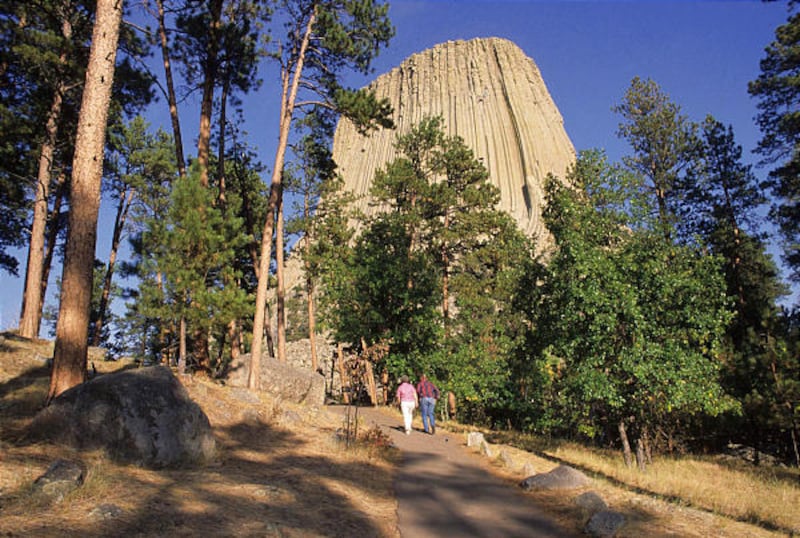
Devil's Tower National Monument in Wyoming is yet another highly prominent monolith that is sacred. The Shoshone, Arapaho, Cheyenne, Crow, Kiowa, and Lakota are among the tribes that consider the tower holy.
Even The Church of Jesus Christ of Latter-day Saints has what could be considered its own holy mountain of sorts, north of Salt Lake City. Ensign Peak is perhaps Utah's most sacred mountain — kind of the state's own version of Mount Sinai.
At an elevation of 5,414 feet, this mound-shaped peak located behind the Utah State Capitol is only about 1,100 feet above the city streets — far lower than most other Wasatch Mountain peaks. However, no other Utah mountain probably has a more significant religious history.
That's because this was the first peak in the valley the pioneers climbed; it was also used as an outdoor temple until the Endowment House was finished, and President Brigham Young had a vision of Joseph Smith, who showed him the mountain that we now call Ensign Peak. This vision was prior to the pioneer trek, and it showed there was an ensign that fell upon that peak, and Joseph said, "Build under that point where the colors fall and you will prosper and have peace. "
The Hill Cumorah, near Palmyra, N.Y., is yet another sacred Mormon hill, being the place where Latter-day Saints believe the Golden Plates were buried, which Joseph Smith translated into the Book of Mormon.
E-mail: lynn@desnews.com