



Many critics of The Church of Jesus Christ of Latter-day Saints claim the advent of the Internet and free access of information created their critical view of Mormonism. A new collection of early writings about the Book of Mormon, however, demonstrates that new technology isn't a prerequisite for attacking the church.
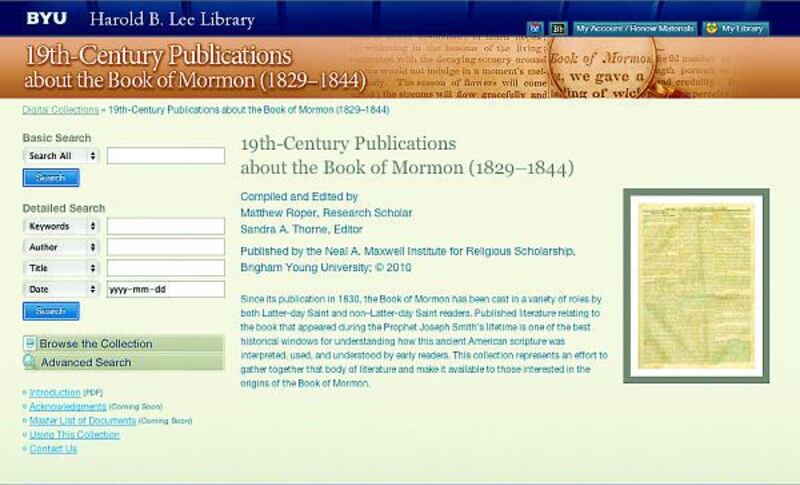
The Internet now has a tool that shows negative views of the Book of Mormon surfaced right at the beginning of the Restoration. A new collection titled "19th-Century Publications about the Book of Mormon (1829-1844)" is accessible online at lib.byu.edu/dlib/bompublications >>< lib.byu.edu/dlib/bompublications< as part of the Digital Collections at BYU's Harold B. Library. This database includes almost 600 publications and about one million words — all searchable by keywords. According to a press release from BYU, the goal was to include everything published during Joseph Smith's lifetime relating to the Book of Mormon.
The collection was jump-started by the pioneering work of Francis W. Kirkham>>&hideNav=1&sourceId=511005481ae6b010VgnVCM1000004d82620a____&locale=0< lds.org/ldsorg/v/index.jsp?vgnextoid=2354fccf2b7db010VgnVCM1000004d82620aRCRD<, the late author who wrote a book defending the Book of Mormon. Kirkham collected rare newspapers beginning in the 1930s. Matthew Roper, Research Scholar at the Neal A. Maxwell Institute for Religious Scholarship and head of the project, collected and assemble Kirkham's and other sources for more than 10 years.
The collection is searchable and provides the text and images of the relevant pages.
Browsing by date through the collection is like following the trail of rumors as articles are written and reprinted.
"The Wayne Sentinel," a newspaper in Palmyra, New York had this to say > >&REC=1 &CISOPTR=188< contentdm.lib.byu.edu/cdm4/document.php?CISOROOT=/BOMP< on June 26, 1829: "Just about in this particular region, for some time past, much speculation has existed, concerning a pretended discovery, through superhuman means, of an ancient record, of a religious and a divine nature and origin, written in ancient characters, impossible to be interpreted by any to whom the special gift has not been imparted by inspiration. It is generally known and spoken of as the "Golden Bible." Most people entertain an idea that the whole matter is the result of a gross imposition and a grosser superstition. It is pretended that it will be published as soon as the translation is completed." The paper then printed the text from the title page "as a curiosity."
On Aug. 31, 1829, news had reached the "Rochester Advertiser and Daily Telegraph," that reprinted an article >>&REC=6&CISOPTR=176< contentdm.lib.byu.edu/cdm4/document.php?CISOROOT=/BOMP< from the "Palmyra Freeman." It described the Book of Mormon as "The greatest piece of superstition that has ever come within our knowledge." It said that Martin Harris was both " an honest and industrious farmer of this town" and "blindly enthusiastic."
"The Reflector," another Palmyra paper, comforted its readers > >&REC=7&CISOPTR=182< contentdm.lib.byu.edu/cdm4/document.php?CISOROOT=/BOMP Sept. 2 that "Priestcraft is short lived." The Reflector's next article >>&REC=18&CISOPTR=310< contentdm.lib.byu.edu/cdm4/document.php?CISOROOT=/BOMP< on Jan. 2, 1830 gave a relatively positive review: "We are, however, prepared to state, that from a part of the first chapter, now before us, and which we this day publish, we cannot discover any thing treasonable, or which will have a tendency to subvert our liberties."
The "Rochester Daily Advertiser" trumpets "Blasphemy" in its headline > >&REC=1&CISOPTR=349< contentdm.lib.byu.edu/cdm4/document.php?CISOROOT=/BOMP< on April 2, 1830. "A viler imposition was never practised. It is an evidence of fraud, blasphemy and credulity, shocking to the Christian and moralist. The 'author and proprietor' is one 'Joseph Smith, jr.' — a fellow who, by some hocus pocus, acquired such an influence over a wealthy farmer of Wayne county, that the latter mortgaged his farm for $3000, which he paid for printing and binding 5000 copies of the blasphemous work."
On April 9, 1830, only three days after the LDS Church was organized, a letter to the editor > >&REC=11&CISOPTR=300< contentdm.lib.byu.edu/cdm4/document.php?CISOROOT=/BOMP< of The Reflector warns Hyrum Smith "and some of his ill-bred associates, not to be quite so impertinent, when decent folks denounce the imposition of the 'Gold-Bible' The anathemas of such ignorant wretches, although not feared, are not quite so well relished by some people — Apostles should keep cool." Unfortunately, Hyrum Smith's account of the alleged encounter doesn't survive.
Epithets abound in the newspapers such as "imposition and blasphemy," "credulous," "ignoramous," "pretended," "that spindle shanked ignoramus Jo Smith," "impudence," "one of the most ridiculous impostures, ever promulgated," "barefaced," "deception," "duped and led astray," "depraved,"
"Isn't it remarkable it's still an important book today?" Roper said in a phone interview. "How many books ... have become important when there was so much against it?"
Even though a friendly voice is hard to find, the earliest newspaper reports help give valuable information. For example, on May 15, 1830, "The Gem" Rochester, N.Y. newspaper mocked the names of the books in the Book of Mormon > >&REC=15&CISOPTR=232< contentdm.lib.byu.edu/cdm4/document.php?CISOROOT=/BOMP<: "(T)he books of Nephi, Nimshi, Pukei, and Buckeye." For modern scholars, this rhyme helps demonstrate the early pronunciation of "Nephi."
Throughout this all, Joseph Smith, Oliver Cowdery, Martin Harris and others attempted to clarify and correct. Their efforts are only glimpsed in a background of willful or negligent distortion, but they shine through like the sun in a grove of trees.
e-mail: mdegroote@desnews.com