

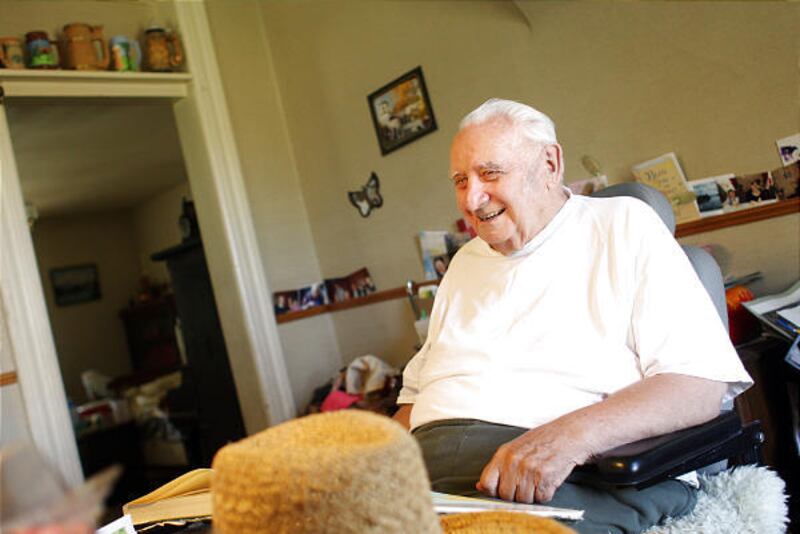
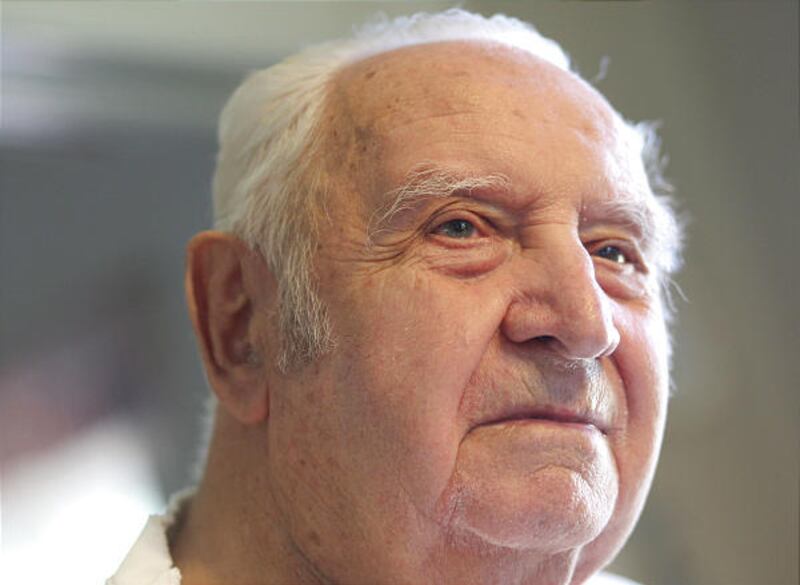
BOISE — Today, Helmut Yurke lives a quiet life in a house hidden by tall trees on a busy Boise street. Few of those who pass know it's there, let alone that its owner was once their sworn enemy.
When he was 17, Yurke was drafted into Adolf Hitler's army. He served in World War II under the famous "Desert Fox," Field Marshal Erwin Rommel. His unit repeatedly was attacked by Allied planes.
Today, Yurke is an American citizen and retired painter. Among other things, he painted buildings at Mountain Home Air Force Base — where pilots trained to attack Nazi forces.
He had no reservations about it, no mixed feelings. The former Private Yurke's Americanization — sown by Hitler's war and ripened by Cold War communism — couldn't have been more complete.
"This is my country," he said. "You'll never hear me say anything bad about America."
Yurke is one of roughly 100 one-time German soldiers estimated to be living in Idaho.
"It's not that unusual," said Ken Swanson, director of the Idaho Military History Museum. "The ones they really wanted to fight were the communists. Many who were captured and spent time in the states came back and became good citizens."
Yurke's story could have come from a World War II novel or Cold War movie. It began in his hometown of Gorlitz, near the Polish border. He grew up while Hitler was rising to power.
"We didn't think much of Hitler," he said. "He demanded absolute obedience. If you expressed an anti-Nazi opinion, you were sent to a concentration camp."
Yurke had little choice but to obey his draft summons. By age 18, he had finished basic training and made a fateful choice.
"They wanted 11 volunteers for Rommel's Africa Corps," he said. "I thought real fast. If I didn't volunteer, I'd go to the Russian Front. I'd seen a trainload of men who had frozen there, crying and screaming for pain medicine. I volunteered."
The 12th volunteer, Yurke got lucky when one of the 11 was rejected for wearing glasses. A month later, he was in Africa. He spent just less than a year there without being seriously injured, narrowly missing being killed by an exploding tower.
"I wasn't a coward, and I wasn't a hero," Yurke said. "I just did what was expected of a soldier."
All the German soldiers, he said, "had great respect for Rommel," who treated prisoners well, refused orders to kill Jewish soldiers and civilians and was a brilliant strategist. One of Yurke's most vivid war memories is of "burned-out American tanks for as far as you could see."
But the German cause in Africa was all but lost.
"Our officers told us it was hopeless and that we could try to get back to Germany if we wanted," Yurke said. "Some of us did, but the moment our trucks started moving, the British started shooting at us. We destroyed our weapons, told them we had nothing to fight with, and they told us to follow them to a POW camp."
Later, at an American prisoner-of-war camp near Casablanca, Yurke got his first taste of what life could be like in the United States.
"You could take a shower every day," he said. "We had American toilet paper. There was a modern kitchen, and the food was good. In the German army, we'd been nearly starved to death. I had to become a prisoner to get a good meal."
From there, Yurke and other German POWs were sent to camps in Alabama and New Jersey, where he learned English and worked in a cannery and glass factory.
"We were treated well," he said. "One of the camps even had a swimming pool."
When the war ended, Yurke was repatriated to Germany on one of the hundreds of Liberty ships built for the war effort. He settled in Wittenberg, where his mother and sister were living. The city had been occupied by Soviet troops and later became part of East Germany. It also was where he met his future wife, Helga.
Life under its communist regime was one of privation.
"Things went from bad to worse," Yurke said. "They used all the clothing for the army. You couldn't buy socks, shoes or pants. The army got everything."
"My parents struggled just to eat in East Germany," said Yurke's son, Otto. "They went to farmers' fields and picked up scrap potatoes."
After seven years, Yurke had had enough.
"We had a baby that I didn't want to grow up there," he said. "I said to Helga, 'Let's go. I know a better place.' "
With their valuables hidden in a baby cart, they took a train to Berlin. The Berlin Wall was yet to be built, but West Berlin was divided into British, American and French sectors. East Berlin was the Soviet sector.
"We escaped from East Germany by getting out in the American sector," Yurke said. "Right away, we applied to go to the U.S."
For Helga Yurke, who was leaving everything she knew, the decision wasn't difficult.
"I'd have followed Helmut anywhere," she said. "I was willing and able."
The paperwork took three years. When it was approved, Helmut Yurke told his wife that for the rest of her life, her birthday would be on a holiday. She was born on the Fourth of July.
They came to Idaho, where a church group had found them a sponsor, in 1956.
"They still feel fortunate to be here," said their son, Bernard, a research professor at Boise State University. "They love America."
Helmut Yurke worked a year as a well driller and six at Emmett's Boise Cascade sawmill before becoming a painter. Now 87, he's never stopped being thankful for the opportunities that brought him here.
"We've been back to Germany to visit, but this is home," he said. "It's still the number one country in the world."