


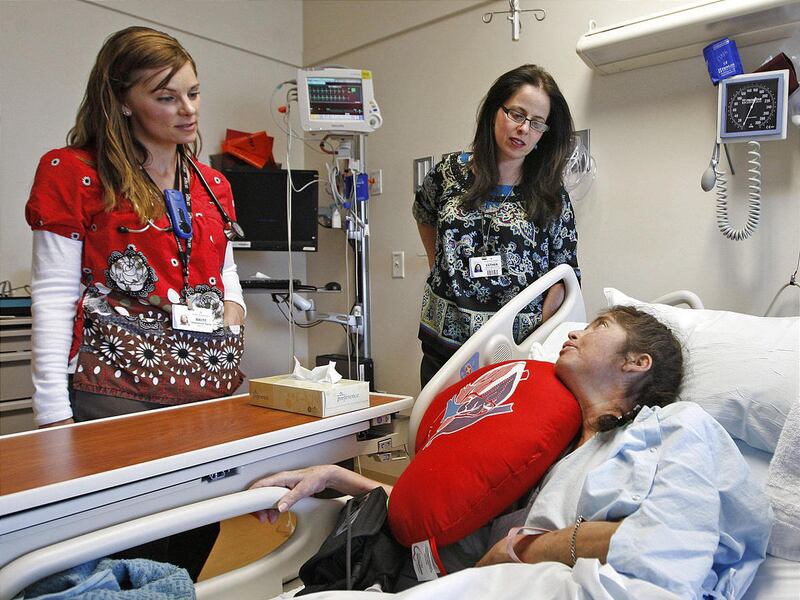

SALT LAKE CITY — As the population of the greater Salt Lake Valley continues to grow more diverse, local hospitals and clinics are finding the need to provide a wider base of interpretation and translation services to patrons and patients alike.
While some languages, such as Burmese and Tinka (Sudanese) still linger on the outskirts, others, like Spanish, Russian and even Bosnian and Vietnamese, are needed on a daily basis within the region.
"In the last 10 years, the demographics in Utah have changed drastically," Angela Outzen, director of interpretation services at Intermountain Healthcare, said last week. With the growing Hispanic population — which now makes up 12 percent of the city's population, according to the latest census data — it is necessary to employ at least 14 full-time medical interpreters who are highly proficient in Spanish and English, to be on-site at any one of five Intermountain facilities in the Urban Central Region at any given time, she said.
MountainStar Healthcare's Timpanogos Regional Hospital used to ask newly hired employees to disclose whether they spoke languages other than English, and spokeswoman Audrey Glasby said so many were "more than willing to help out when they were needed."
But she said MountainStar is moving to a video conferencing system with contracted interpreters to provide more professional care.
With the available and growing base of returned missionaries in the area, Glasby said the hospital was able to satisfy a large number of foreign language interpretation requests with the on-hand experience of employees, but the medical terminology is sometimes too complex.
"They've returned from missions to multiple countries around the world and they are able to step in on a pretty immediate basis," she said. Contracting with other agencies will increase the language base even more and not rely on employees as much for interpretation services.
Intermountain has more than 50 qualified bilingual employees who help to offer interpretation services in the top 10 requested languages: Russian, Vietnamese, Bosnian, American Sign Language, Chinese-Cantonese, Mandarin Chinese, Tongan, Farsi, Arabic, and southeast Asian languages including Laotian and Khmer (Cambodian). Bilingual doctors and nurses are also utilized at times for their language experience.
Outzen said employees who help are required to participate in extensive and rigorous training.
For the remainder of needed interpretation services, which are free to patients, both the MountainStar and Intermountain network hospitals contract with outside interpretation agencies, locally and out of state.
"It is a reflection of the diverse population of Salt Lake Cityto have so many proficient language speakers," Outzen said, adding that the size of the city limits the number of full-time interpreters they can hire. She'd like to have more in-house interpreters because those on the phone cannot provide further explanation and can only relay spoken communication.
Under the Civil Rights Act of 1964, any agency that accepts federal funding is required to provide access to language options to all customers. Title VI of the act was amended in 2001 to include medical facilities.
The law can be satisfied in a variety of ways, including full-time interpreters available in-person or over the phone, qualified bilingual employees and providers, as well as community volunteers. But Outzen said each participant is heavily tested and must go through a rigorous and extensive training program for medical interpretation, which is sometimes very specialized.
The best interpreter candidates need to know medical terminology in both the target and the source languages, should have some formal education, experience in health care and exhibit advanced language proficiency in the two languages, as well as have some customer service skills and be able to work well with others.
The on-site staff at Intermountain facilities also assist with coordinating service providers for up to 80 different languages, as patients present the need. Last year, Intermountain Healthcare provided interpretation assistance during 25,188 visits at the Intermountain Medical Center, LDS Hospital, Alta View Hospital, Riverton Hospital and The Orthopedic Specialty Hospital.
Hospitals are not required to provide written translation in most cases, but having access to interpretation services for verbal communication between providers and patients helps to facilitate better outcomes, Outzen said.
Many tongues
Languages offered for interpretation services (most common are bolded) within Intermountain Healthcare's Urban Central Region (greater Salt Lake Valley) of hospitals and clinics:
American Sign Language, Aklan, Albanian, Amharic, Arabic, Armenian, Assyrian, Basque, Bambara, Bengali, Bhojpuri, Bosnian, Bulgarian, Burmese, Cambodian, Cantonese, Chaochow, Croatian, Czech, Danish, Dari, Dutch, Estonian, Farsi, Fijian, Finnish, French, Fukienese, German, Greek, Gujarati, Haitian Creole, Hebrew, Hindi, Hmong, Hungarian, Indonesian, Italian, Japanese, Karen, Korean, Kurdish, Laotian, Lithuanian, Malayan, Macedonian, Mandarin, Navajo, Nepali, Norwegian, Paiute, Pashto, Polish, Portuguese, Punjabi, Romanian, Russian, Samoan, Serbian, Somali, Somali May, Spanish, Swahili, Swedish, Tagalog, Taiwanese, Tamil, Thai, Tibetan, Tigrinya, Tongan, Turkish, Ukranian, Urdu, Vietnamese, Yoruba
Email: wleonard@desnews.com. Twitter: wendyleonards