

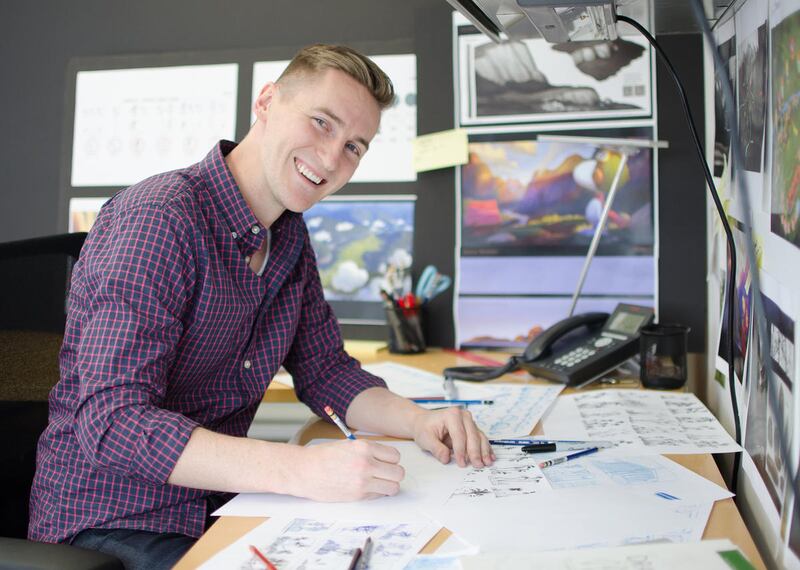
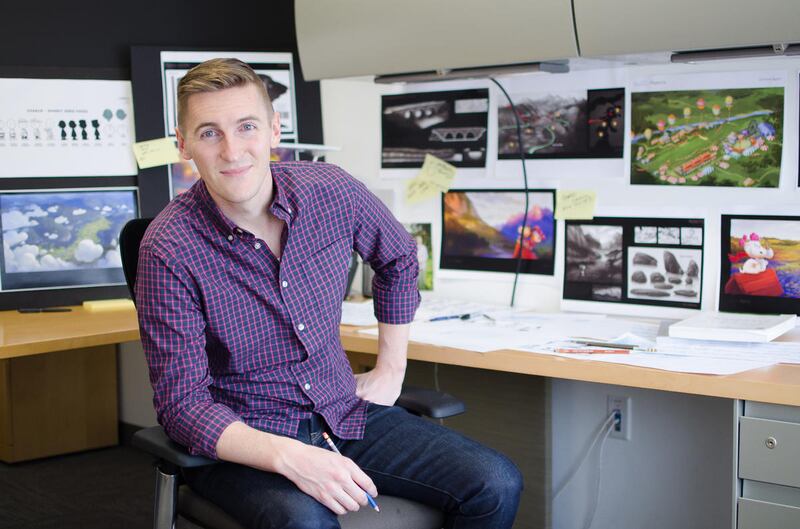
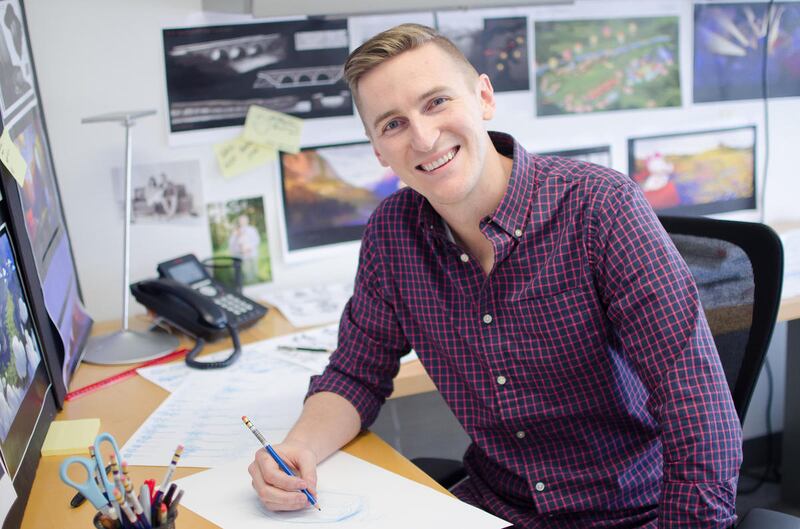





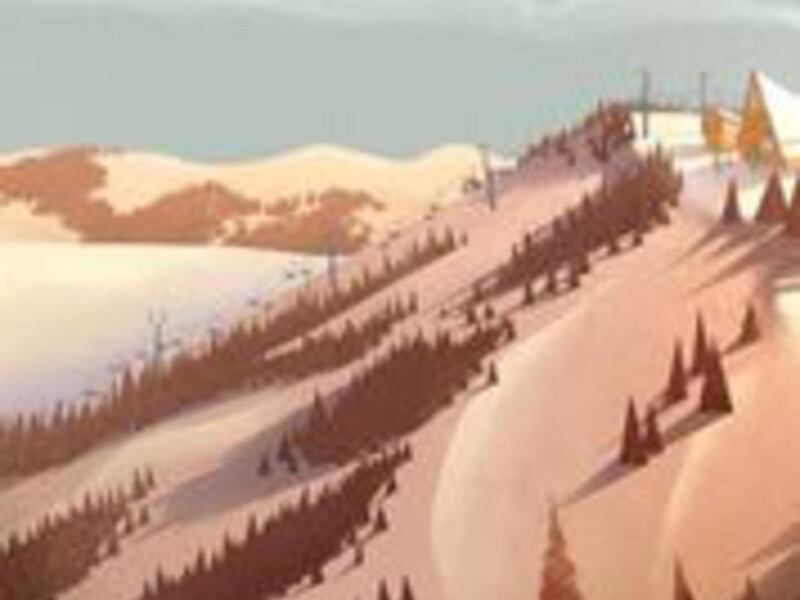



Tyler Carter, the young artist from Sandy and Brigham Young University, helps design and draw feature-length animated movies for a living. You can see his latest work in the new “Peanuts” movie.
None of the above will be a surprise to his former teachers at Lone Peak Elementary, who remember him as the child whose worksheets were turned in with extracurricular drawings around the entire perimeter of the assignment — math problems surrounded by the animal kingdom.
Carter could draw and listen to a teacher’s lecture simultaneously, which is probably why teachers encouraged his art rather than shut it down. Sometimes they found their own lectures converted into drawings, including, at the end of a science class, an elaborate pipe system that showed gas dripping out of a pipe, falling into a pan over a flame, and smoke rising from the pan into a balloon, which rises into the sky. Later, his doodling consisted of cartoon flipbooks, a precursor to his future career.
“I have always been able to concentrate better when I’m drawing,” he says.
His art was already so good that it was too good. He was once disqualified from a school Reflections contest because the judges decided his parents must’ve done it for him.
So here he is now, drawing for Blue Sky Studios, a 20th Century Fox film company based in New York City and one of the four major animated feature filmmakers (along with Disney, DreamWorks and Pixar). Carter, who was hired by Blue Sky shortly before graduating from BYU in 2011, has been a major contributor on several big Blue Sky productions: “Ice Age 4,” “Epic” and “Peanuts.”
“Oh, man, I am so grateful for my job,” he says. “There are so many talented people out there. …”
Carter works in the visual development side of a highly collaborative art form. He is part of a group of artists who design and draw characters, props, poses, scenes and everything else you see in a movie, as well as determine the colors that will be used for various scenes and characters.
In simpler terms, he’s a sketch artist. Anything you see on the screen has to be envisioned, created and drawn by Carter and his co-workers. It’s exhaustive work. On most days Carter’s desk is buried under stacks of paper consisting of hundreds of drawings, each one an iteration of largely the same thing in his quest to get, say, the right shape or the right look of a character's face and so forth.
“The heart of the movie should be the story,” he explains. “That’s what drives it. It has to be supported by the design and art, especially the characters. For instance, you strive for certain shapes for the protagonist and certain shapes for the antagonist, so that when you see it you have an emotional reaction.”
Once he finds exactly what he is looking for in a character, Carter makes hundreds of other drawings of the character from different angles and in different poses. Once he achieves that, he scans the drawings into a computer and refines his work, which requires hundreds of iterations as well.
His work also includes conceptions and renderings of the scenery. For “Peanuts,” he had to envision and draw a valley in France, including a view from the sky and a view from the ground that featured a bridge, a village, trees, rocks, houses, etc.
It’s meticulous, nuanced work. As Carter tells it, “You have to nail the design. If you don’t hit it in the design stage, it won’t get done down the road (as the movie progresses in production).” As an example, he says this about one of his biggest challenges: “It’s really easy to make something look creepy, but it’s really difficult to make something cute, adorable and endearing. That’s what we’re paid to do: Make everything beautiful and appealing. ”
No wonder animated movies are a lengthy endeavor. Carter is usually working on a movie two to three years before it is released in the theater. He’s working on a project now that will be released in 2018 or 2019.
Animated feature films are a difficult market to crack for an aspiring artist, there being relatively few companies that make them and relatively few feature films being made. Carter knew the odds were stacked against him even when his talent for drawing was apparent to teachers and family. His mother, Kay, once told him, “Wouldn’t it be cool if you could work for Disney someday?” Carter says, “I couldn’t bridge that thought and reality.”
As a senior at Alta High, he won the state’s Sterling Scholar Award in visual arts. He also was a captain of the school’s soccer team, although he did most of his “captaining” leaning on crutches on the sideline. He broke one foot before the season started. When it healed, he kicked the game-winning goal in his first return to action, but the next game he broke the other foot and that was that.
It was his father, Scott, who learned about BYU’s animation program and urged him to look into it. He learned that a number of BYU students had been hired by Disney and Pixar (mostly in the technical end of the business). "That’s the first time I thought, 'OK, this could be a real job opportunity,'" he says.
After serving a two-year mission for The Church of Jesus Christ of Latter-day Saints, Carter enrolled at BYU. He taught Spanish in the Missionary Training Center and took general-studies courses while he worked up the courage to build a portfolio for application to the animation department. Eleven months later he was working for Disney in California.
Before that happened, he took an introductory animation class. He quickly realized his work needed a lot of improvement, but he had only two months to turn in his portfolio. Drawing on the discipline and hard work of his experience in high school athletics, he turned to repetition and long hours to improve his craft, focusing on certain elements each time he drew — color, anatomy, perspective.
“I worked hard to create a portfolio with figure drawings and work on student films, but when the class was finished, I just wasn’t sure if I should apply,” he says. He applied anyway and was accepted into the animation program in early May. He immediately began to apply for an internship. He was rejected by Disney Avalanche in Salt Lake City — a subsidiary of Disney — and Pixar (he suspects his interview with the latter probably doomed his chances there — he thought it was an April Fools' prank call from his roommates. “That didn’t go well,” he says. “But who calls on April Fools' (Day)?”).
To his surprise, he received a call from Disney Animation offering him a summer internship. While there, he did some supporting work on “Bolt,” a 2008 release. The following summer Carter won an internship with Pixar and worked on “Cars 2” and “Toy Story 3.” Says Carter, “I didn’t do important stuff, but I got to work on those films and it was exciting.”
When he returned to BYU to complete his degree, he started a personal film project he named “DreamGiver.” Fellow students — nearly 50 strong — rallied around him to complete the project. It won a student Emmy and played in the Cannes Film Festival in France and the Anima Mundi Film Festival in Brazil. As Carter neared graduation he had several job offers and in 2011 accepted the position with Blue Sky.
Carter, who lives in Connecticut with his wife, Anikah, and his daughter, Tula, relishes his job and the chance to work with skilled artists. “The artists I’m working with are some of the best in the world,” he says. “These guys can do all sorts of things. Animation is their day job. A lot of them do other things when they go home.”
Carter himself completed a personal project in his free time that he called “Wasatch,” a self-published book of his drawings and paintings of outdoor scenes, many of them from Utah national and state parks (his art is displayed on his website: tycarter.com). Like many of his peers, his living is his hobby and avenue for expression.
“There’s this inner desire to fulfill yourself,” he says. “You’re not always working on really awesome assignments at work. Sometimes you’re designing rocks and sometimes you’re working on a lead character, and then you can’t stop thinking about how cool the movie is going to be.”
Carter likes to go to the theater to see the finished product with regular moviegoers, despite having seen it dozens of times with his coworkers. “That’s one of my favorite things to do,” he says. “I like to see it with everybody else and hear their reactions. You want them to react. You want to connect with people on a large scale.”
Doug Robinson's columns run on Tuesdays and Wednesdays. Email: drob@deseretnews.com