



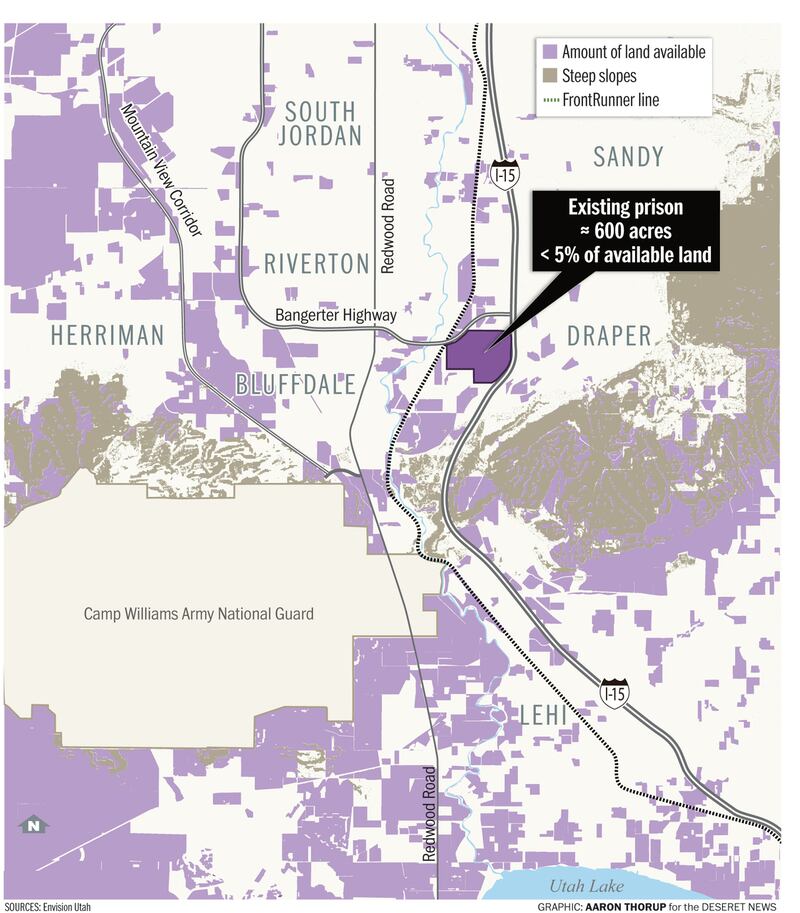
LEHI — If you think future development at Point of the Mountain is limited to the 600-acre site of the existing state prison, think again.
There are some 20,000 acres of undeveloped land between Main Street in Lehi and 9000 South in Sandy, much of it owned by a "who's who of well-known developer families in Utah, many of whom have been positioning themselves there for decades," said Robert Grow, president of Envision Utah.
"That's a really good thing because many of them are families sophisticated about development or are in the give-back phases and know how to do it right," he said.
The prison site makes up about 3 percent of the total acreage.
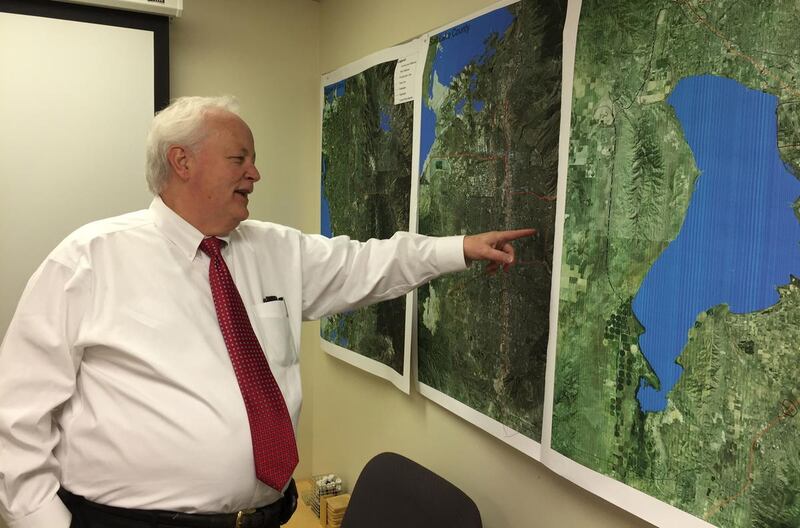
"Perhaps the most misunderstood thing about this project is that when we started talking with the Legislature about this a couple of years ago, it was clear you cannot plan the 600 acres where the prison is without thinking about what was going on around it," Grow said during a recent meeting with the Deseret News and KSL editorial boards.
Now, Envision Utah is ready to launch an intense study process to collect the best ideas from local leaders for how to build out those 20,000 acres in the coming decades.
That study kicks off with a major stakeholder meeting at 2:30 p.m. Monday at Adobe Systems Inc.'s Utah headquarters, 3900 Adobe Way.
What's at stake
For local leaders in Salt Lake and Utah counties, the study is not only important but imperative to ensure the future viability of cities surrounding the Point of the Mountain.
"If we don't get this right, we could stunt our own growth," said Utah County Commissioner Greg Graves, who sits on the Point of the Mountain Commission. "If everybody's on a different page, then all of a sudden we've created a major problem for transportation."
Commuters are already seeing symptoms, with bottlenecking on I-15 at Traverse Mountain and through Lehi, Graves said, meaning the Point of the Mountain plan is already "long overdue."
The area encompasses six of the state's 10 fastest-growing cities: Lehi, Vineyard, Bluffdale, Saratoga Springs, Herriman and South Jordan.
One in every 6 new residential units statewide is in Lehi, Herriman or South Jordan, according to the University of Utah's Kem C. Gardner Policy Institute.
By 2020, the Alpine School District is on track to serve 80,000 students, compared with 68,275 in 2010. Jordan School District's enrollment is expected to skyrocket by 9,250 over the next five years.
More than 57,755 new jobs have been created in the corridor since 2010, according to the institute. Lehi trails only Salt Lake City in new office construction in the state.
"Homebuilders can't build fast enough. The people are still coming and the issues keep stacking up," Lehi Mayor Bert Wilson said. "If we wait until 2023 to (expand transportation), we're going to have to have helipads for everybody."
Andrew Gruber, executive director of the Wasatch Front Regional Council, said Utah County's extraordinary growth — now outpacing Salt Lake County and ranking second in the nation for job growth — is exciting, but the geography at Traverse Mountain creates a "pinch point" that's creating big challenges for the Wasatch Front.
The rapidly growing area will also require enhanced infrastructure, including water, sewer, electricity and communications systems, Grow said.
"The risk is, if we don't do this right, those challenges — traffic congestion and air quality — could all be exacerbated," Gruber said. "But that's why it's so exciting that these stakeholders are going to share ideas to come up with the best plan, to make sure everybody's voices are heard to develop this vital area for the future of the entire state of Utah."
Early visions
As for the soon-to-be-former prison site that has acted as a catalyst to the Point of the Mountain plan, Draper Mayor Troy Walker pictures high-rise business headquarters, Fortune 500 companies, research centers, and mixed-use developments to keep workers within walking and biking distances of their workplaces.
But without the cooperation of the state and neighboring cities, Walker said that growth could further "clog" commuters, restricting accessibility to and from Salt Lake and Utah counties.
"If we don't work together, we'll all fail," he said. "It's pretty fortunate we have this opportunity, because it would be a disaster without it."
Like Walker, Lehi's mayor envisions high-rises — hotels, major shopping centers, mixed-use housing and transit-oriented developments. More housing and other mixed-use business parks will likely sprawl in Saratoga Springs and Eagle Mountain.
From Sandy south and west — South Jordan, Riverton, Herriman, Draper, Bluffdale — Salt Lake County Mayor Ben McAdams pictures "smart density" housing and town center nodes so people can "live, work and play close to home."
"Salt Lake County is hitting our natural growth boundaries," McAdams said. "Density needs to be part of the conversation. We know we can't continue development as we have in the past."
Mass transit will play a critical role, McAdams said, picturing an extension from the Draper TRAX line into the former prison property. Graves sees TRAX and FrontRunner expanding further south.
Gruber said the entire area must have a mix of transportation — from TRAX to bike paths — because the area is "too geographically confined" to rely on driving alone.
"If we don't, we're going to have total gridlock in that area," he said. "The majority of our population is in the narrow area of the Wasatch Front. If we're going to have a strong economy, good air quality and good quality of life for decades to come, we need to come together to form the right path forward."
The process
Between the stakeholder meeting and opportunities to comment online at pointofthemountainfuture.org, plans call for the development of "an overarching conceptual vision of what it could be if we do everything right" by early spring, Grow said.
The second phase will focus on developing scenarios, followed by more outreach to the public and stakeholders as leaders develop a vision for the area, he said.
The third phase involves implementation of the vision, breaking down costs and exploring public and private funding options for various aspects of the plans, according to Envision Utah's website. This process could be in place by early 2018, Grow said in a recent meeting with state lawmakers.
The Utah Transit Authority will play a crucial role to figure out transit solutions. UTA spokesman Remi Barron said transit officials are "excited" to begin working with local leaders on plans, though those plans are likely years down the road.
Funding for transit projects have not yet been discussed, Gruber said, but that will be considered in the third phase of the Envision Utah study.
Preserving Utah's quality of life and providing a pool of well-educated employees to support the workforce needs of high-tech employers at "Silicon Slopes" are also high priorities.
Mayors of four of the cities in the corridor — Sandy, Draper, Lehi and Saratoga Springs — serve on the Point of the Mountain Development Commission.
While each city stands to benefit from future development in its own right, all are engaged in the collective planning process, Grow said.
"They realize the sum of the parts may not be equal to the whole," he said, "so we might as well do it right."