


This article was first published in the State of Faith newsletter. Sign up to receive the newsletter in your inbox each Monday night.
Luke Burgis, an entrepreneur-in-residence at The Catholic University of America, spent years chasing startup success in Silicon Valley. By most measures, he achieved it. He started several companies and sold one. After the mortgage crisis of 2008, his latest venture was battered by the collapsing economy, and after a last-ditch deal to save the company fell through, Burgis found himself amid both a professional and spiritual crisis.
The moment prompted Burgis, who had grown up Catholic but fell away from faith in college, to wrestle with his life’s calling and why he wanted a particular kind of success in the first place.
One night, he picked up a biography of St. Francis of Assisi from his grandmother’s bookshelf and spent the entire night reading it.
“And then one night, I decided that I was going to take as much risk in my spiritual life as I had in my business life,” Burgis said during his recent appearance in Utah. “I’d risked everything to start my companies, and I realized that I was tremendously courageous as an entrepreneur, but not in spirit.” That night, he said “the most dangerous prayer” a person can pray, asking to eliminate what stood in the way of closeness with God.
Burgis went on to enter the seminary at the Diocese of Las Vegas and spent five years studying to be a Catholic priest. He also spent three years in Rome and immersed himself in Catholic teachings. Ultimately, he felt that God called him to a ministry in secular spaces where confusion around questions of purpose and identity grew more common.
Burgis, who is also the founder of the Cluny Institute, made a career drawing on Christian wisdom and philosophy to help people better understand how to find their path to their true purpose and belonging.
Burgis’ first book explored human tendency to want what other people want, an impulse that French philosopher René Girard called “mimetic desire.” Girard argued that our desires are rarely entirely our own and that we unconsciously mistake borrowed desires and hopes for authentic ones.
These ideas were influential for billionaire investor Peter Thiel, who studied under Girard at Stanford and praised Burgis’ more practical version of these concepts. Last fall, Burgis taught an online class on the “foundation of agency” to help people make decisions independent of social pressures. He also thinks a lot about AI, faith and ethics.
One of Burgis’ ideas that struck me as especially timely — and crucial to the life of religious communities in an age of fragmented attention and authority — is the concept of a “solid self,” a term he borrows from American psychiatrist Murray Bowen.
“A solid self can communicate what they believe and stand for, or what they will or will not do, without engaging in social calculus,” Burgis writes in his latest book, “The One and the Ninety-Nine.” Burgis contrasts a “solid self” with a “pseudo-self,” which is more likely to blend with the group, even at the expense of their own values and integrity.
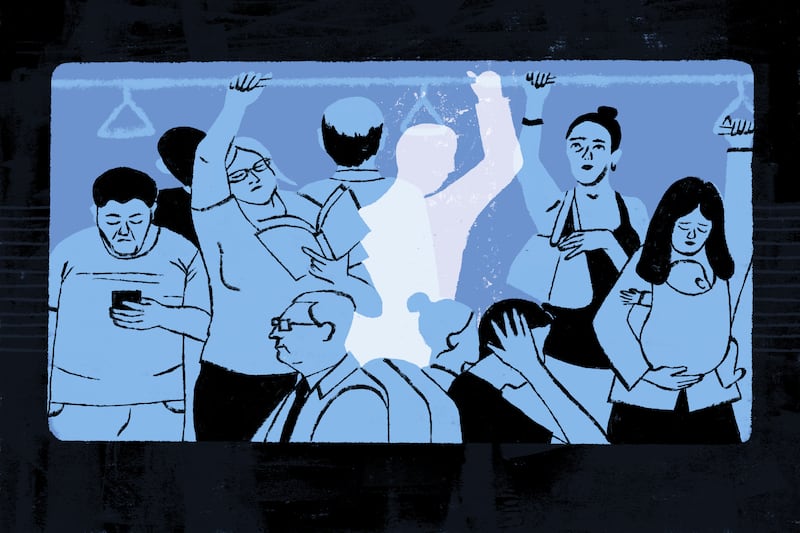
Without a solid self, Burgis argues, we risk creating communities where everyone conforms but no one really belongs. Ironically, this excessive sameness ultimately weakens a community rather than strengthens it.
To illustrate this relationship between an individual and a group, Burgis turns to the parable of the Good Shepherd. The shepherd does not reject the 99 in order to rescue the one, nor does he abandon the one for the sake of the crowd. Burgis’s point is that the shepherd allows for both at the same time: the unity of the flock and the freedom to differentiate from it.
A solid self, he writes, includes accepting the “limits and responsibilities” of a community, but also staying true to one’s own unique features and depth of character. This is how he describes this tension: “Each of us is torn between belonging and differentiation, and a few ever learn to manage that tension. We might not even realize it exists. Once we become aware of the tension and learn to navigate it, we can live with far more freedom and far more integrity — than ever.”
The problem is that the internet often paints a distorted image of what belonging looks like.
Social media clips and loud partisan rhetoric have made it easier to be swept up in tribal identities without deeply engaging with the complexities of beliefs and principles that are possible within those groups.
And the independent thinking necessary to discern that nuance is evaporating.
A recent Atlantic story described the decline in college students’ ability to read or think, with one student even asking AI to break down novels in simpler language.
This decline has profound implications for religious life and the individual faith that sustains it.
How will young people discover what they believe if they’re losing the ability to engage with complex and symbolic language of sacred texts and examine their own beliefs and convictions? As the authority of inherited traditions and institutions dwindles, cultivating solid convictions and the courage to bring them to public life becomes a harder task.
Burgis closed his remarks by extending an invitation to Christians to be the defenders of the “real” in the age of artificiality — their faith, personal suffering and weakness, and honest language. “ I think the courage to be saints in the modern world is also, in some sense, the courage to become real.”
Fresh off the press
The Little Sisters of the Poor are back in court continuing a more than decade-long fight for a religious exemption from providing contraception in their health plans. I tuned into the hearing last week. Here’s my report.
Artist John Hafen struggled with poverty, but he’s always seen art as a way to build faith and character.
Why gay Latter-day Saint church members choose to stay in the church.
What I’m reading
One of Sen. Lindsey Graham’s last speeches was at a Baptist church in South Carolina. “This is like the highlight of the year for me, to come to this service with my family to remind me what our country is about through Baptists, who can sing and dance,” he said, according to Baptist News Global. “And to those who say Baptists cannot sing and dance, come here; you will be proven wrong.”
Is there such thing as too many books? Not for Jewish scholar Mendel Uminer. — The New York Times
An 80-minute production of “A General’s Prayer” at the Museum of the Bible explores the faith of George Washington. — The Christian Post
How “The Chosen” found their mega fans and sparked an era of faith-filmmaking. — The New Yorker
A new AP-NORC poll found a generational divide in how American Jews understand their Jewish identity: Older Jewish adults are more likely to see support for Israel as central to being Jewish, but younger Jewish adults place more emphasis on cultural practices like celebrating Jewish holidays. — AP
Authors Ross Douthat and Rod Dreher talked Christian re-enchantment, totalitarianism in America and Dreher’s quest for belonging. You can check out profiles of both Ross and Rod. — The New York Times
How a podcast by the Dominican nuns went viral. — National Catholic Register
End note
Some Latter-day Saints wished that Taylor Swift would have asked them for help with the setup for her wedding at Madison Square Garden (thank you to the Believing newsletter for spotting this.) After all, who is better at turning a basketball gym into a wedding venue?