

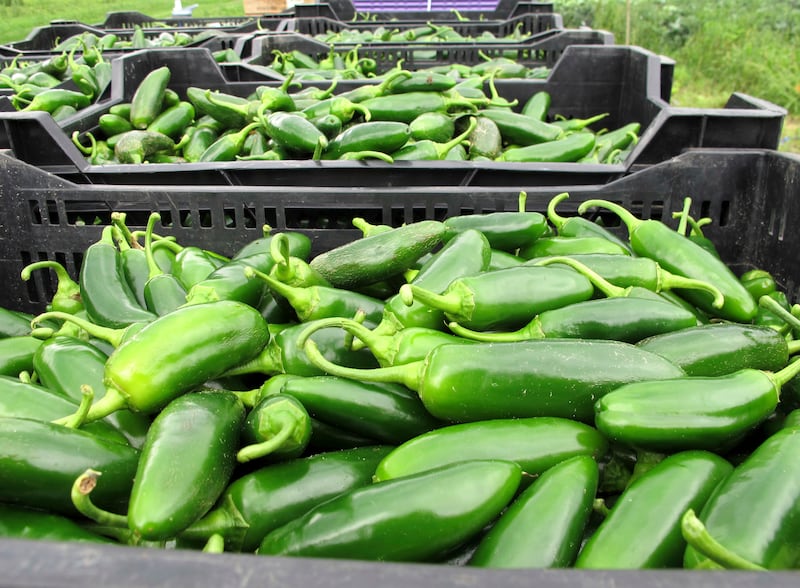

- A salmonella outbreak linked to jalapeño peppers from Mexico has sickened 345 people in 27 states.
- The cyclosporiasis outbreak now has more than 22,000 confirmed suspected cases in 47 states.
- Multiple other active Food and Drug Administration recalls demand consumer attention.
If you’re not used to washing and carefully prepping your fresh produce before it’s consumed, please pay attention. Besides the Cyclospora parasite illness raging across the country that’s at least in part linked to fresh lettuce, there’s now a salmonella outbreak stretching across states that’s been tied to jalapeño peppers.
And while you’re at it, start noticing food recalls in general. Your family’s well-being may depend on it.
The cyclosporiasis count since May 1 is now at least 22,000 confirmed and suspected cases. But at least in hardest-hit Michigan, that appears to be slowing down some, though public health officials are still investigating several outbreaks of the illness across the country. The parasitic infection has taken a heavy toll, hitting 47 states with a total of 517 hospitalizations and two deaths of people who had underlying conditions that put them at particular risk for severe outcomes.
The jalapeño pepper salmonella outbreak is much more recent.
Coast Citrus Distributors is voluntarily recalling the fresh jalapeño peppers grown in Sinaloa, Mexico, in at least 27 states that has included 345 cases so far and resulted in 36 hospitalizations, according to the Centers for Disease Control and Prevention surveillance page. No one has died.
The company’s jalapeño peppers do not appear to be for sale in grocery stores, per a U.S. Food and Drug Administration update. But they have gone out nationwide “to distributors, restaurants and food service companies, including Mexican-style restaurants in the U.S.”
It’s believed that those who received the product have been alerted and are no longer serving the jalapeño peppers in question.
Cases have been reported in Alabama, Arkansas, California, Colorado, Georgia, Illinois, Indiana, Kansas, Kentucky, Louisiana, Michigan, Minnesota, Missouri, Montana, North Carolina, North Dakota, Nebraska, Ohio, Oklahoma, South Carolina, Tennessee, Texas, Utah, Virginia, Washington, Wisconsin and Wyoming.
“This outbreak may not be limited to the states with known illnesses, and the true number of sick people is likely much higher than the number reported,” the CDC reported, noting that “this is because many people recover without medical care and are not tested for salmonella.”
Salmonella symptoms typically include diarrhea, fever and stomach cramps. It may also cause headache, nausea, vomiting, and loss of appetite. Usually, it goes away on its own. But some people are more at risk of severe symptoms than others and sometimes it creates complications by spreading to urine, blood, bones, joints, the brain or other internal organs, per the CDC.
The FDA reports that salmonella infection typically occurs within 12 to 72 hours after consuming food that has been contaminated with it and symptoms can last up to a week. It notes that children younger than 5, older adults and people with weakened immune systems are the most apt to have severe infections.
The outbreak and subsequent recalls follow on the heels of the ongoing nationwide health challenge with the parasite Cyclospora and the illness it causes, which is called cyclosporiasis. The illness causes diarrhea, nausea, dehydration and other gastrointestinal symptoms.
The gut-wrenching illness is caused by feces contamination believed to be from irrigation water that allows the parasite into, in the case of the biggest ongoing outbreak, iceberg lettuce. Reuters reported that lettuce from central Mexico has been linked to the parasite, broadening the original nine-state outbreak to 15 states.
Other active recalls
Meanwhile, fruits and veggies aren’t the only source of food-borne illness if proper handling or preparation is lacking. The Clarion Ledger in Mississippi reported that the FDA has traced a large salmonella-linked egg recall to a pair of Texas farms.
The FDA has active recalls on, among others:
- Close to 1.6 million dozens of eggs from Midwest Poultry Services because of the salmonella outbreak.
- Taylor Farms de Mexico iceberg lettuce linked to at least one of the biggest Cyclospora outbreaks.
- Clover Hill Dairy cheese products sold in New York and elsewhere after a fatal listeria contamination.
- Frozen berries from GreenWise Organic Frozen whole Blueberries and Whole Mixed Berries over E. coli.
If you think you have a recalled product or want to keep up on what’s being recalled, you should visit the FDA Recalls, Market Withdrawals, & Safety Alerts page. When products are recalled, it most often only involves certain lots or types of a product, or products produced in certain locations on specific dates. That information is available on the recall page.
The page will typically also say what to do with the product if you have it and provide information on contacting the company or producer if you have questions.
What is going on with recalls?
WWL-TV in Louisiana has been asking why there are so many recalls right now, amassing a list that includes jalapeños, eggs, lettuce, chips and infant formula. Achyut Adhikari, a food safety specialist with the Louisiana State University AgCenter, told the station that not all recalls carry the same level of risk.
But both the salmonella and Cyclospora recalls fall into the most worrisome Class I recall, involving products that can cause serious illness. Less serious health risks are Class II and those that don’t cause health problems but involve packaging and labeling are Class III.
Asked whether more recalls are happening because the food network is so vast or because health officials are getting better at detecting problems, Adhikari said the answer is “both.”
Clean that produce
It’s important to be aware that prewashed produce may not be washed enough. And some things that can cause infection, like the Cyclospora parasite, may not be eradicated by simply washing produce. But cooking to at least 158° Fahrenheit will kill it.
Healthline’s guide to washing produce notes most fruits and vegetables simply need a light scrub with clean, cool water. But “for foods with more ridges or crevices,” the advice is to “swish them in a bowl of water” to clean them up.
The article offers advice based on types of produce:
- Firm produce like apples, lemons and pears, as well as root vegetables like carrots and turnips, can be brushed with a clear, soft bristle to remove residue.
- Leafy greens like lettuce or Brussel sprouts should have an outer layer removed, then be submerged in cool water, swished, drained and rinsed with new water. In the case of lettuce, current advice is two or even three layers.
- Delicate produce like raspberries or mushrooms need a “steady stream of water and gentle friction using your fingers” to clean them.
- Wash before you cut fruit with tough skin.