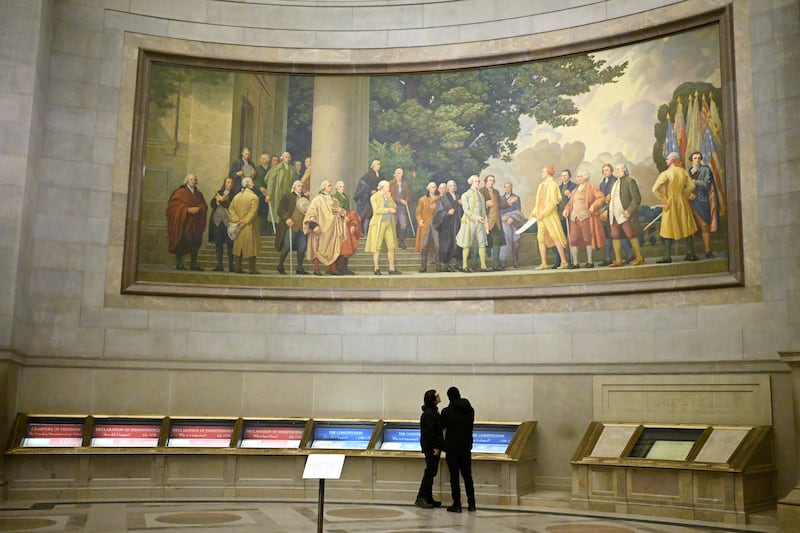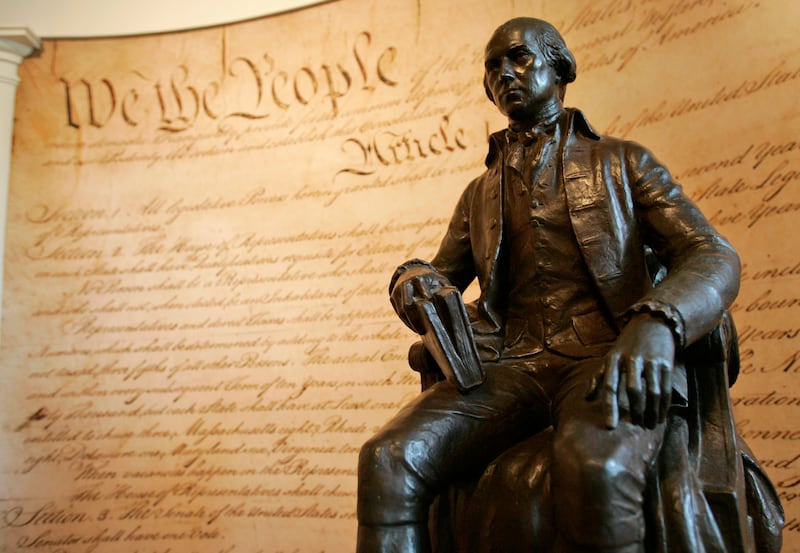
Editors note: This is the third in a series of six pieces exploring the ideas behind America’s founding. Each piece will accompany one of five master classes on the Declaration of Independence from Utah Valley University’s Center for Constitutional Studies. The classes are free and open to the public. Read more about and access the classes here.
On Oct. 27, 1787, in the Independent Journal, a “General Introduction” was published under the pseudonym “Publius.” In what would become the first in a series of essays defending the newly proposed Constitution of the United States, Publius argued that Americans were then presented with a singular, historical question.
“It has been frequently remarked,” Publius stated, “that it seems to have been reserved to the people of this country . . . to decide the important question, whether societies of men are really capable or not of establishing good government from reflection and choice, or whether they are forever destined to depend for their political constitutions on accident and force.”
Why did Publius — later identified as Alexander Hamilton — believe this grave question was put before the American people?
Part of the answer stems from the theory upon which the U.S. Constitution was crafted. The ratified Constitution emerged more than a decade after the Continental Congress had determined it would no longer be governed by force or accident.
The Declaration of Independence set out a theory of human beings and natural law that justified breaking the political bands binding the colonies to the Crown. The declaration espoused that all human beings were created equal and based on natural law, they had certain unalienable natural rights, including life, liberty and the pursuit of happiness.
In this way — returning to Publius — the American people were set to answer the question of whether a people could indeed consciously determine their rights were not adequately protected and thereby institute a new way of living, by consent. Government was meant to protect the unalienable rights of its citizens. In doing so, it was owed allegiance for that protection. If it failed to do so, those inhabitants had a moral and political obligation to break that allegiance in favor of a new political arrangement.
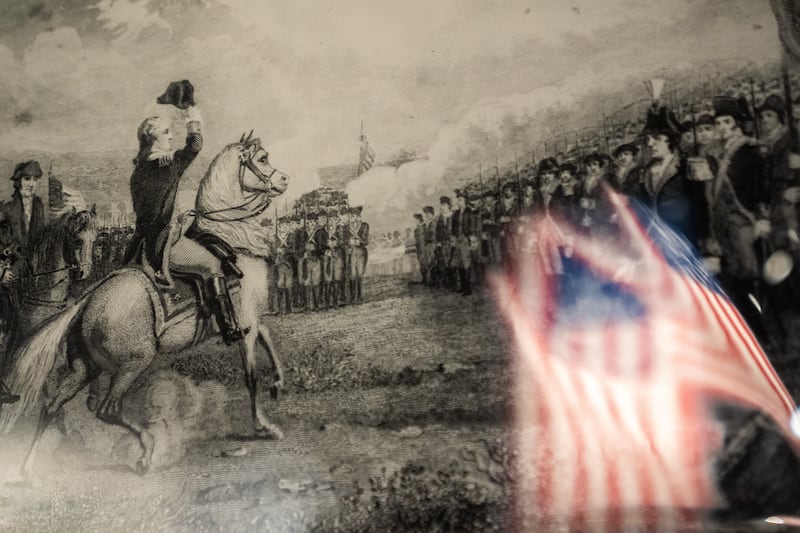
But, creating a new government would not be simple, and gaining the consent of all to protect the natural rights of all was not a foregone conclusion. Millions were enslaved and actively under bondage, their natural rights deprived. Many states would not consent to a constitutional arrangement of universal freedom. But how could a new nation build itself on a philosophical foundation that it simultaneously rejected? Publius likely did not have this aspect of the dilemma in mind when identifying the grave question of self-governance put before the American people, but it mattered.
This question of self-governance and the tension between the theory of the declaration and the practice of the nation remained present through the nation’s founding and its early history. Prominent abolitionist William Lloyd Garrison invoked the declaration at a Fourth of July celebration in 1829 when excoriating America for its complicity in the vile practice of slavery, stating a “greater Jefferson would fail” to account for all the abuses perpetrated on the slave population. The Crown may have violated the rights of colonists, but these violations paled in comparison to what Americans themselves were doing to their own. If Americans had a right to dissolve political bands with Great Britain, how much more so did slaves with the U.S.?
Later, as the Civil War waged on, Abraham Lincoln raised again Publius’s question, whether a nation “conceived in liberty, and dedicated to the proposition that all men are created equal . . . can long endure.” One might say that the question of self-governance and the preservation of human equality and natural rights is an irresolvable conundrum of the American experiment.
Though the persistence of inequality and injustice seem ever-present, the principal reason we continually come back to “reflection and choice” is the natural-rights philosophy of the declaration. It did not operate in practice to vindicate the rights of all inhabitants on July 4, 1776. But its theory continually brought the American people to account, and it can promise to do so today.
Indeed, the declaration made fighting for human equality and the natural rights of all the foundation of American patriotism. One might answer Publius and Lincoln’s question affirmatively if the declaration’s philosophical principles continue to bring American constitutional practice to account.