


A version of this article was first published in the Right to the Point newsletter. Sign up to receive the newsletter in your inbox every Wednesday morning and to vote in subscriber polls.
Not so long ago, it was obvious if you were being recorded. There was a clue: Someone was pointing a camera at you.
Cameras are everywhere now, for good and for ill, disguised as all manner of things, including house plants, clocks, teddy bears and, of particular note as summer begins, Ray-Ban sunglasses.
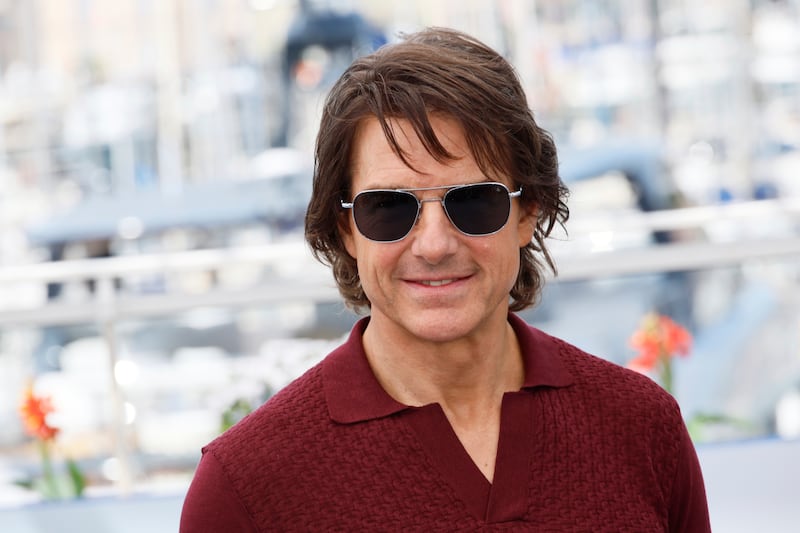
These aren’t Tom Cruise’s Ray-Bans, but George Orwell’s.
As Amos Barshad reported for Columbia Journalism Review last week, people are using Meta’s AI-enabled, video-taking sunglasses to surreptitiously record large gatherings of people. And it’s not just Nick Shirley and a handful of other news hounds using the glasses, which can be had for anywhere from $200 to $800. Per Columbia Journalism Review, Ray-Ban’s parent company sold more than 7 million pairs last year.
In other words, if someone at your next family reunion isn’t taking their sunglasses off inside, beware.
In “1984,” Orwell’s classic novel, “You had to live — did live, from habit that became instinct — in the assumption that every sound you made was overheard, and except in darkness, every movement scrutinized.”
We’re not there yet, but just in the past month, we’ve seen consequential fallout from two discussions that were meant to be private but became public: a “60 Minutes” staff meeting and a conversation with a Washington Nationals executive. That executive, Sean Hudson, and “60 Minutes” correspondent Scott Pelley both lost their jobs.
And the BBC recently reported on a case of blackmail enabled by covert recording: A man filmed a woman at a London mall without her knowledge, then posted the recording on social media and demanded money to take it down.
It seems like we’ve entered a space where we should assume that someone is recording everything we say and do, and that it can be used against us. (Witness this warning from law enforcement in Southern California that criminals are hiding cameras outside homes to determine the best time to break in.)
It would be nice if there were a trade-off for this unsettling development — say, overnight, everyone got nicer and behaved better — but there’s a new video every week that shows this hasn’t happened.
The one positive seems to be that the glasses are life-changing for people with impaired vision.
In the meantime, keep an eye out for glasses with a tiny blinking light in the corner — that’s the sign that they’re recording (but only if this feature hasn’t been turned off).
The CJR article ended with a quote from podcaster Kate Lindsay, who said, “The solution cannot be if you don’t want to be filmed, stay home. That just can’t be where this is headed.”
Headed?
It seems like we’re already there.
The worst hidden camera?
Mark Zuckerberg’s Ray-Bans aside, any discussion of the worst hidden cameras has to include one marketed by an online business called the International Spy Shop. There you can purchase a hidden camera built into a small cross, a holy symbol for more than 2 billion Christians across the world.
The website describes the device as a crucifix. It’s not. A crucifix is a cross bearing a figure representing Jesus Christ. A cross is just, well, a cross.
Putting that aside, it’s profoundly tone-deaf, if not sacrilege, to promote a religious symbol in this manner: “You can wear it as a necklace and capture people in the act and the possibilities are endless. ... It’s very easy to capture video evidence for court, nanny camera, or recording live sports.”
Somehow Meta’s sunglasses don’t seem so bad next to that.
Recommended Reading
We hear a lot of doomsday talk about Social Security, but one nonprofit has done the math about what it would actually look like if and when benefits are cut. Jay Evensen has the details.
“For years, I’ve noted that politicians tend to avoid dealing with problems that won’t become emergencies during their time in office. But those days are ending. As the report notes, insolvency is ‘projected to occur during the terms of the next elected senators and president.’”
How would a Social Security collapse play out?
Dubai has a minister of happiness — an actual government position. Asma Uddin was skeptical when she first heard about this, but has come to see how Americans could benefit from being more intentional about our own happiness.
“A minister of happiness was never the absurd part. The absurd part is the belief we put in her place, that happiness is something you optimize alone, frictionlessly, on a screen, rather than something built through the friction of real life itself.”
Maybe a minister of happiness wouldn’t be a bad idea after all
And if you missed this from me, there’s an interesting back story in how the winsome beagle became the poster dog of animal-welfare advocates.
“‘We are in a very unique moment’ when it comes to animal testing in research, Lara Trump told me. The story of how we got here involves not just the University of Utah’s Beagleville, but also the backlash against the COVID-19 pandemic response and its architect, Dr. Anthony Fauci.”
End Notes
Last week, the Los Angeles Times called “60 Minutes” the “most-watched TV news program that has managed to retain its vitality and importance in the face of major changes across the media landscape.”
Not for Right to the Point subscribers.
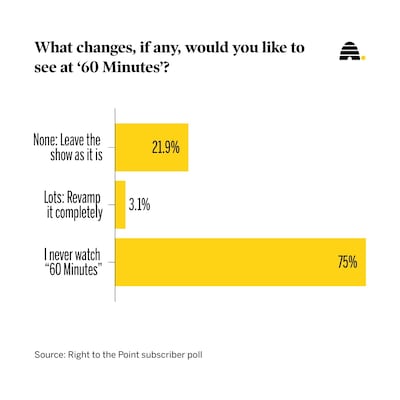
In last week’s poll, we considered this question: What changes, if any, would you like to see at “60 Minutes”?
Not a lot of us watch “60 Minutes,” as it turns out. Here’s how it went.
Finally, I had the chance this week to try out something that, if it works, could make air travel much less stressful.
Logan International in Boston is the first airport to establish what they’re calling a “remote terminal” — an offsite security screening, with the aim of making the process quicker and easier.
Here’s how it works, and why it’s intriguing.
Boston already offered travelers the option of catching a bus to the airport from various points around the city. At one, in the city of Framingham, it’s established a TSA outpost that anyone flying Delta or JetBlue can use for $9 — which is the same price as a regular bus ticket to Logan. Parking is right outside, for $7 a day, or you can be dropped off.
After going through the screening, you board a bus that takes you directly to your airport terminal — and they do mean directly. The bus travels across the tarmac where the planes are, in order to drop passengers at a special entrance by the gate. All in all, it felt like VIP experience, and the security screening itself took about three minutes — and I don’t have TSA PreCheck or Clear.
The travel website The Points Guy notes that the facility has the vibe of a “miniaturized airport terminal” — but, I would add, without the crowds and the stress of Logan and other large airports.
It may not always be this quick; the service just started last week, and not everyone knows about it. And also, they suggest that you arrive 45 minutes before your bus leaves. I was initially skeptical about that — if you have to go that much earlier, what’s the difference in waiting at the remote terminal and waiting in a TSA line?
A whole lot, as it turned out. It was a first-class experience for an economy price.
Flying has gotten more miserable since 9/11, for reasons related and unrelated to the terror attacks. So let’s celebrate this one small step for travelers in a very specific suburb of New England — and hope that soon it will turn out to be a big step for air travelers everywhere.