

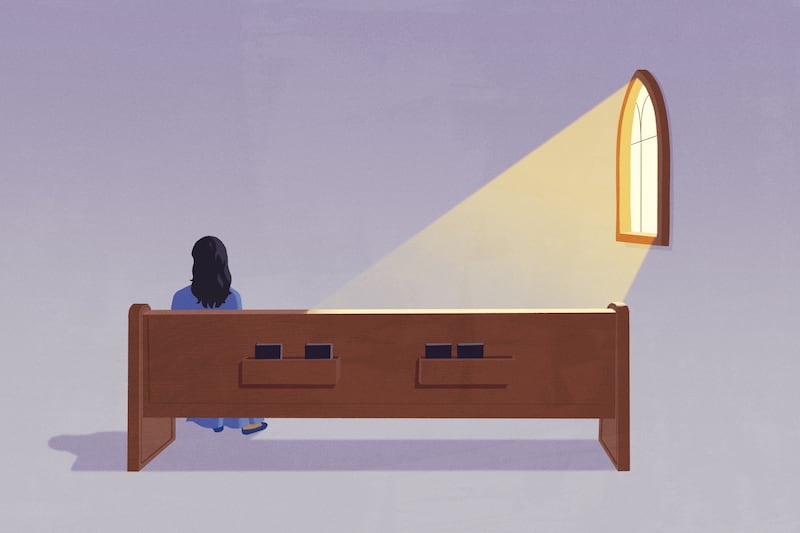

Many years ago, a woman approached us in the church foyer on a Sunday morning. “Where have you been?” she asked.
Her intentions were pure and she smiled sincerely. But her question left us confused.
We hadn’t abandoned our faith or made some dramatic exit. We were a young family. We’d moved twice in quick succession, had two little girls and I’d been traveling for work. Admittedly, we were also still socially and emotionally tied to our previous church family 20 minutes away, so we’d only attended the new congregation a few times.
We weren’t hiding. We were just living.
I’ve thought about that morning many times since. We were familiar with the woman but not yet friendly, and she wasn’t being unkind. Her heart was likely where it should have been. But there was an assumption tucked into the question, like a bookmark in a story she hadn’t read.
Her approach hinted that our absence needed an explanation before our return could be celebrated.
Hope in the data
A recent Pew Research Center study found that 35% of American adults have left the religion in which they were raised. Some stopped believing. Some gradually drifted away. About a third of those who left their childhood faith simply found another one.
But another study, “Signs of Rebound Amid Uneven Recovery: The Changing Congregational Landscape,” surveyed more than 7,400 congregations and found that median in-person worship attendance has climbed above pre-pandemic levels, marking the first positive gain in 25 years of tracking.
The data doesn’t tell us where any one person has been. But in communities like yours and mine, the numbers suggest that someone wakes up every single Sunday morning wondering, “is today the day I go back?”
Maybe they’ve been asking themselves that question for weeks, for months, for years.
I’ve been invited to speak in congregations of many faiths, and I’ve seen that this isn’t unique to any one of them. Bishops, ministers, pastors, priests, rabbis and other leaders describe the same reality. Attendance ebbs and flows. People leave. People return. Every congregation wonders how to welcome them home.
Some people step away because they were hurt. Some drift. Some move ideologically or geographically. Some get busy raising children or caring for aging parents. Some explore other faith traditions.
Some may not think of themselves as having left at all. Their faith may have changed, deepened or simply taken a different path.
Their stories are different, but many are asking the same questions. Will anyone remember me? Will I still belong?
Courage to come back
We shouldn’t underestimate what it can take to walk through those doors again. The person pulling into the parking lot may sit in the car for a few extra minutes before going inside.
In a decisive moment like that, they may wonder who will notice them, what questions they’ll be asked or whether they’ll recognize anyone at all. They may even rehearse what they’ll say if someone asks where they’ve been.
Then they open the door. That’s the moment the rest of us enter their story.
When they return, even if just for the day, they don’t want a parade, speech or spotlight. They want to know there’s still a place for them.
That’s why our first words matter.
“I’m so glad you’re here.”
“It’s wonderful to see you.”
“We’ve missed you.”
And then, perhaps most importantly, “What do you need?” and “How can I help you?” — both of which reflect a deeper, underlying curiosity: “Where do you want to go from here? How can I help you get there?”
The welcome belongs to you
You don’t have to be the bishop, the pastor, the minister or anyone with a formal assignment to strike up a conversation like this. If you’re standing in the foyer this Sunday, those first welcoming words belong to you.
And if you’re the one wondering whether this is the Sunday to come back, I hope you’ll extend a little grace as well. As hard as we try, sometimes there’s a language barrier between the heart and the mouth.
We may never know how much courage it takes for you to walk through that door, but we can work to make sure you find soft hearts and genuine warmth when you do.
When you’re ready, come home.
We’ll do our best to remember that first words matter.