

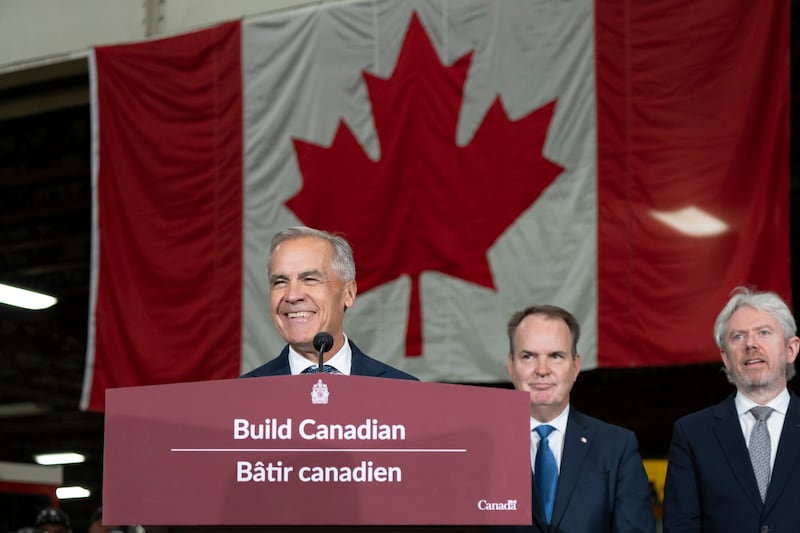
It’s been a bumpy week for the United States and Canada. Trade negotiations broke down, the U.S. imposed new tariffs on billions of dollars of Canadian goods, and Canada announced matching tariffs. This will impact everything from toilet paper and timber to auto parts and even Christmas ornaments, right in time for the holidays.
But the most damaging development may be the collapse in trust. Canada is one of our closest trading partners, so when Prime Minister Mark Carney says America’s commitments are “written in pencil,” we should take note.
That phrase stings as a diplomatic insult, but it’s really an economic warning: our reliability, long an economic asset, is now at risk.
The fix isn’t rhetoric from D.C., it’s the kind of steady, local diplomacy that Utah and other states are proving works.
Canada and the U.S. have spent decades building one of the world’s most integrated economic relationships. Weaponizing that integration comes with consequences as companies reconsider investment, materials are sourced elsewhere and foreign partners look to Europe and Asia instead.
Tariffs can be useful strategically, to protect industries like semiconductors and aerospace, but disruption shouldn’t become our governing philosophy, especially with our closest allies.
Last year, Utah Gov. Spencer Cox led a trade mission to Quebec and Toronto. Canada is Utah’s #2 trading partner, with Canadian-owned companies employing 5,000 Utahns, plus partnerships on metals, auto parts, machinery and aerospace.
A year later, that mission looks even more consequential. Even amid tariff fights, Utah didn’t retreat. Utah is good on its word. That instinct is exactly what should guide how the federal government treats its own institutions.
America is more durable than Washington
The President controls the core elements of foreign policy and trade. But governors and mayors preserve commercial relationships, connect companies and keep channels open when Washington becomes unpredictable.
One thing I learned as an elected official is that local leaders demonstrate that the United States is larger and more durable than whoever occupies the White House at any given moment.
I saw this firsthand at the Export-Import Bank, where I led the first state and local engagement initiative. Governors and city mayors knew where federal tools could make the greatest local impact.
Take BETA Technologies. When EXIM looked at financing BETA’s electric-aircraft facility in Vermont, then-Burlington Mayor Miro Weinberger wrote directly to the Bank to explain what Washington couldn’t see from the financials alone: BETA already employed hundreds of people, and had helped fund workforce programs with local schools and airport infrastructure. EXIM provided nearly $170 million in financing; in 2024, BETA was named EXIM’s Deal of the Year.
Then BETA’s footprint began to expand. In 2025, Cox signed an MOU with the company making Utah a partner in advanced air mobility ahead of the 2034 Winter Olympics. This month, EXIM and BETA announced plans to expand financing to as much as $1 billion. BETA’s growth has spanned two administrations and leaders from both parties — a model for industrial policy at every level of government.
The federal government has financing tools that states don’t. Governors and mayors understand their economies in ways Washington never will. A governor can’t cancel a tariff, and a mayor can’t negotiate a trade agreement — but they can build relationships so we don’t have one point of failure.
Now that EXIM is up for renewal, Congress should use reauthorization to give governors and mayors a standing role in how the Bank engages regional economies — for instance, a formal advisory seat in project consideration, the way Burlington’s mayor shaped BETA’s financing. If you make something in Utah or Idaho, you should be able to export it to the 90% of global consumers who live outside our borders. Institutions that reinforce America’s economic strength and continuity abroad are worth investing in.
Utah offers a model: building on regional strengths by connecting federal tools to local efforts. Presidents come and go, but our commercial relationships, long-term competitiveness, and our word should be as durable as possible.
Regardless of politics, we know that strong relationships around the globe are an asset and good for our economy and families.
The warning that America’s word is “written in pencil” should sting. But around here, our word means something.