


A friend recently invited me to a dinner and comedy show at a community space in the middle of Long Island. I rarely have the time to get out there from New York City, but last week I did, so I said yes.
I knew that those at this event would be very different from those in my usual circles, and my friend made that very clear in his invitation. But I figured “why not?” and went to support him.
When I arrived, it was almost immediately clear that he was absolutely right; those at the event were not only dressed appreciably differently from what I am used to, but their outlook and preferences were vastly different from my own — from their hobbies and politics to how they saw the world. Many of the references in the jokes went right past me, and there were stretches during the show when everyone around me was laughing and I only sort of understood why.
Despite all of these differences, I never felt unwelcome.
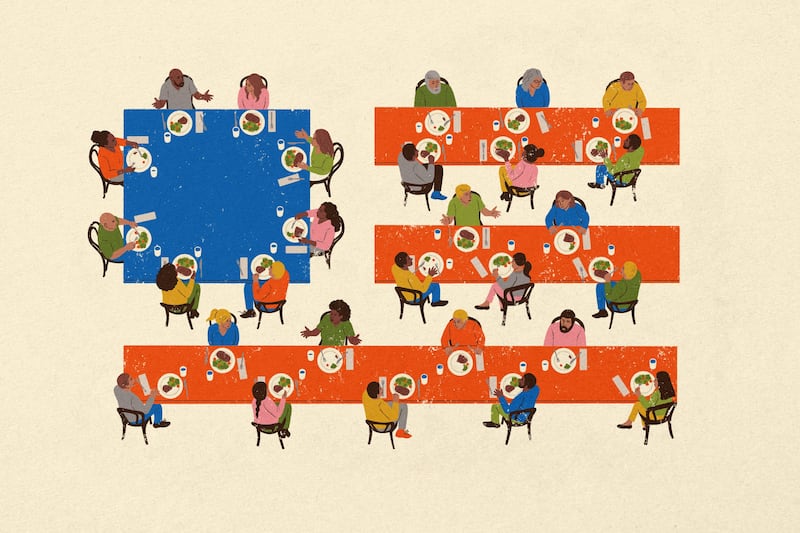
After walking in, I saw that there were long tables set in rows, 10 chairs to a side and everyone facing one another across them, with about 200 people in the room.
The dinner itself went on for a while and I enjoyed the lingering pace, because it gave me time to talk to people and learn about their families, their work and their lives. There was an ease, an almost congregational feel that comes from people knowing one another, and that is nice to see in a world with so much of life lived online. Then five comics went up to a microphone and the crowd loved them.
The event was a huge departure from anything in my typical routine and while I felt like an outsider, nobody seemed to mind that I was there. People were open with me and I tried to be open with them. By the end of the evening, I had had a wonderful time.
We spend so much time talking about how different Americans are from one another and, of course, we are not homogeneous. Americans live in different places, send our children to different schools, worship differently, consume different media and increasingly spend much of our time around people who are a lot like us. I am not immune to any of this either.
We have become very good at spotting what divides us and much less practiced at noticing what remains underneath.
Some of this inward turn is just how modern life works. We live near people who can afford the same neighborhoods. Our children meet families through school and shared interests — like baseball, ballet or chess. We join religious communities, clubs and organizations where people have certain things in common. There is nothing necessarily wrong with any of that, but someone in Utah does see and experience the world differently than I do in New York.
Social media makes this narrowing even easier. Many of us are now in a strange civic situation where we know enormous amounts about people who agree with us and almost nothing about the people living a few miles away who do not.
What struck me that night — both unnerving and, oddly, deeply refreshing — was how unusual it felt simply to be somewhere where I did not know all the rules and norms, I did not know every reference, and I was a little worried about saying something foolish or insensitive.
Nothing about attending my friend’s evening was a hardship or traumatic. It was just unfamiliar, and that unfamiliarity was actually good for me. It made me listen more carefully than I normally would, and I asked many questions. I realized that I had walked into the room with assumptions that did not hold up once I actually started talking to people there. Having those biases challenged was refreshing and worth the drive.
We have arranged our lives to keep surprises and stress to a minimum. We often know where we are going, who will be there and roughly what kind of people we are going to meet. There is comfort in that narrowness, but there is also a societal cost: We convince ourselves that we understand whole groups of people we barely know. We have an image of what they believe, what they value or how they raise their children. Often those images come from television, social media or other people who also do not know them. But actual people tend to be more complicated.
I want to be very clear here: I am not suggesting that one dinner can solve our nation’s problems; that would be naive. Our political divisions and cultural differences are real and increasingly dangerous. It would be foolish to think that we are all the same underneath — we are not.
But I loved seeing so much familiarity in the room. While most of the jokes that night were not my jokes, and much of the discussion at dinner meant absolutely nothing to me, other ideals were in complete sync with my own. People cared about their families. They worried about their kids and they wanted life to go well for the next generation. They cared deeply about the community around them, and there was a real love of country in the room. We are still a creedal nation.
I know that can sound abstract, especially when we use terms like “creedal nation” in classrooms or political writing. But our shared creed did not feel abstract while I was sitting at that dinner table. People who had very different backgrounds from mine still cared about the same basic things I care about: family, community, opportunity, the future of their children, and our shared country and heritage in which all of this takes place. That did not erase the differences; it put them in proportion.
We have become very good at spotting what divides us and much less practiced at noticing what remains underneath.
So many of us miss our shared creedal values at a distance and they can be easily missed online. Sometimes you have to sit with different people, look and listen, and my evening in the middle of Long Island reminded me of that truth.
I am leaving out quite a few details from that Long Island night because this was a private gathering and I do not want to turn private conversations into public material. But I did leave the event thinking that most of us probably do not put ourselves in rooms like that often enough.
Journalists, civic leaders, pundits and professors all talk about civic renewal as if it always has to involve some enormous program, creation of a new institution or national effort. We look to schools, government, nonprofits and political leaders to step up and help. All of them have a role, certainly. But some of this work is much simpler and it begins when people from different backgrounds actually meet, spend time together and get to know one another.
My point here is simply to encourage people to say yes a little more often when they are invited to a dinner or an event. Go somewhere outside your normal routine and spend time with people you would otherwise never meet. Ask questions and listen to the answers. You may feel out of place, miss half the jokes, and encounter real differences that do not disappear after dinner. That is part of the value of doing it.
But you may also come away with a better sense of how other people live and what they care about. I did. The world felt a little bigger to me after that night, and the people in it a little less distant. I’m really glad that I went.