

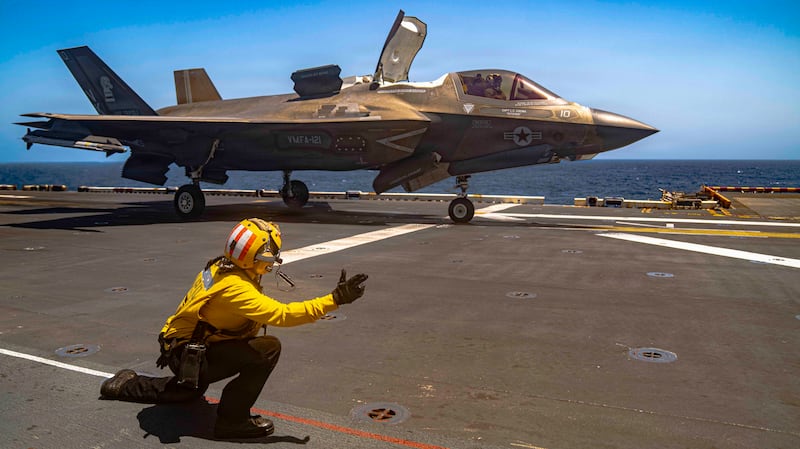

While Utahns broadly oppose the ongoing war with Iran, their views become more complicated when asked about specific military objectives.
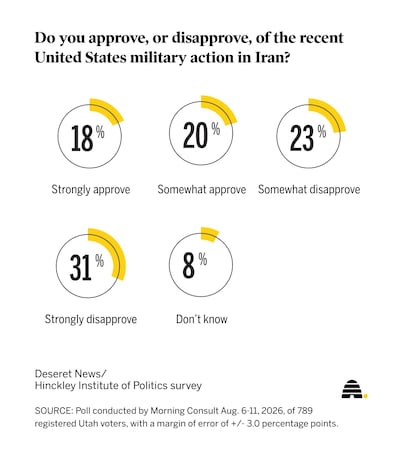
According to a recent Deseret News/Hinckley Institute of Politics survey conducted by Morning Consult, just 38% of registered voters in Utah approve of the ongoing war in the Middle East while 54% oppose the war.
They also are more likely to say that they don’t approve of President Donald Trump’s handling of the war, particularly as negotiations are stalled and it appears the conflict is at a standstill.
Utah represents nationwide disapproval
Colin Dueck, a policy and government professor at George Mason University and senior fellow at the American Enterprise Institute, said the trend seen in Utah is one that’s also happening nationally.
“I think Utah is typical of the whole country,” he said in regard to opposing the Iran war. “The national trends are that this war is quite unpopular.”
“Democrats, independents and non-MAGA Republicans ... have all turned hard against this war,” he continued. “The president is deep underwater in terms of support.”
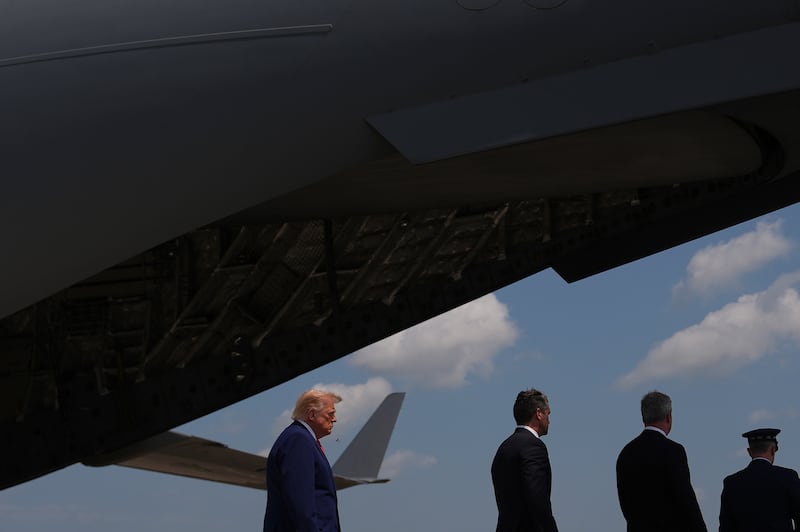
Dueck noted that it’s almost “mathematically” true that wars become more unpopular among the American people the longer they go on, but Trump is in a unique position with the midterm elections looming and no real pathway to out-leverage Iran before November.
Americans are stating in public opinion polls in Utah and across the country that they don’t like the way the war is going, which Dueck said is “a perfectly rational response because it’s not going well.”
Trump stated earlier this year that the war would be a “short incursion” but the months since have been marked by ceasefires starting and ending.
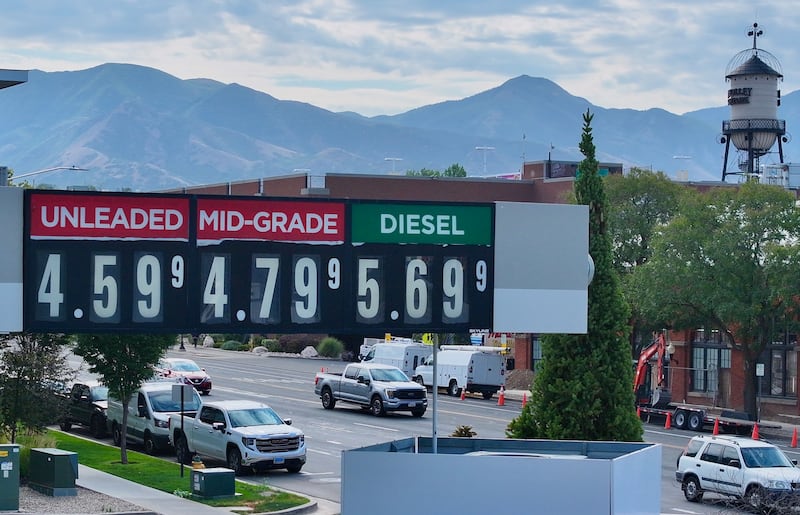
Amid the war, Americans are seeing record-high gas prices, with the American Automobile Association reporting the national average per gallon of gas is $4.08. In Utah, it’s higher at $4.38 per gallon. GasBuddy expert Patrick De Haan said this week that data showing live U.S. average prices of diesel hit $5.50 a gallon and could reach or surpass the record soon.
Utah shifts over war justifications
While Utahns aren’t happy about the ongoing war, their responses shift when they are asked about whether the military operation is justified for specific purposes.
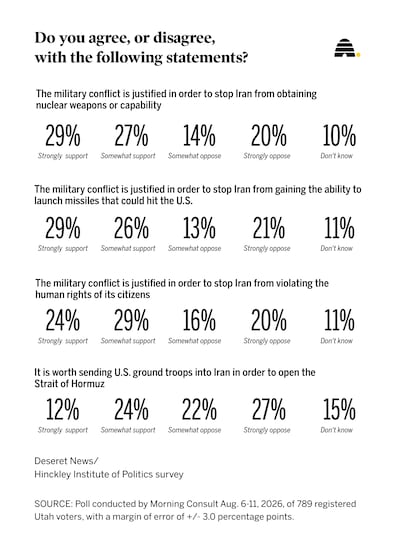
For example, 58% oppose the war when asked about the conflict generally, compared with 38% who support it. But those numbers nearly reverse when Utahns are asked if the military action is justified to prevent Iran’s leadership from obtaining a nuclear weapon. In that case, 56% said the war was justified for that purpose, while 34% said it was not.
The same pattern emerged when Utahns were asked about other potential justifications for the war, including preventing Iran from developing the ability to launch missiles capable of striking the United States, with 55% saying that justifies military intervention, while 53% of Utahns say conflict is justified to stop the Iranian regime from harming the human rights of its citizens.
The survey results show that while Utahns appear broadly opposed to the war, that opposition becomes less clear-cut when the question is framed around specific threats or objectives.
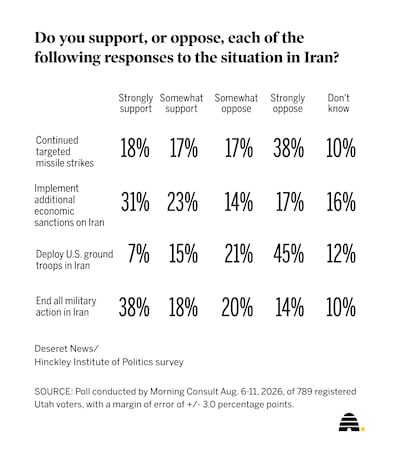
When asked what should come next in the conflict, the survey found Utahns were most likely to say they want the U.S. to wind down the operation. More than half, 56%, of respondents wanted the military action to end while 34% were against ending the war.
There was broad support for levying additional economic sanctions on the regime, which is the latest approach by the Trump administration, led by Treasury Secretary Scott Bessent.
Still, Dueck warns that there’s a lot of “fluidity” in public opinion polls and answers to questions can change often and often are based on how they’re worded.
“Most people don’t have ironclad points of view on a very specific foreign policy matters from day-to-day,” he said. “I mean, they may have a general sense of it, and I think that the general reluctance to be at war is quite widespread.”
However, Jason Perry, the director of the University of Utah’s Hinckley Institute of Politics, said the data show an important distinction between the “goal and how you get there.”
“Utahns can believe Iran should not have a nuclear weapon or that human rights abuses should be confronted without necessarily supporting continued military action. In fact, we see majority support for additional sanctions at the same time a majority wants U.S. military action to end,” Perry said. “That suggests the disagreement may be less about whether Iran poses serious problems and more about what the United States should do about them.”
Trump facing responsibility
The war is becoming a larger issue for Trump, whose approval rating among Utahns is underwater. Since the start of the war, his approval rating has been dropping and Jeremy Pope, a political science professor at Brigham Young University, detailed how there’s a relationship between Trump’s low approval and the war in Iran.
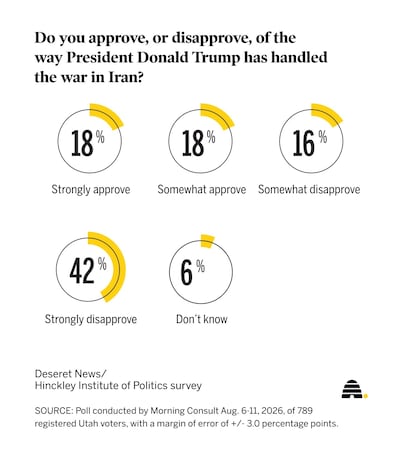
Before the war started in late February, his job approval was at or above 50% in Utah but has dropped off since the conflict started.
Pope argued that if Trump were able to “wind down” the war with Iran, instead of being in a negotiation phase, he’d see his approval start to tick back up because Americans won’t be deflated by high gas prices.
“It’s like an open sore on his presidency and he doesn’t know how to fix it,” he said.
Dueck agreed, saying the apparent stalemate in the Middle East is “definitely” a problem for the president and “definitely” a problem for Republicans.
“This is one of those rare cases where you have a foreign policy problem that really impacts people’s lives in the sense of they can see that gas prices are up, and that’s already in a situation where affordability is an issue and inflation is a concern and prices in general are higher,” he said.
“This is one of those unusual cases of a foreign policy decision that actually could impact a midterm election and it ties into these pocketbook reasons,” Dueck added.
It’s put Trump in between a rock and a hard place, the experts explained.
“We can’t say for sure from this poll that the war caused his approval rating to decline, but when voters are also concerned about the economy and the cost of living, it adds another significant issue on which the president is facing dissatisfaction,” Perry said.
Since starting the war in late February, Trump has struggled to find a way to end the unpopular war. He can’t escalate the fighting as much as he’s threatened to, but he’s also unwilling to cede ground to Iran.
Trump is stuck, Dueck said, because prior to the start of the conflict, Iran didn’t see the Strait of Hormuz as something it could assert control over. Now, they’re being uncompromising about the vital waterway.
Dueck argued that Trump should have factored in the issue of the strait before launching the operation and he “ultimately has responsibility for this.”
As a Republican, Dueck believed the president handled foreign policy better during his first term and pointed to Trump’s previous statements, including during his 2024 campaign, in which the president said he wouldn’t get the United States into new wars.
“They absolutely did not consider and take into account all the possible downsides and ... that’s up to the president,” he said.