
Put yourself in Nate Schmidt’s shoes for a moment.
At age 25, you’re ripped away from the only NHL team you’ve ever known. Now, you have to play for an expansion team — a rag-tag group of misfits — 2,500 miles away. You have very few connections in Las Vegas, but you decide to make the best of it.
Your new team surprises the hockey world by making the Stanley Cup Final that very first season. You turn into somewhat of a household name among NHL fans rather than the depth piece you were in Washington, D.C. The city embraces the team and you’re among the faces of the franchise.
Life is great, too. You can wear shorts to the rink in February, you have no state taxes and there’s plenty to do off the ice. Every game is sold out and your team quickly becomes one of the most respected in the league.
Before long, you’re offered life-changing money: $35.7 million on a six-year deal. Undrafted players rarely get that type of money in the NHL. It’s a no-brainer to sign it.
And then everything changes.
The team decides it would be better-off with the cap space rather than keeping you. You’re traded for a third-round pick. Where do you land? With the Vancouver Canucks, a team with low expectations in a with high taxes and gloomy weather.
It didn’t work out for you there, so after one season, the Canucks recoup their third-rounder by shipping you to perhaps the coldest-climate city in the NHL: Winnipeg to play for the Jets.
What went wrong? You didn’t negotiate enough trade protection.
Your future was always at management’s mercy — and through that and a number of similar moves the Vegas Golden Knights have developed a reputation as a team with no mercy. To them, players are like car parts: If one isn’t working, you toss it in the trash and install a new one.
Hoping to avoid similar situations, the majority of notable players in the current era of the NHL have some form of trade protection. As of the time of writing, there are 111 no-movement clauses in the NHL, and 312 players have some form of trade protection.
No team has fewer than five players with at least a modified no-trade clause. The Toronto Maple Leafs, who have the most, would have to get approval from 15 of their players before involving them in certain trades.
Compared to the other major professional sports leagues in North America, that’s a lot.
Eric Macramalla, a sports legal analyst for Forbes and TSN, posted the stats in June. Major League Baseball at the time had 35 players with trade protection. The NFL had eight and the NBA had just two.
Precise numbers have changed since then, but the point remains: NHLers are much more likely to negotiate trade protection. Why is that?

Hard cap and a culture of ‘taking less’
Of the four major pro sports leagues in North America, the NHL and the NFL are the only ones with a hard salary cap.
In the NBA, for example, there are a variety of exceptions that allow a team to go over the cap. In the NHL, the league will not approve a transaction that puts a team over the cap during the season.
Why is that significant? Because in the NHL, teams offer trade protection in place of monetary compensation as a means of keeping their payrolls lower. That strategy hasn’t found its way to the other leagues.
Tyler Johnson, a 13-year NHL veteran who retired after the 2024-25 season, recently joined Jeff Marek on The Sheet to break it down.
“When you negotiate your contract, you always, kind of, have a dollar amount based off that no-trade or no-move,” he said.
“So, for example, when I signed my bigger contract, we believe that the no-trade clause was worth about $500,000 to $750,000 a year. So, if we didn’t want that no-trade or no-move, I was going to have to make that much more each year, so it was kind of up to the team to decide.”
Some players see it as less transactional than what Johnson explained.
As explained in a recent Deseret News article, certain guys take less money as a way to help manage the team’s salary cap and increase its competitiveness. However, unless they negotiate trade protection, they can end up being casualties of a cutthroat business, getting shipped off to a less desirable location — sometimes with much higher taxes — while still playing at that discounted rate.
Darren Ferris, an agent who represents the likes of Mitch Marner, Bowen Byram and Sam Bennett, joined The PuckPedia Hockey Show, where he touched on the topic.
“If you don’t have a no-move, it makes no sense (to take less),” he said. “You could sign a deal in Florida and end up in New York state, and then your salary’s a lot different.”
Stability
According to data listed on the NHL media site, the average age of an NHL player is 28.6.
That’s significantly older than the average in both the NBA (26.4, according to The Hoops Geek) and the NFL (26.6, per JokerMag). MLB players come in slightly below NHLers at 28.5, according to Statista.
Older players are more likely to have spouses and children, which complicates moving significantly. A single, childless player can move with relative ease. He’s only packing the belongings of one person, and his teammates form a built-in social network in his new city. His biggest inconvenience might be finding the new stadium on his maps app.
A family man, on the other hand, has to make arrangements for countless items to be moved; His kids have to adjust to a new school; His spouse has to find new friends.
For that reason, it’s likely that the average NHL player values guaranteed stability more than those in other leagues. Stability is only guaranteed if you negotiate it into your contract.
Does the NHL have a trade protection problem?
Recently, a trend has taken over the NHL: Using your trade protection to control your precise landing spot.
A player will commit to a team on a long-term contract, and the team will give him a no-movement clause as a commitment to not trade him. If the player changes his mind a few years into the deal, he will go back on his commitment and demand a trade.
The problem is that the team is still obligated to keep its no-movement commitment, meaning the player can tell the team exactly where to trade him. If the team opts not to trade him, things get awkward really quickly.
The Deseret News wrote on this in detail earlier in the summer.
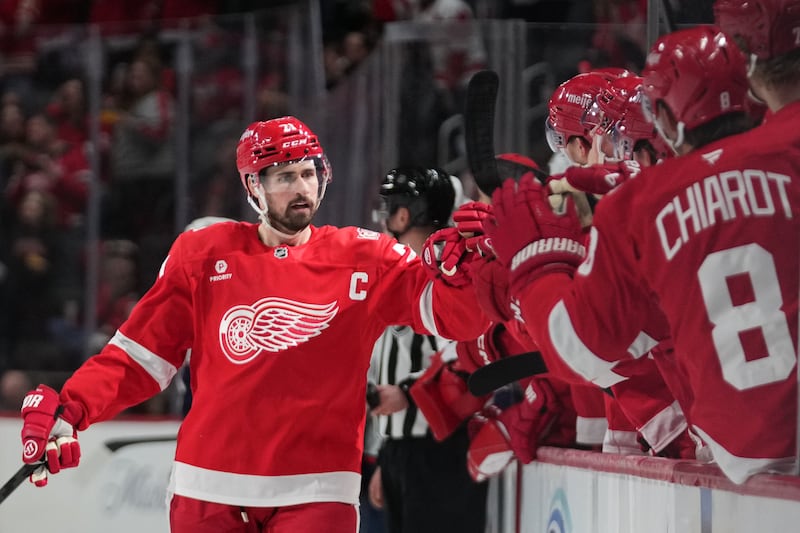
It worked for Brady Tkachuk this summer when he forced his way to the Florida Panthers to play alongside his brother, Matthew. Dylan Larkin is trying to do the same, giving the Detroit Red Wings a list of four teams to which they can trade him.
Zach Weresnki reportedly tried to pull a similar maneuver, but he and the Columbus Blue Jackets have since announced that he will stay put.
This isn’t a new concept.
Jarome Iginla, for example, did it when he went to the Pittsburgh Penguins in 2013, much to the chagrin of the Boston Bruins. Claude Giroux did the same in 2022 to land with the Panthers. But when so many stars do it at the same time, with the same handful of destinations on their lists, it makes a joke out of the NHL’s parity.
Many have suggested that the league should step in and adjust its rules in the next collective bargaining agreement — perhaps a stipulation that if you ask for a trade, you lose the right to control your landing spot.
Others want to see a limit imposed on how many NMCs and NTCs each team is allowed to give out.
Here’s why that will never happen.
It’s not as simple as creating a new rule. CBA negotiations involve a certain amount of give-and-take between the league and the players’ association. If the NHL wants to limit a player’s rights, it will come at the cost of something the players want.
Trade protection just isn’t a big enough issue for the league to give something up.