



Everyone expects things to be the same as they were the previous year.
Look at any NHL expert’s season predictions and you’ll see a carbon copy of the previous year’s standings, aside from a few teams moving up or down a couple spots.
Truthfully, though, the Stanley Cup Playoffs feature a different group of 16 virtually every spring.
Who would have predicted, for instance, that the back-to-back Stanley Cup champions and the defending Presidents’ Trophy winners would both miss the playoffs in 2026? On the other hand, after a full offseason of being discussed as the only team actively trying to get worse, the Pittsburgh Penguins made the playoffs.
It’s especially true in the Central Division, the almost-undisputed toughest division in the league.
This is not to say that the Central Division will have a new champion this year, but it’s not unfathomable that the current powerhouses could begin to fade.
Nobody is getting younger
According to the NHL Media Site, only two NHL teams are older than the Colorado Avalanche — and once it updates to exclude the departed Zakhar Bardakov from the Avs’ roster and include Gavin McKenna on the Toronto Maple Leafs, Colorado might jump up another spot or two.
Nathan MacKinnon and Cale Makar are still at the height of their abilities and the team’s Stanley Cup contention window is as open as it’s ever been. But a lot of the supporting cast is already getting fitted for walkers and dentures.
- Brent Burns is the oldest player in the league, but he still averaged 19 minutes a game last season.
- Nazem Kadri qualifies for performance bonuses now — essentially the NHL’s senior discount program.
- Josh Manson is only a year behind Kadri, believe it or not.
- Brock Nelson has more gray hairs than black ones now.
- Gabriel Landeskog was once the youngest captain in NHL history, but he’s a seasoned veteran now.
- Brett Kulak and Devon Toews are closer to the end of their careers than they are to the beginning.
Once Father Time catches up to the group, there’s nothing in the system to replace them. The Avalanche haven’t drafted in the first round since 2023 and their top prospects could realistically never even see NHL ice.
Perhaps they plan to take a page out of the Golden Knights’ book and replenish the cupboards through trades and free agency signings, but that strategy doesn’t seem to work long-term for teams whose taxes are more plentiful than their palm trees.
Departing stars?
Age won’t deteriorate the Minnesota Wild anytime soon, but plane tickets could.
They committed $17 million to superstar forward Kirill Kaprizov last fall. That was before they acquired Quinn Hughes, whose $7.85 million salary is among the most team-friendly in the league.
After the upcoming season, though, Hughes is due an unprecedented raise. Whatever the number is, it will take some gymnastics for the Wild to be able to fit it under their salary cap.
There’s also a gravitational pull coming from the state of New Jersey, where both of Hughes’ brothers play.
If he leaves, the Wild could regress back to their previous state: a good team that’s still a few stars short of accomplishing anything. And much like the Avalanche, they have pushed all their chips into the middle too many times to have any hope of retooling through the draft.
The Winnipeg Jets are in a similar situation.
Rumblings have surfaced that goaltender Connor Hellebuyck, whom you might remember as the goalie that single-handedly beat Team Canada in the Olympic gold medal game, might ask out of Winnipeg.
Being cold, remote and highly taxed, that city has a notoriously hard time attracting free agents, so losing one of the best players in the world might be more than it can overcome.
The team experienced a major fall-off when Hellebuyck missed 11 games due to knee surgery last year, going 2-8-1 ultimately leading it to miss the playoffs. Hellebuyck won the Hart Trophy in 2025 as the most valuable player on the team — largely because when he wasn’t in net, the team turned from Dr. Jekyll into Mr. Hyde.
Imagine how helpless the Jets would be if Hellebuyck left altogether.
Plus, if he switches teams, will Mark Scheifele, Kyle Connor and Josh Morrissey be inclined to do likewise?

One team isn’t going anywhere
The Dallas Stars round out the class of the Central Division, and their decline doesn’t seem to be coming anytime soon.
Yes, there’s a high likelihood that Jason Robertson is gone by this time next year, but the team has so many young stars, the impact shouldn’t be too big.
The Stars have put on a masterclass in building through the draft while staying competitive.
In the last 10 drafts, they’ve selected Robertson, Miro Heiskanen, Wyatt Johnston, Thomas Harley, Jake Oettinger, Logan Stankoven and Mavrik Bourque, among others. In that same span, they’ve only missed the playoffs three times. They’ve made the Stanley Cup Final once and reached the Conference Final four times.
Dallas is a team that will be good for years to come, and it will be shocking if this era doesn’t involve at least one parade down Victory Avenue.
Who’s on the rise?
Utah Mammoth
When one team falls out of the running, another naturally takes its place. The Utah Mammoth are in a prime position to take the mantle as the next great team in the Central Division.
Clayton Keller, Nick Schmaltz and Mikhail Sergachev should still have five-plus years of highly productive play before they even think about declining. Logan Cooley and Dylan Guenther are just arriving at the prime of their careers and Tij Iginla, Dmitri Simashev and a number of others form a third wave of potential Mammoth stars.
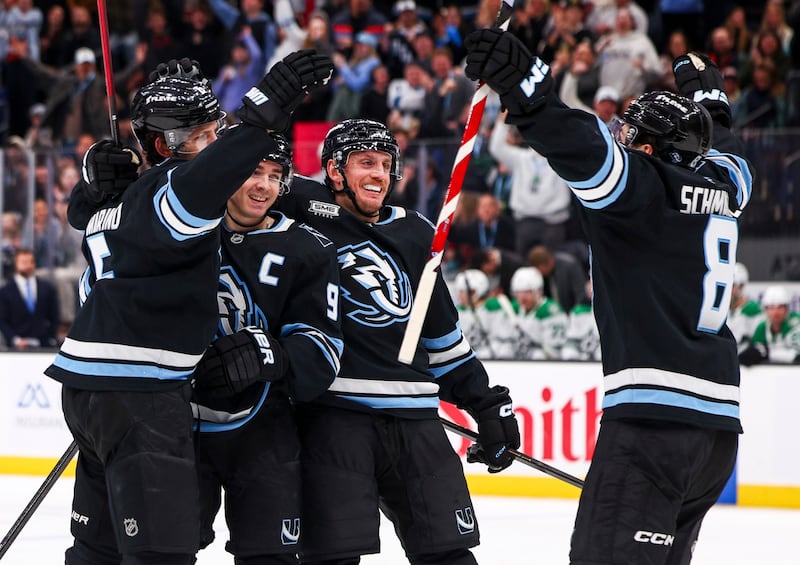
The salary cap plays a major role in a team’s ability to build a successful roster. The fact that Cooley, Guenther and Schmaltz are all locked up for the next seven or eight years at highly manageable price tags gives Utah a huge leg up.
Remember, Cooley and Guenther combined make less money than Anaheim’s Leo Carlsson makes on his own — and the Ducks will likely have to pay Cutter Gauthier a similar number to Carlsson’s.
Having made the playoffs in 2026, the Mammoth are already on the rise. It’s still too soon for them to go all-in, but they’re steadily taking steps forward. Don’t count them out from being contenders in the next few seasons.
Chicago Blackhawks
They aren’t as close to the top as the Mammoth are, but the Chicago Blackhawks have a stable full of young thoroughbreds champing at the bit.
Connor Bedard is steadily morphing into the top player he was always projected to be; Frank Nazar looks like a future first-line NHLer; Bowen Byram is set to become the highest-paid defenseman in the league; Spencer Knight has consistent moments of greatness.
The next wave is set, too.
Anton Frondell had a great showing in his 12 games last season and will likely finish high in Calder Trophy voting as the 2027 rookie of the year; Artyom Levshunov and Kevin Korchinski could still become productive NHL defensemen; Oliver Moore and Sacha Boisvert will get to show what they’re made of this year; and Roman Kantserov comes in from Russia with high expectations.
The Hawks are the fourth-youngest team in the NHL, but with a few more years, they could easily develop into an absolute force.
Does this change the perspective of top free agents?
Of this summer’s 20 highest-paid unrestricted free agents, only three chose to sign in the Central Division. By contrast, the Metropolitan and Atlantic each drew six and the Pacific had five.
It’s a small sample size, but it suggests something that some had suspected: people don’t want to get stuck in the most difficult division in hockey.
A Central Division representative has not made the Stanley Cup Final since the 2022 Avalanche. The teams tend to beat each other up so much in the first and second rounds that they have no energy left for the Conference Final, allowing the Pacific Division winner to waltz on through to the big dance.
Do you think that will factor into Connor McDavid’s decision if he decides to leave the Edmonton Oilers in 2028? Players want to go places where they can win, and the Central Division is too crowded right now.
