

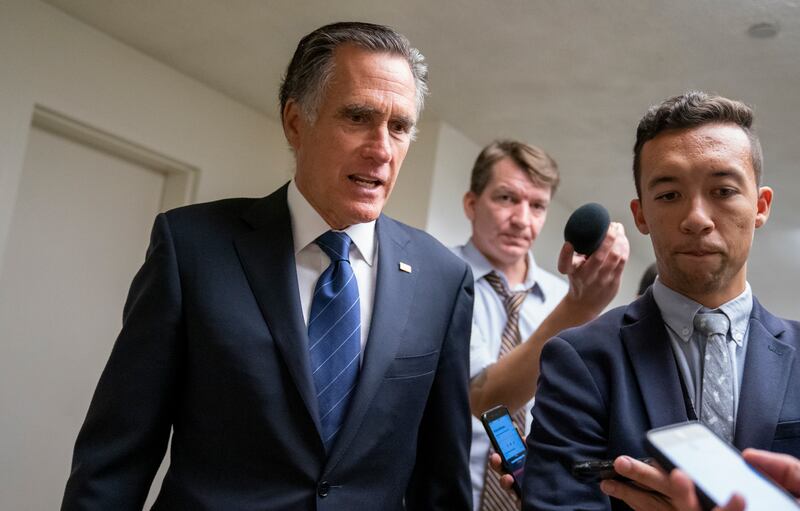

SALT LAKE CITY — Sen. Mitt Romney says the Trump administration is ill-prepared to deal with the coronavirus should there be an outbreak in the United States.
The Utah Republican said “we should be pulling out all the stops” while raising his concerns in a private briefing with administration officials in Washington.
“I’m very disappointed in the degree to which we’ve prepared for a pandemic, both in terms of protective equipment and in terms of medical devices that would help people once they are infected,” he told reporters.
Romney, a member of the Senate Health, Education, Labor and Pensions Committee, said things like masks and gowns that medical workers and the public would need should have been put aside a long time ago, but haven’t been. He also wondered if there are enough respirators and other equipment to take care of people if they get sick.
“I’d like to see us investing more than we have been and probably more than than we’re planning at this stage, to make sure that in the event that something comes to this country and were to spread that we’re able to care for our people,” he said.
Romney said it would make sense to have a person in the government to ensure a unified response to the threat of coronavirus.
President Donald Trump and U.S. officials sent mixed messages Tuesday about the risk of the virus in the United States.
Trump and his chief economic adviser said that the new coronavirus is under control in the U.S., even as the government’s top disease fighters warned Americans to prepare for an outbreak.
The competing views came as the stock market tumbled for a second straight day and lawmakers from both political parties questioned whether the White House’s request for $2.5 billion in virus response funding will be enough to prepare the nation, according to The Associated Press.
Speaking earlier in the day from New Delhi, India, Trump said “we have very few people with it.” A “lot of talent” and a “lot of brainpower” is being tapped for the coronavirus response, he added.
Trump said the situation is “very well under control in our country.”
Later, economic adviser Larry Kudlow portrayed the stock market’s slide as a buying opportunity for investors.
“Our economy is in good shape,” said Kudlow. “This virus won’t last forever. We have contained it.”
But Dr. Nancy Messonnier, who leads work on respiratory diseases for the Centers for Disease Control and Prevention, told reporters that “it’s not so much a question of if this will happen anymore, but rather more a question of exactly when this will happen — and how many people in this country will have severe illness.”
U.S. health officials say there’s no mixed messaging — they have previously warned that they expect some spread around the country. The message has become more urgent as they work to educate Americans about the risk, and about the steps that would be taken if they are unable to contain the new virus by quarantining travelers coming to the U.S, The Associated Press reported.
Now, they want people to start thinking about different kinds of measures they might see if the virus starts spreading, including closing schools and encouraging telework. Those steps were taken during the 2009 H1N1 flu pandemic.
“Part of preparedness is an educated population thinking about the future,” said Health and Human Services Secretary Alex Azar. “The immediate risk to the general American public remains low, but that has the potential to change quickly,” he added.
Tuesday morning on Capitol Hill, senators of both political parties questioned whether the White House’s request for $2.5 billion would be enough, according to The Associated Press.
“If you low-ball something like this, you’ll pay for it later,” Sen. Richard Shelby, R-Ala., told Azar, Trump’s top health official. The two faced each other at a budget hearing that turned into a forum for assessing U.S. readiness.
Shelby said if the virus keeps spreading, “it could be an existential threat to a lot of people in this country.” He chairs the powerful Appropriations Committee, which sets spending levels for federal agencies.
Azar said that nearly two months after the first alarms were raised, there’s no evidence the virus has spread here beyond patients infected overseas and a few close relatives. He credited travel controls and mandatory quarantines, adding that government scientists are working to develop a vaccine and to perfect a test for detecting the virus, according to The Associated Press.
“We cannot hermetically seal off the United States to a virus and we need to be realistic about that,” the health chief acknowledged. “We’ll have more cases in the United States, and we’ve been very transparent about that.” If it happens, “we’ll work to mitigate those.”
Democratic Sen. Patty Murray of Washington said the administration’s handling of the crisis has been “unacceptable.”
“We cannot afford to plan on the cheap or at the last minute,” she said. “I’m deeply concerned that we are way behind the eight-ball on this,” she added.
In an indication of the challenges, Azar said the government currently has stockpiled 30 million special N95 respirator masks, but 300 million would be needed to protect health care workers in an outbreak.
Azar told senators that U.S. cases currently total 57. That includes 14 who either traveled to China or were close relatives of travelers; three Americans repatriated from Wuhan, the epicenter of the outbreak in China; and 40 passengers returned home from the cruise ship Diamond Princess.
The White House budget office said the $2.5 billion would be used for vaccine development, treatment and protective equipment, but Democrats immediately slammed the request as insufficient.