


SALT LAKE CITY — Physicists at the University of Utah have been awarded a grant to study how environmental conditions might affect the spread of the novel coronavirus.
This is ongoing as a rising number of cases are being confirmed in Utah.
The Utah Department of Health on Thursday said 78 people have now tested positive with COVID-19 in Utah, including 68 residents and 10 visitors, after more than 1,526 people have been tested, though some private labs are not reporting tests with negative results to the state.
It’s a jump of 15 cases since Wednesday, according to the health department.
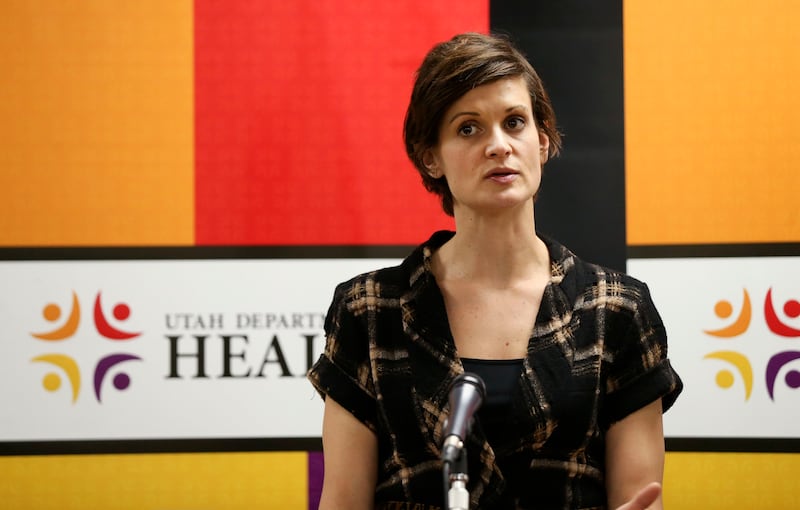
“Salt Lake County and Summit County are really bearing the brunt of this disease,” said state epidemiologist Angela Dunn. She said Salt Lake is affected because it is the most populated area in the state and Summit because of tourism.
“We are at the very beginning of this epidemic,” Dunn warned. “Outbreaks like this can last several months.”
Dunn said it is important that Utahns continue to adhere to social distancing recommendations and public health orders statewide to limit the spread of illness by people who may or may not be experiencing symptoms.
A breakdown of cases by health district, according to the Utah Health Department:
- Salt Lake County, 29 residents, 2 nonresidents
- Summit County, 19 residents, 7 nonresidents
- Davis County, 6 residents
- Weber-Morgan, 4 residents
- Utah County, 2 residents, 1 nonresident
- Southwest Utah, 1 resident
- Wasatch County, 3 residents
- Tooele County, 1 resident
- Bear River Health Department, 3 residents
More Utah cities are declaring states of emergency, including Herriman on Thursday. The declaration, which is largely a formality, allows cities to have the option of federal and state funding assistance should virus response efforts need to be ramped up.
Researchers at the U. are also using their expertise to help with a grant to study the spread of the novel coronavirus.
“The idea is to figure out what makes this virus fall apart, what makes it tick, what makes it die,” said Michael Vershinin, assistant professor of physics and astronomy and co-principal investigator of the grant.
He said they are not working to find a treatment or develop a vaccine for the rapidly spreading illness, but “hopefully inform policy decisions going forward.”
Vershinin and Saveez Saffarian, also of the U.’s department of physics and astronomy, have searched the fully-sequenced SARS-COV-2 genome and found the exact genes responsible for the structural integrity of the virus. They will recreate it in a way that it won’t have the potential to replicate, infect or spread. And they will study it in living cells to see how it might react to changing temperatures and humidity levels — such as would happen during different seasons.
“Coronavirus spreads similarly to the influenza virus, as small droplets suspended in the air,” Saffarian said.
He said viruses tend to lose their ability to infect people because they lose their structure in different environmental conditions.
Their study “is a clear example of how our investment in basic research years later prepares us for a response to a crisis that impacts not only our society, but also the world,” said Krastan Blagoev, director of the National Science Foundation’s physics division, which awarded the U. physicists the funding on an urgent basis to continue their dive into the global pandemic at the molecular level.
“You don’t just gain the insight that you want by looking at the virus on a large scale,” Vershinin said. “Looking at a single virus particle is the key to being able to tease out what’s going on.”
He credits modern advances in science for being able to arrive at new conclusions and “ask these questions in a way we never have before.”
Scientists across the globe are scrambling to understand all aspects of the fairly new and highly contagious illness and are learning new things every day. The U. physicists have been studying coronavirus since January and are prepared to help inform the ongoing dialogue that is framing how people react to the spread of this disease.
Dunn said the availability of testing is increasing throughout Utah, but requires partnerships with private and community laboratories. They each need approval from federal sources, as well.
“Testing is an essential part of any pandemic response,” Dunn said Thursday, adding that testing helps “identify early-on who has the disease and isolate them to limit the spread to other people.”
The issue, however, has been with testing supplies, as each facility providing testing must have enough personal protective equipment for those conducting tests, and that has been in short supply, she said.
Utah has its own priority list for who gets tested and that is set by federally issued public health guidelines and does not favor celebrities or politicians, Dunn said. Unless there is a reason to test someone, which include known exposure or active symptoms of the virus, she said results won’t help.
Dunn said a lot remains unknown about this new strain of coronavirus, but lab testing doesn’t change anything, as known treatments are not available at this time and medical care involves managing symptoms.
“Whether or not you have a test,” she said, “if you have symptoms, you need to stay home.
“The actions taken by everybody will help limit the spread of COVID-19.”