

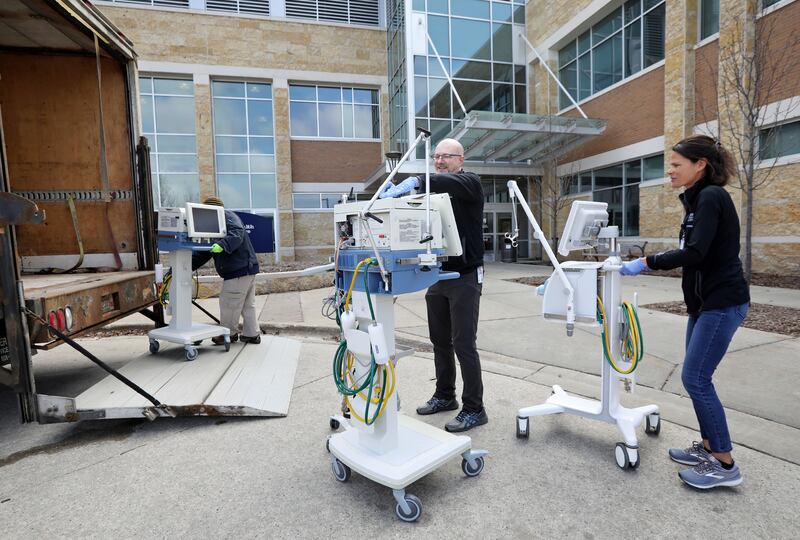

SALT LAKE CITY — As Utah leaders brace for more COVID-19 cases and a possible overwhelming of the state’s hospital system, officials say they believe Utah will have enough ventilators to handle the crisis at its peak.
And yet, it still wasn’t clear Monday exactly how many ventilators are available — though one figure that’s been discussed is around 170.
An analysis by the Institute for Health Metrics and Evaluation at the University of Washington predicts, based on Monday’s projections, Utah will need at least 194 ventilators at the peak of the COVID-19 crisis, shown by its modeling to be April 27. That figure can change daily, based on cases reported nationwide and the dynamic nature of the rapidly spreading disease.
The mechanical breathing devices are critical to save the lives of patients whose lungs are under attack by the virus. If hospitals lack enough ventilators, doctors could face the difficult choice of deciding who gets lifesaving treatment, and who doesn’t.
Salt Lake City Mayor Erin Mendenhall told the Deseret News and KSL editorial boards Monday that officials are reluctant to release the number of ventilators available because they want to “control public panic,” but when pressed to disclose the number for the sake of public information, Mendenhall said the figure discussed in a briefing Sunday was 170.
But that number is fluid. State and hospital officials say efforts are underway to ramp up the state’s preparedness for COVID-19’s peak, including making sure there will be enough ventilators.
Kirsten Rappleye, chief of staff for Lt. Gov. Spencer Cox who is chairman of the Utah COVID-19 Community Task Force, said officials are still counting ventilators and are working on getting more.
“The COVID-19 Community Task Force is working everyday with hospitals to get a clearer picture of how many ventilators they have available for COVID-19 patients. We do not have an exact number of ventilators statewide as of yet, but our medical partners are optimistic that there will be enough resource to address the modeled surge for Utahns,” Rappleye said.
Rappleye added that it’s not just hospitals that can contribute ventilators.
“We believe there are potentially many more to be found throughout the state within clinics and other types of medical facilities, which could be integrated to treat future COVID-19 patients,” she said. “We applaud many innovative companies throughout Utah who have reached out and are willing to repurpose their manufacturing capabilities to potentially help us meet this and other needs.”
Greg Bell, president and CEO of the Utah Hospital Association, told the Deseret News on Monday health care officials estimate the state will have enough ventilators when they consider consolidation of resources systemwide, but he did not clarify how many ventilators that entails.
“When you add in convertible units, anesthesia units in operating rooms, pediatric units, we feel we have sufficient ventilators to meet the predicted surge estimated by (the Institute for Health Metrics and Evaluation),” Bell said in an email. “I’m meeting with the hospital systems today and will refine that somewhat.”
Salt Lake County and state leaders have been conducting their own modeling, based off of local projections, and are bracing for when the health care system will be overwhelmed. While numbers can change daily, based on their modeling, Mendenhall said the stress point for hospitals could be soon.
“Between about April 6 and May is the time we are likely to see our health care system reach its capacity and not be able to serve people as functionally as it should,” Mendenhall said.
On Friday Gov. Gary Herbert issue a directive to encourage Utahns to stay home and further restrict their movements in hopes of slowing the spread of COVID-19, just short of a stay-at-home order. Soon after, mayors of Salt Lake City and Salt Lake County issued their own proclamations to complement Herbert’s directive, making violation punishable as a misdemeanor — though the mayors have said the aim is not to prosecute, but urge Utahns to voluntarily comply.
The Institute for Health Metrics and Evaluation’s predictions are based on the state having no stay-at-home order, but doesn’t factor in other measures that are taking place in Utah.
David Schuld, intelligence section chief with Salt Lake County’s COVID-19 response team, told the Deseret News the county’s modeling does factor in those measures. He also said the IHME’s study uses national data that is “skewed” by areas like New York that have much more dense population and case counts.
“Because Salt Lake County has implemented stricter social distancing policies earlier, we’ve been able to mitigate and flatten that trajectory so that medical systems in Salt Lake County and across Utah have more time to prepare and get ready for that eventual rise to a peak,” Schuld said.
Still Schuld didn’t have a clear answer to the question of whether Utah will have enough ventilators when COVID-19 peaks here.
“I wish I could answer that question on a daily basis,” he said, adding that his team is working daily to monitor Utah’s projections and forecast cases. That trajectory can change every day, depending on how many cases are reported and if they bump the trend up or down.
So far in Utah, 806 COVID-19 cases have been reported. As of Monday, officials have confirmed four deaths in the state. Those numbers will continue to rise. And it’s too soon to say what kind of impact state and local directives will have and whether they will “flatten the curve.”
Officials likely won’t know for one to two weeks whether the new social distancing orders will have the desired impact. Symptoms of exposure may appear anywhere between two to 14 days, based on COVID-19’s estimated incubation period, according to the CDC.
“So yes, I’m absolutely concerned,” Mendenhall said. “We all should be.”
In the meantime, Utahns should heed those warnings, treat the epidemic seriously and act as though lives depend on their actions. Because they do, Mendenhall said.
“We need to be remembering why we’re doing this,” the mayor said. “It’s literally about saving lives, about the people in our community, about our parents, our workers, our neighbors. That’s what’s on the line here. It’s not just how long will our economic impact be felt, but how many people will be impacted.”
As Utahns react in different ways to the global pandemic, state and local leaders have been caught between a range of opinions over governments’ action to control COVID-19’s spread. Some have urged leaders to enact stronger stay-at-home orders. Others say the pandemic has been overblown and are pushing for a return to normalcy sooner rather than later to prevent further damage to the economy.
In a letter sent to state leaders on March 17, a group of rural county commissioners argued the United States had only 90 deaths and the panic was overstated. Eight days later, the national death toll had risen to 942. As of Monday, the toll was over 2,400.
Dr. Angela Dunn, the state’s epidemiologist, said that even though Utah has a roughly 8% hospitalization rate, which is “small” compared to other states, if cases continue to rise at their current rate, “we will overwhelm our health system in coming weeks.”
Still, Utah’s case rate isn’t growing as fast as other states. “That means social distancing is working,” she said.
Herbert also said state officials are seeking to ramp up testing, from 2,000 tests a day to hopefully 7,000 a day.
“In doing so, that’s going to help us reduce the transmission rate,” the governor said. “Our goal is to drive down the transmission rate and keep from overwhelming our health care system.”
That’s why the next few weeks are crucial for Utahns to social distance and abide by local orders.
“The next two weeks are critical,” Herbert said. “Everybody has a role to play and everybody needs to be engaged.”