

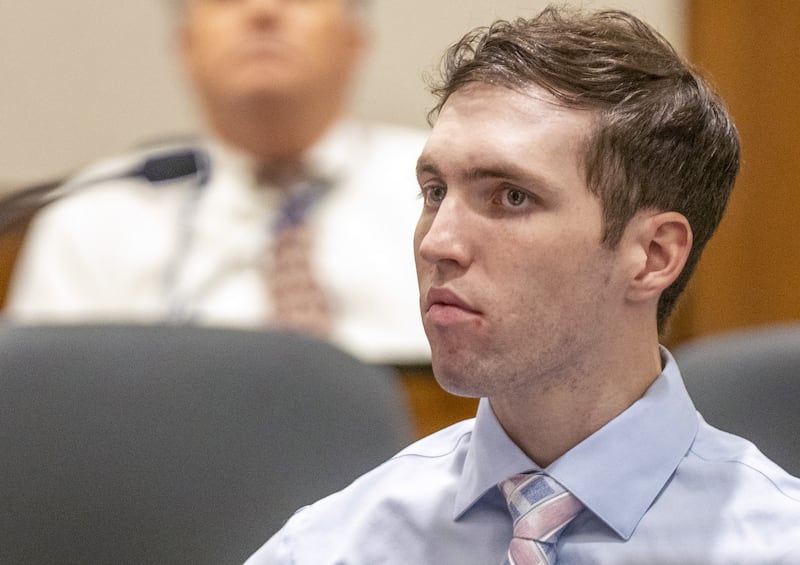
he media will be allowed to have cameras and microphones in the courtroom for the Tyler Robinson preliminary hearing and livestream the proceedings.
Fourth District Judge Tony Graf issued his written ruling Tuesday afternoon. The only exception is the Deseret News will not be allowed to take pictures on July 6, the first day of the preliminary hearing, because its request was submitted after the deadline.
“(Robinson’s) objections to all other electronic media requests are overruled,” Graf stated in his ruling. The Deseret News will be allowed to take pictures on July 8 and 10. KSL will livestream each day of the hearing.
Robinson, 23, is accused of shooting and killing political activist Charlie Kirk at Utah Valley University on Sept. 10, 2025. He faces a potential death sentence if convicted. At a preliminary hearing, a judge decides if there is enough probable cause for a defendant to proceed to trial on the charges levied against that person.
Robinson’s preliminary hearing is scheduled to start on Monday. Kirk’s widow, Erika Kirk, and his parents are expected to attend.
Robinson’s defense attorneys argued that “electronic media coverage of the preliminary hearing will create a reasonable likelihood that (their client’s) right to a fair trial will be violated,” according to court documents.
Graf acknowledged that “this case has received extensive public attention,” and “mainstream news sources, independent news sources, and social media platforms have been saturated with information and misinformation about this case, including conspiracy theories, rumors, and disparaging and inflammatory comments about both (Robinson) and Mr. Kirk.” He also recognized Robinson’s argument “that electronic media coverage of the preliminary hearing will encourage more dialogue and perpetuate the bias and misinformation that has saturated the public sphere.”
However, the judge stated in his decision that the public commentary will continue whether the preliminary hearing is livestreamed or not, and that Robinson has not shown that livestreaming the hearing “will prejudice his fair-trial rights,” according to the ruling.
“This court has already taken remedial measures to reduce the risk of a ‘reality TV show’ or ‘carnival atmosphere’ in the courtroom by enacting a strong decorum order and regulating the seating of observers and placement of video cameras in the courtroom. There is no doubt that participants in the proceedings will be under pressure during the preliminary hearing, but the presence or absence of cameras in the courtroom will not change the rules of evidence and what is admissible or inadmissible in the record. The court intends to focus the attorneys on the determination of probable cause,” Graf continued.
As for the filming of evidence the state intends to introduce during the hearing, Graf did not make a blanket ruling on Tuesday,
“The court reserves ruling on (Robinson’s) objection. The parties are ordered to meet and confer about each exhibit that will potentially be admitted at the preliminary hearing before the hearing begins. The parties are ordered to try and reach an agreement on which exhibits should not be allowed to be captured by video or photography,” according to Graf’s decision.
With Graf clearing the way for cameras in the courtroom for the preliminary hearing, Robinson now turns his eyes to the Utah Supreme Court, where defense attorneys have asked the state’s high court to take another look at two of the judge’s decisions.
Robinson is requesting that the Utah Supreme Court not only take a second look at Graf’s decision allowing electronic media in the courtroom, but also his recent decision to allow hearsay evidence at the preliminary hearing. Specifically, the defense is concerned about the judge’s decision to allow a video interview conducted by prosecutors with Robinson’s former roommate, Lance Twiggs, at the preliminary hearing and holding that Twiggs does not have to appear in person.
Last week, Graf ruled that hearsay evidence is acceptable for the purposes of a preliminary hearing — including a video-recorded interview with Twiggs — and denied a request from defense attorneys to compel Twiggs to attend the hearing in person.
The judge said that the limited purpose of a preliminary hearing is to determine whether the state can meet its low burden of proof that Robinson allegedly committed the crimes he’s accused of. And because a determination of guilt or innocence is not made at that time, hearsay evidence is acceptable. Graf also ruled that unless the defense expects to get testimony during cross-examination that is “reasonably likely to defeat probable cause” established by the state, a recorded interview with a witness is sufficient.
Robinson, however, contends that the court “made fundamental errors in the ruling by failing to address all of the constitutional claims” that he made, and “to compound the problem created by the ruling described above, the district court also improperly rejected Mr. Robinson’s effort to secure the attendance of (Twiggs) who is, perhaps, the most critical witness in this entire case, a witness who, importantly, is not a victim,” the request for appeal argues.
“The combination of these rulings will imminently deprive Mr. Robinson of his constitutional rights to the effective assistance of counsel, compulsory process, due process and equal protection, and protections under the Eighth Amendment at the preliminary hearing that is nearly upon us,” the defense continued. “It is clear that Mr. Twiggs is a material witness. His recorded video interview the prosecution intends to proffer at the preliminary hearing touches on almost every count in the pending (charges) including the sentencing enhancements, and, most importantly, attributes to Mr. Robinson statements which the district court acknowledges constitute a confession as to the charged homicide and an alleged motive.”
Robinson was living with Twiggs in southern Utah when prosecutors say he shot and killed Kirk. The state says in charging documents that Robinson left a note and exchanged text messages with Twiggs, whom he referred to as “Luna,” following Kirk’s assassination.
“Luna, if you are reading this per my text, then I am so sorry. I left the house this morning on a mission and sent an auto text. I am likely dead or facing a lengthy prison sentence. I had the opportunity to take out Charlie Kirk, and I took it,” the letter states, according to a search warrant affidavit.
Robinson’s attorneys argue that they could not cross-examine Twiggs if he is not present in the courtroom.
The defense has requested expedited reviews from the state’s high court on both the electronic media and hearsay issues.
The Utah County Attorney’s Office is expected to call six law-enforcement witnesses and present about 40 exhibits during the preliminary hearing, including the Twiggs video. Robinson says he has three out-of-state forensic witnesses he plans to call to the witness stand.
Contributing: Associated Press