

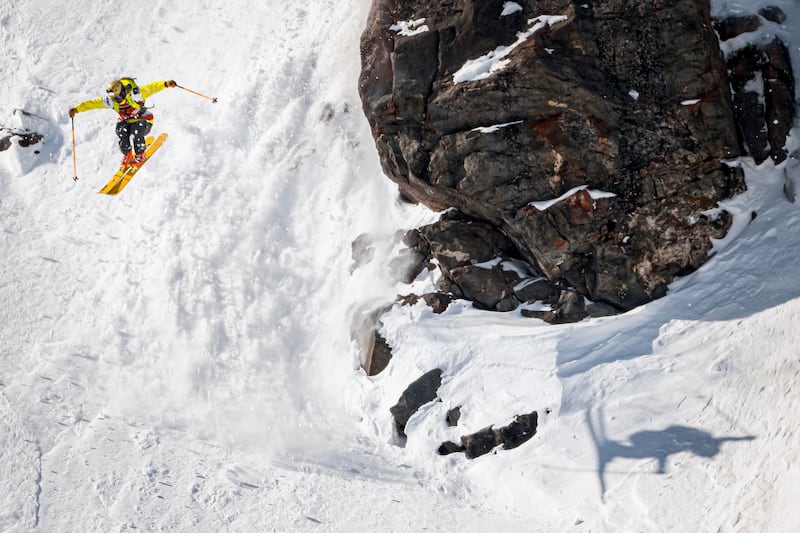

Two new sports disciplines — freeride skiing and snowboarding, along with synchronized ice skating — will make their Olympic debut at the 2030 Winter Games in the French Alps, but Nordic combined was cut from the program.
Tuesday’s decisions by the International Olympic Committee Executive Board, which included adding new ski mountaineering or skimo events, are intended to “enhance gender equality, innovation and youth interest” in the Games as well as help control their cost and complexity.

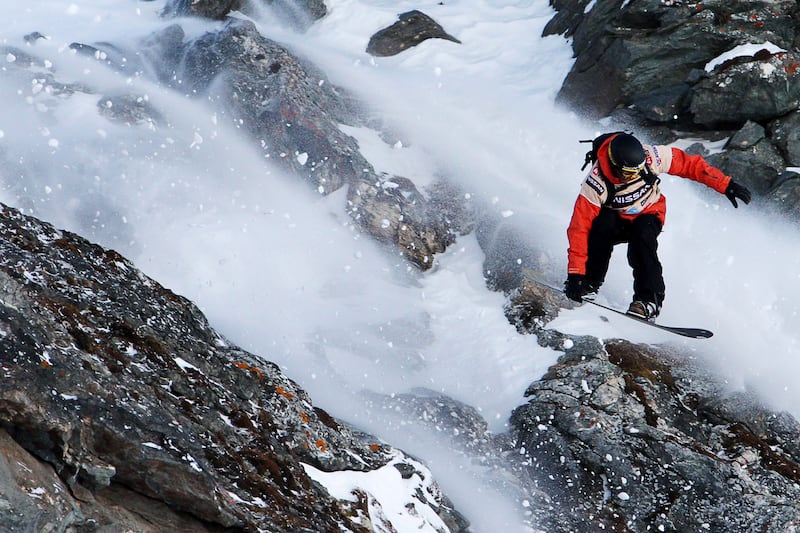
Freeride skiing and snowboarding, a sport that’s growing fast internationally, uses what the IOC calls a “natural field of play,” un-groomed terrain with features like cliffs, deep powder and steep descents.
The “synchro9″ synchronized skating team event added is described as “a key factor in achieving gender parity” for the first time at a Winter Games. The IOC announced 3,046 athletes are expected to compete in the French Alps, 1,525 female and 1,521 male.
What the IOC says about gender equality
“This is a really important part for us,” IOC President Kirsty Coventry told reporters from the organization’s Swiss headquarters during a virtual news conference following the Executive Board meeting.
Asked if Utah’s 2034 Winter Games as well as those that follow will be expected to have an equal number of male and female athletes to match this milestone, Coventry made it clear there will be some leeway.
“What I expect in the future is to be a little bit fluid,” she said. “We don’t want to leave anyone out just because we’re stuck on a specific number. We would love to be able to ensure that every Games is 50-50.”
But, Coventry said, if the gender split was 49-51 in favor of either men or women, “I think that would be OK, too, right. I think it’s just the priority that this is important for us to continue to keep working towards. And not just on the field of play, but also outside of that.”
For the IOC, she said, achieving gender equality is “a principle and a value, and it’s a guiding principle and a value.”
The program for what’s now known as the “Alpes 2030″ Olympics will have a total 126 events — 56 for women, 55 for men and 15 mixed. Details of Utah’s Olympic sports program are not set to be finalized until 2028, according to an updated Games Plan released last month.
Whether any of the new additions made to the French Alps edition show up remains to be seen.
“The program for 2034 will be carried out according to the process we validated two weeks ago,” IOC Sport Director Pierre Ducrey said Tuesday, referring to a new systematic review of sport disciplines approved by the full IOC at a session in June.
That means the IOC will evaluate all the “incumbent” disciplines on the 2030 program, Ducrey said, as well as any new “candidate” disciplines “that could be of interest out there and ultimately make our decision for the finalization of the 2034 program.”
When asked if that would come in 2028, he said the IOC “has not set a date for now. In principle, as we said at the session, it will be seven years before. But we will take the time to decide what is the right time for Salt Lake City.”
No more new sports at Utah’s next Olympics?
Fraser Bullock, president and executive chair of the Organizing Committee for the 2034 Olympic and Paralympic Games, said the changes made for the French Alps Games set a new baseline for deciding what’s on the 2034 program.
“We’re wide open to new experiences and new things that could enhance the Games,” he said.
So does that mean that Utah organizers are eying even more new additions to the 2034 sports program?
“No, nothing. I think they’ve pretty much added everything that was under consideration,” Bullock said, noting Utah’s next Winter Games already will have 40% more events than when the state hosted for the first time, in 2002.
“We’ve got a very full program that’s fantastic,” he said, a program that mostly uses venues from 2002. “So we’ll have a very busy set of venues. Therefore, we don’t see a need to add any additional disciplines at this point in time.”
Plus, more events can mean spending more money. The organizing committee has a $4 billion budget expected to be raised entirely from private sources, largely through the sale of sponsorships, broadcast rights and tickets.
Possible additions suggested for 2034 have also included skijoring, a mashup of skiing and rodeo that originated in the West where a rider on horseback pulls a skier, as well as even some sports more suited to a Summer Games, such as cross-country running or cyclocross.
The IOC previously ruled out any summer sports being added to the 2030 Olympics, but have left the door open to expanding beyond snow and ice competitions for the 2034 Winter Games and beyond, as well as making changes to the Summer Games due to climate change.
Another venue may be needed for the 2034 Winter Games
The new disciplines of freeride and synchronized skating wouldn’t have much impact on the 2034 budget, Bullock said. Nor would skimo, which made its debut at the 2026 Winter Games in Milan-Cortina, Italy, and will be expanded for 2030.
Both synchronized skating and skimo could use existing venues, he said, while freeride’s location appears to be up for grabs. That’s led to speculation either Big or Little Cottonwood Canyons could be considered, even though they were off limits in 2002 due to environmental concerns.
Still, Bullock said there are plenty of alternatives for freeride, a discipline more focused on a TV audience.
“Freeride can be anywhere that has the right terrain,” Bullock said. “It can be in the High Unitas because typically there are not a lot of people that attend that event because it’s at the top of the mountain and difficult to access.”
In 2034, Nordic combined events are planned to be held at the Soldier Hollow Nordic Center near Midway for the cross-country skiing portion and the Utah Olympic Park near Park City for ski jumping. Both venues are also holding other events.
Bullock was excited about the new sport disciplines coming to the French Alps Games.
“I love to ski and freeride blows my mind,” he said, describing the descent by skiers and snowboarders choosing their own lines down challenging terrain as “totally unpredictable. ... I think that’s what makes it appealing and exciting for people to view.”
At synchronized skating’s U.S. championships, held last March at the Maverik Center in West Valley City, Bullock said he “found the precision and coordination of the skaters to be amazing. The creativity as well.”