

Editor’s note: This article is published through the Great Salt Lake Collaborative, a solutions journalism initiative that partners news, education and media organizations to help inform people about the plight of the Great Salt Lake.
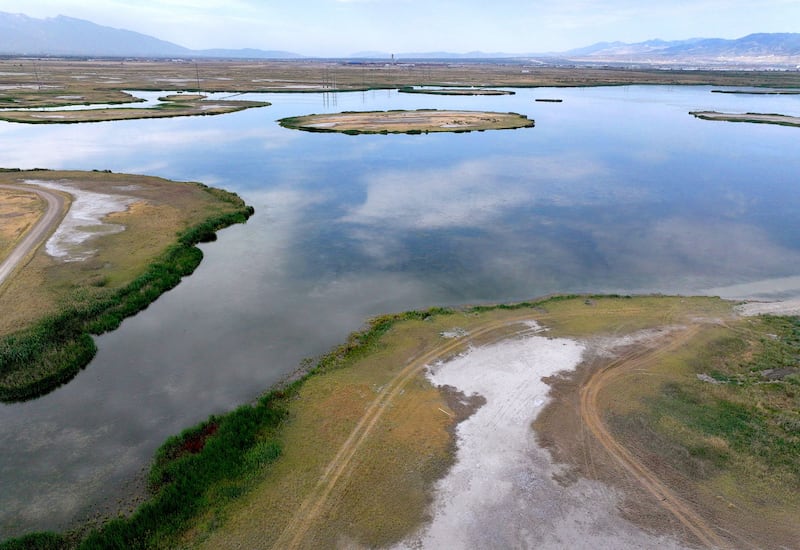
Joel Ferry, Utah’s natural resources commissioner, says he enjoys taking in the sights and smells of the wetlands that surround the Great Salt Lake.
The lake’s wetlands attract a majority of the estimated 10 million to 12 million migratory birds, which utilize the lake every year, and the lands help clean the water that arrives in the lake. Yet, these types of ecosystems have also become threatened over the past few decades by the lake’s decline on one end and mostly commercial development encroaching into them on the other.

“This type of ecosystem is the most imperiled ecosystem that exists around the Great Salt Lake,” Ferry said, standing in the middle of the wetlands within the Rudy Duck Club as various shorebirds chirped around him.
That’s why he’s thrilled about a new partnership with the Utah Inland Port Authority that seeks to preserve the lake’s wetlands and shoreline, protecting them from future growth. The port authority announced on Wednesday that it is allocating $7.5 million toward land conservation funding this year, $2.5 million more than was previously expected.

It will help the Utah Department of Natural Resources protect the lake’s remaining wetlands, Ferry said. The inland port is also launching a new partnership with the state’s water conservation nonprofit Utah Water Way to improve industrial water consumption at inland port facilities, seeking to reduce the water consumed before it reaches the Great Salt Lake.
“It’s everyone’s responsibility to help protect our dear old friend, the Great Salt Lake,” said Ben Hart, director of the Utah Inland Port Authority, adding that there needs to be an immense effort for economic opportunity and the environment to coexist.
Creating a ‘buffer’

Wednesday’s announcement was a few years in the making. Utah is seeking to create a more defined “buffer area” between development and the lake so that commercial developers know where the endpoint is as they seek to develop existing open land, Ferry said.
These types of buffers became noticeable with the creation of the inland port in Salt Lake City and the Legacy Highway connecting Davis and Salt Lake counties, said Utah House Speaker Mike Schultz, R-Hooper. Many new warehouses built in and around Salt Lake City’s last remaining agricultural area added to this.
“This is an area that is under threat,” Salt Lake City Mayor Erin Mendenhall said.

Developers started eying this buffer, adding to the concerns. Utah already purchased one of the highest-risk areas, turning it into the 665-acre Blackhawk Waterfowl Management area, which came from various state sources, Schultz noted.
Salt Lake City also started tweaking zoning rules as commercial development exploded over the past decade, faster than what city leaders expected.
Amid all of this, state officials began working with Salt Lake City to improve the inland port’s model after the two had historically clashed over it. It led to a change this year that sets aside some of the inland port’s profits to go toward public safety and environmental impacts, which is where the new funding comes from.
“(We’re) making sure that we’re not wasting the money on little dinky things that don’t really matter, but we’re making true investments,” Schultz said.
Curbing industrial water
This helped solve one of the wetlands’ risks, but not the Great Salt Lake’s overarching issue. The lake reached an all-time low in 2022 and is nearing that again this year amid drought conditions, which factor into some of its decline.
Most of its decline, however, is tied to consumptive loss. Agricultural uses remain the biggest consumer of the basin’s water, but Utah’s Great Salt Lake Strike Team warns that municipal and industrial water use is growing.
Utah Water Ways conducted a survey last year that found residents were most concerned about there being enough water for future residential growth, but also that the lake’s ecosystem is healthy, said Tage Flint, the organization’s director.
As work to settle the buffer concerns carried out, Utah Water Ways and inland port officials also began working to hammer out ways to conserve water for the ecosystem and future growth. They will work to ensure that every inland port development within the lake’s basin is “water-conscious,” Hart said.
It will be part of a new natural resources policy, which also plans to take into consideration insights from Utah Clean Energy and Utah’s International DarkSky that seeks to balance natural resources while supporting long-term economic opportunity, he explained. The port plans to adjust what’s included in the policy after public feedback before it’s scheduled to be voted on in September.
State and local leaders believe these are just the beginning of what may otherwise seem like an odd partnership.
“We’re going to keep finding ways to make the things happen that we need to save the Great Salt Lake that normally would not happen in the course of business,” Mendenhall said. “That’s the magic of the state of Utah.”