

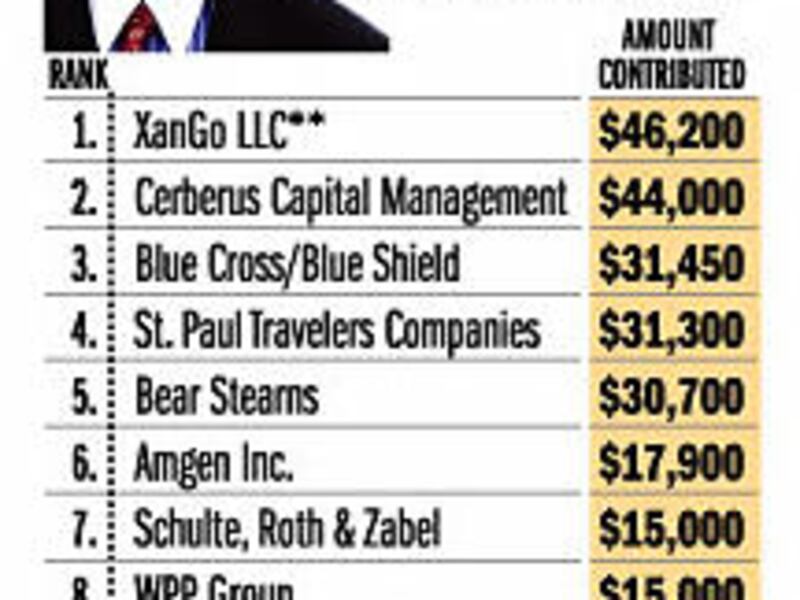
WASHINGTON — XanGo's juice did not exist the last time Sen. Orrin Hatch ran for his Senate seat, but now as the Utah Republican prepares to win his sixth term, the Utah County nutritional drink company has become the top contributor to his campaign — and even added a member to his re-election team.
All six of XanGo's executives, and some of their spouses, have given $4,200 to Hatch, meeting the $2,100 limit for primary and general elections, based on an analysis of Federal Election Commission records and data compiled by the Center for Responsive Politics and PoliticalMoneyLine. All of the donations came in during an April 7, 2005, lunch with XanGo executives and a representative from Hatch's campaign, according to the company.
XanGo of Lehi is Hatch's top contributor to his $3.3 million campaign chest, according to the Center for Responsive Politics, a nonpartisan group based in Washington, D.C., that tracks money in politics. Hatch has about $2 million in cash on hand. FEC data shows XanGo total contributions to be $44,200, although the company says $2,000 will be returned because it exceeded the legal individual contribution limit.
XanGo chairman and chief executive officer Gary Hollister originally donated $2,000 in February 2004 and then tried to donate $8,400 last April, which exceeds the legal limit. His wife, Beverly, made her own $4,200 donation or $2,100 per election, matching her husband's, so all of the money still made its way to Hatch.
The other executives, including president Aaron Garrity, executive vice president Joe Morton, executive vice president Gordon Morton, executive vice president of international relations Bryan Davis, and their spouses followed a similar route. Chief operating officer Kent Wood made contributions, but his wife did not, according to FEC records through Oct. 31, 2005. Some of the executives and their spouses gave about $10,000 to Sen. Bob Bennett, R-Utah, during the 2004 election.
Hollister said the executives each made the decision on his own to give to Hatch; there was no corporate pressure to make the contributions. The latest campaign contribution data will be updated on Jan. 31.
"Orrin has been very good to the supplement industry in the state of Utah," Hollister said in an interview. "We feel very strongly that he has been good to the state of Utah."
Hollister said being aware of what is going on politically is important for any business and that the contributions do not get the company anything specific.
The political contributions help the company be a "good corporate citizen," Hollister said.
Hollister said he is also finance co-chairman on Hatch's campaign because he wanted to back up his financial commitment and continue his support for the senator. He started the volunteer position about six months ago.
Dave Hansen, Hatch's campaign director, said the senator has always been a strong supporter of the supplement industry, and he is proud to have the support of a Utah company like XanGo.
"They give because they believe in what he is doing; it doesn't work the other way around, that's not the way this senator operates," Hansen said. "Nobody gets a favor because of what they give."
Hatch is often described as a "friend" of the supplement industry because he authored the Dietary Supplement Health and Education Act, which passed in 1994. Under the law, dietary supplements do not need approval from the Food and Drug Administration before they are marketed. The industry is still waiting for the government to establish "good manufacturing" requirements called for in the bill, according to the National Nutritional Foods Association.
Metabolife, another dietary supplement, ranks 14th on Hatch's top 20 contributors, according to the Center for Responsive Politics, and the group lists "Pharmaceuticals/Health Products" as the third top industry supporting Hatch with $150,500 in contributions.
XanGo sells one product, the dietary supplement XanGo Juice, named for the antioxidant xanthones found in the mangosteen fruit found in Southeast Asia. The antioxidant is said to help minor muscle pain, the immune system and joint flexibility, according to the company. Any changes to the supplement law or the FDA's role in regulating supplements would affect it.
XanGo is a little more than 3 years old and now has 550 employees, compared to the 13 it had in December 2002, Hollister said. There are 500,000 XanGo distributors, and the company is building two 100,000-square-foot buildings to house its growing business, Hollister said.
The company executives' political contributions and campaign participation are not uncommon, several experts said, but it is likely to bring them more access and some influence regardless of what the company or the campaign says.
"What do they want?" was the first question Gary Ruskin asked when told about XanGo's contributions. Ruskin is the executive director of Commercial Alert, which watches commercialism as well as money's influence on politics.
"Congress resembles a coin-operated machine where you put in a quarter and out comes your favor," Ruskin said.
"Increasingly, we have a Congress that is for sale," Ruskin said. "Money is the lifeblood of American politics, sadly enough.
"This suggests they are probably making some money and want to be political players," Ruskin said. "They see Orrin Hatch as their best horse in the political horse race."
David Magleby, dean of the College of Family, Home and Social Sciences at Brigham Young University, said senators tend to pay more attention to someone who has contributed than someone who has not.
He said there is not a "quid pro quo" for contributing, but there is better access for contributors and those working on a campaign.
"Clearly there is an interest on the part of this enterprise to have a friendly senator," Magleby said. "This is not unusual."
Larry Sabato, director of the Center for Politics at the University of Virginia, said the amount donated is "few grains of sand upon the beach."
"It sends a signal they are present and accounted for," Sabato said. "It's not very much in the scheme of things, but Hatch now knows something about that company. Any senator is going to take care of the needs of a major employer in his state regardless."
Some experts said that a company will not put their money toward candidates they do not support or who will not support the company.
"Money doesn't buy votes, per se, but money follows votes," said Sara Binder, a senior fellow at the Brookings Institution, a Washington think tank. "Giving money is unlikely to change a member's behavior."
She noted that campaign contributions within the legal limits are regulated by federal law, and there is nothing wrong or illegal about them.
Massie Ritsch, communications director for the Center for Responsive Politics, said some people do just give contributions because they support the senator and want to see them succeed. He said it will be important to watch who else the company begins to donate to over time, if it decides to donate to other candidates and if it continues to financially support Hatch.
E-mail: suzanne@desnews.com