

Here's the deal about living in northern Utah County: The towns are not exactly dotted along the freeway.
If you're a resident of, say, Eagle Mountain or Alpine, you've got a good drive to get to Interstate 15 — anywhere from five or 10 to 15 or more miles.
And as northern Utah County has become more populated, commuting along two-lane highways has become even more difficult. On the west side of the interstate, the Utah Department of Transportation is building Pioneer Crossing, which goes from Redwood Road in Saratoga Springs through Lehi to I-15 in American Fork, to relieve congestion.
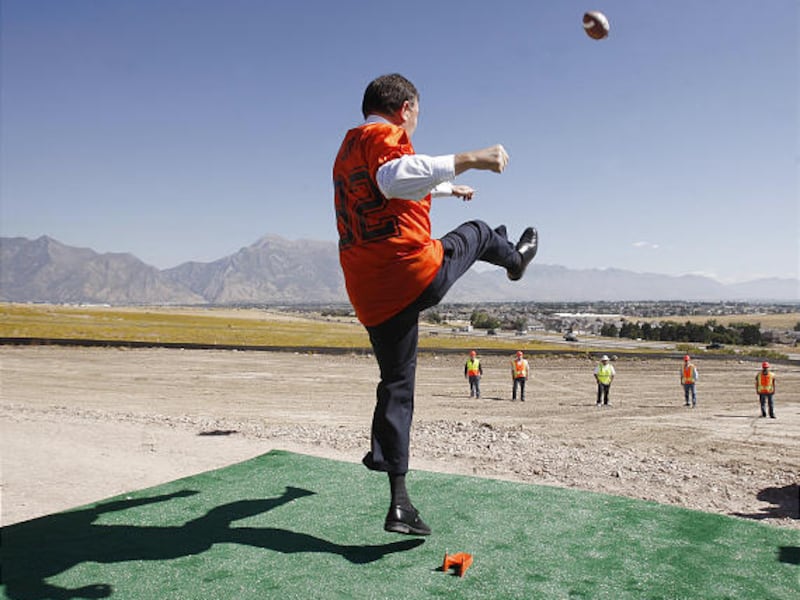
And on Wednesday, UDOT and dignitaries kicked off a $139 million project to expand state Route 92. With completion expected in the summer of 2011, it will affect residents in Lehi, Alpine, Highland and Cedar Hills.
"For a lot of old timers, they like the rural-feel feeling" that the hamlets in northern Utah County provided, said Rep. John Dougall, R-American Fork. "But our community is changing."
Between 2000 and 2008, the area gained about 50,000 new residents, said J. Kent Millington, member of the Utah Transportation Commission, which prioritizes projects for UDOT.
Lehi's population has increased from 19,000 to 50,000. Highland's has increased from 8,000 to 16,000. Alpine's has increased from 7,000 to 10,000. Cedar Hills' has increased from 3,000 to 10,000, Millington said.
Most of the growth is internal, as Utah County has a high birth rate, said Gov. Gary Herbert, who formerly served on the Utah County Commission.
Herbert believes the project will help revitalize the Utah economy as contractors hire crews to expand the road.
"People will have an opportunity to purchase goods and services as that $139 million ripples throughout the economy," Herbert said. "And that affects all of us."
The project involves adding one lane to Route 92 in each direction, plus adding one "commuter lane" in each direction. The highway now has one lane in each direction, plus a turn lane in the middle.
The commuter lanes will be adjacent to, but separate from, the highway. The idea is to keep traffic in the commuter lanes moving. They will not have stoplights and will merge on and off the freeway ramps and various city streets. UDOT Executive Director John Njord does not know yet if the speeds of the commuter lanes will be faster than the regular highway.
In some places, the commuter lanes will run under city streets, such as at 1200 West in Lehi, or over city streets, such as at 1200 East in Highland. In some places, the east- and westbound commuter lanes will run next to each other, almost like a mini-highway next to a larger highway. At other places, the eastbound commuter lane will run adjacent to the eastbound highway lanes, and the westbound commuter lane will run adjacent to the westbound highway lanes, almost like a frontage road next to a freeway.
UDOT has maps at www.udot.utah.gov/sr92/.
The idea of the commuter lanes developed on UDOT drawing boards, as engineers scratched their heads about how to move people to the freeway fast. "We just kind of created it on our own," Njord said. "We've got some really great engineers."
UDOT will also build two sections of asphalt trail to connect with existing or planned trails in the area. Utah County and the four cities have trails in their master plans.
"In our environmental work, we found recreational users use SR-92 frequently," said Dan Avila, UDOT deputy program director, referring to commuting cyclists, parents with strollers and in-line skaters.
UDOT plans for cyclists to use the shoulder, which will be wider than most shoulders, at 8 feet. Car lanes are 12 feet wide, Avila said.
With a trail system adjacent to Legacy Parkway and now Route 92, Avila said, people have been saying at public hearings UDOT holds before beginning a highway project that they want recreation opportunities.
"We recognize transportation is not just moving cars," he said.
e-mail: lhancock@desnews.com