


This article is an excerpt from the weekly ChurchBeat newsletter. Sign up to receive the newsletter in your inbox each Wednesday night.
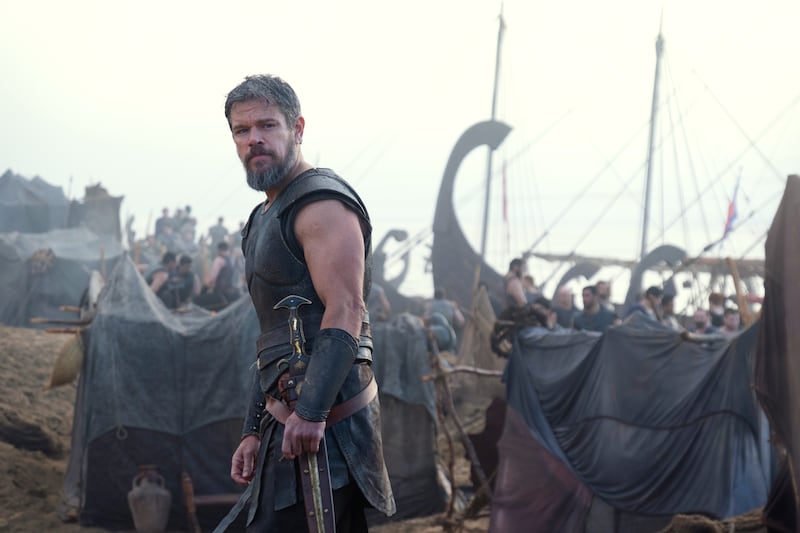
The theme that “you treat people the way you want to be treated” is woven throughout Christopher Nolan’s hit movie, “The Odyssey.”
Odysseus builds a home and kingdom that honor that maxim, then he leaves for a war where he famously violates that value. His violation is heralded as a triumph, but he knows he has created a breach that will destroy Greece’s glorious Bronze Age and usher in dark ages.
The surprise at finding Jesus Christ’s teaching from the Sermon on the Mount inside an R-rated box office smash about Greek mythology is being reflected in movie reviews, news stories and social media posts.
Nolan has merged “whatsoever ye would that men should do to you, do ye even so to them” with the ancient Greek concept of hospitality known as “xenia,” in which hosts and guests — both strangers — treat each other with generosity, dignity and kindness.
The better angels in Odysseus encourage him to honor the second great commandment, “Thou shalt love thy neighbor as thyself" and to live out Christ’s teaching to “love one another, as I have loved you.”
The movie’s characters call it Zeus’ Law. They follow it because they know the stranger they take in may be a God in disguise. That, of course, is an echo of Christ’s teachings in Matthew 25 that when one feeds the hungry, clothes the naked and visits the sick and imprisoned, “ye have done it unto me.”
Nolan talked about these themes in interviews before “The Odyssey” was released.
“It is the golden rule,” he told the Los Angeles Times, “the idea that you treat people the way you want to be treated. Partly it’s because a humble person may be a god in disguise, but it also allows society to function. People need to travel and trade, and everyone is at the mercy of strangers. Its abuse has terrible consequences. There is a price to be paid for vengeance, and violence is the most straightforward expression of that.”
He told The New York Times that this concept made Homer’s epic poem “stunningly relevant” today with “a theological underpinning.”
Odysseus comes to realize the terrible price of breaching human trust, which undermines peace and sows the social division rampant today.
“If hospitality can be used to deceive, if kindness can be manipulated, then how are we ever supposed to work with one another?” asked the reviewer Riceeyyyryan.
Latter-day Saints think often about these issues because their theology insists that Christ’s teachings and Christian discipleship create an active, covenant-based obligation to help others and treat them with dignity.
That doctrine includes the teaching that all people are literal spirit children of Heavenly Parents, creating an even deeper sense of human community and belonging.
In the Book of Mormon, the prophet King Benjamin teaches that “When ye are in the service of your fellow beings ye are only in the service of your God.” That reemphasizes the idea that following the Golden Rule is an act of divine worship.
In modern revelation, Christ says, “Let every man esteem his brother as himself.” (Doctrine and Covenants 38:24)
Baptism in The Church of Jesus Christ of Latter-day Saints makes Christ’s teachings part of a formal covenant of active empathy to “bear one another’s burdens, that they may be light” and to “mourn with those that mourn ... and comfort those that stand in need of comfort.”
Today, the church has a system of ministering that encourages members of each congregation to watch over and care for others. The church also provides more than $1 billion a year in humanitarian aid and applies the Golden Rule to political and social discourse.
For example, President Dallin H. Oaks has regularly referenced the principles of loving others as a core pillar of Christian behavior and mitigating differences.
At one point in the movie, Odysseus says, “No one can stand between me and home,” but in the end of the movie, he isn’t allowed to go home again until he makes the conscious decision to surrender control, or his will, to deity.
That concept, too, is familiar to Latter-day Saints and others who follow Christ.
My recent stories
- The Church of Jesus Christ could own Martin’s Cove if a Wyoming group’s proposed land swap works (July 17)
- Latter-day Saints hit new record with 88,500 missionaries. Here’s why and what it means (July 15)
About the church
- Here’s how Latter-day Saints reacted online to the news of the record number of missionaries.
- Relief Society general President Camille N. Johnson will lead Utah’s largest Pioneer Day parade on Friday.
- A church-backed program organization is teaching children in 23 countries about human rights — here’s how you can be part of it.
- The First Presidency announced the groundbreaking date for new Latter-day Saint temple in Brazil.
- Church leaders also released site maps for three temples in South America.
- Learn more about how the church is preparing for the historic Salt Lake Temple open house in a podcast hosted by Sheri Dew, who speaks with Elder Brent H. Nielson, an emeritus General Authority Seventy, and Richard Sutton of the Temple Department:
What I’m reading
- One of the strongest constants during the World Cup was prayer. One of my colleagues collected great examples that he said offers hope for us all. Read it here: "Different prayers, same field."
- One of the World Cup’s biggest stars was Lionel Messi, family man and believer.
- Reading fewer books? Miss reading? Here’s how to learn to read again as a way to reclaim and deepen faith.
- I finished “Lexington and Concord‚” the book I mentioned last week. So, so good. It left me wanting to read more about the Revolutionary War and wanting to read more, period. I’m grateful.
- A Latter-day Saint basketball player’s three-year journey to an improbable championship and living the gospel in Germany.
- Of course, I am reading all I can about the 15-game winning streak the Boston Red Sox had when I completed this newsletter. It’s been a wonderful ride. I’ll also note that as a softball coach, I wish all my players fully embraced Odysseus’s stated goal that “No one can stand between me and home.”