

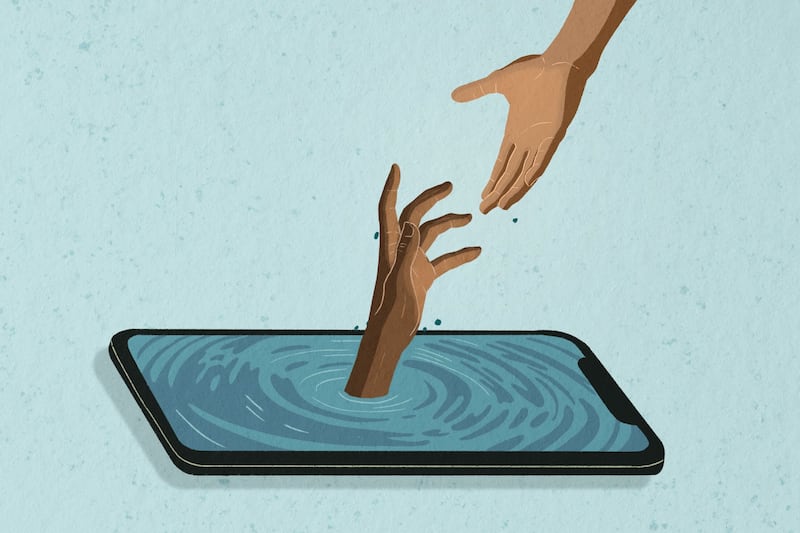

- Meta has agreed to settle state claims of child harm from its social media platforms.
- The social media giant didn't admit fault but agreed to pay $12.2 billion to the states.
- The agreement, if approved, means sweeping product changes for teen accounts.
Meta has agreed to settle with more than 50 attorneys general across states, U.S. territories and the District of Columbia over claims of child harm from its social media platforms.
And while $12.2 billion over 10 years is not insignificant, there’s more than money at stake.
The Meta settlement covers Facebook and Instagram. If other platforms — TikTok, YouTube and Snap — reach a similar deal, the total amount for states could exceed $17 billion. And Meta appears to be pressuring other platforms to agree to make similar changes.
The New York Times reported that “Meta’s legal team said the company negotiated the terms of its settlement to require the other companies to join, setting industry standards that would not single out Meta.”
Meta’s chief legal officer, C.J. Mahoney, posted in a blog that “this framework will only work if all our peers join us.” He added, “Because teens move fluidly across dozens of apps, we need an industrywide solution.”
States’ leaders and social media critics were heralding the agreement, which some compared to settlement reached with “Big Tobacco” decades ago.
Jean Twenge, author of “10 Rules for Raising Kids in a High-Tech World” and an outspoken critic of social media’s negative impact on teens, said the settlement was good news, noting she testified in the trial earlier this week in Oakland.
By email, she told Deseret News, “I’m happy that the case has been resolved. I’m gratified to see this progress for child safety on social media. The linchpin is effective age verification ensuring that children 12 and under can’t have accounts and there can be protections in place for 13- to 17-year-olds.”
She added that “teens should not be using social media in the middle of the night, at school, or for so many hours a day that it crowds out time for talking with friends and family, going outside, exercising and sleeping. I look forward to the platforms having better parental controls, as well.”
Another vocal critic, Brad Wilcox, senior fellow at the Institute for Family Studies, among other titles, told Deseret News there’s still a lot to be done “to protect our kids from Big Tech.”
”When, several years ago, the Institute for Family Studies, alongside its institutional partners, the Ethics and Public Policy Center and the Center for Renewing America, argued that age verification, overnight shutdowns, parental controls, and time limits were an important policy solution to help kids and families in the digital age, we received unrelenting pushback. And now what we imagined will be reality," he said via email. “But it’s the reality for only one company. We need to expand these measures to all social media platforms to keep our kids truly safe.”
State officials also heralded the settlement with written statements like that issued by Colorado Attorney General Phil Weiser. “The relief we are getting in this settlement is very meaningful and well beyond what any court has ordered or is likely to order.”
He added, “The focus of this case was to protect our kids — stopping notifications and alerts at night and when they are in school, encouraging them to take breaks from social media, protecting them against harmful features, implementing age assurance technology and more.”
A safer social media world?
In addition to agreeing to pay $12.2 billion, with no admission of fault, Meta has promised to create safety features to protect teens using its Facebook and Instagram platforms.
Among Meta’s promised protection for teen users will be placing teens in private accounts by default, bolstering protection against unwanted contact by adults including restrictions on the ability to reach out by those who are not “affirmatively connected” and parental controls that are easier to use and more effective. Meta will also simplify the process to report unwanted contact or breaches.
The agreement, which must still receive court approval, also contains some significant product-design changes.
According to the Utah Governor’s Office, Meta has agreed to:
- More effective, “robust” age verification methods.
- Blocks on minors’ access between midnight and 6 a.m.
- No push notifications to children Monday through Friday from 8 a.m. to 3 p.m. during the school year or late at night.
- A two-hour combined daily limit for time online with Instagram and/or Facebook, including what’s called “productive pause” breaks after periods of continuous scrolling. Those will take place at the 15-, 60- and 90-minute marks and will be in effect for five years. The press release noted that if Snapchat, TikTok and YouTube adopt similar terms, the pauses will drop to 60 minutes per platform for 10 years.
- The option to turn off personalized algorithmic feeds for users 17 and younger.
- Age-appropriate content controls, with “stronger safeguards against bullying and content promoting eating disorders, suicide and self-harm.” Meta said teens could turn off autoplay and would then “need to take a deliberate action like a tap or a swipe to see more.” Parents can require it.
- Limits on features linked to poor youth mental health, such as beauty filters and visible “like” counts, which promote social comparison with peers.
Meta also promised that it would regularly review how well the changes are working, as well as regular assessments by an independent auditor and the settling states.
Where will the settlement money go?
While some states have not said how they will use their share of the settlement — which still must be approved by the judge — some already have plans to put the money to use to help children who may have been harmed by Meta’s social media platforms.
As Massachusetts Attorney General Andrea Campbell noted in a news release heralding the proposed settlement, her state plans to target youth crisis intervention and mental-health services, out-of-school programs, digital wellness, school phone bans, and training of medical providers on “interactive-media use and body dysmorphia.”
Some of the money for Massachusetts will also go into the general fund.
The agreement was reached with Alabama, Alaska, American Samoa, Arizona, Arkansas, California, Colorado, Connecticut, Delaware, District of Columbia, Georgia, Hawaii, Idaho, Illinois, Indiana, Iowa, Kansas, Kentucky, Louisiana, Maine, Maryland, Massachusetts, Michigan, Minnesota, Mississippi, Missouri, Montana, Northern Mariana Islands, Nebraska, Nevada, New Hampshire, New Jersey, New York, North Carolina, North Dakota, Ohio, Oklahoma, Oregon, Pennsylvania, Puerto Rico, Rhode Island, South Carolina, South Dakota, Tennessee, Texas, Utah, Vermont, Virginia, Washington, West Virginia, Wisconsin, and Wyoming.
Each state will receive a different amount, based on an agreed-upon formula.